
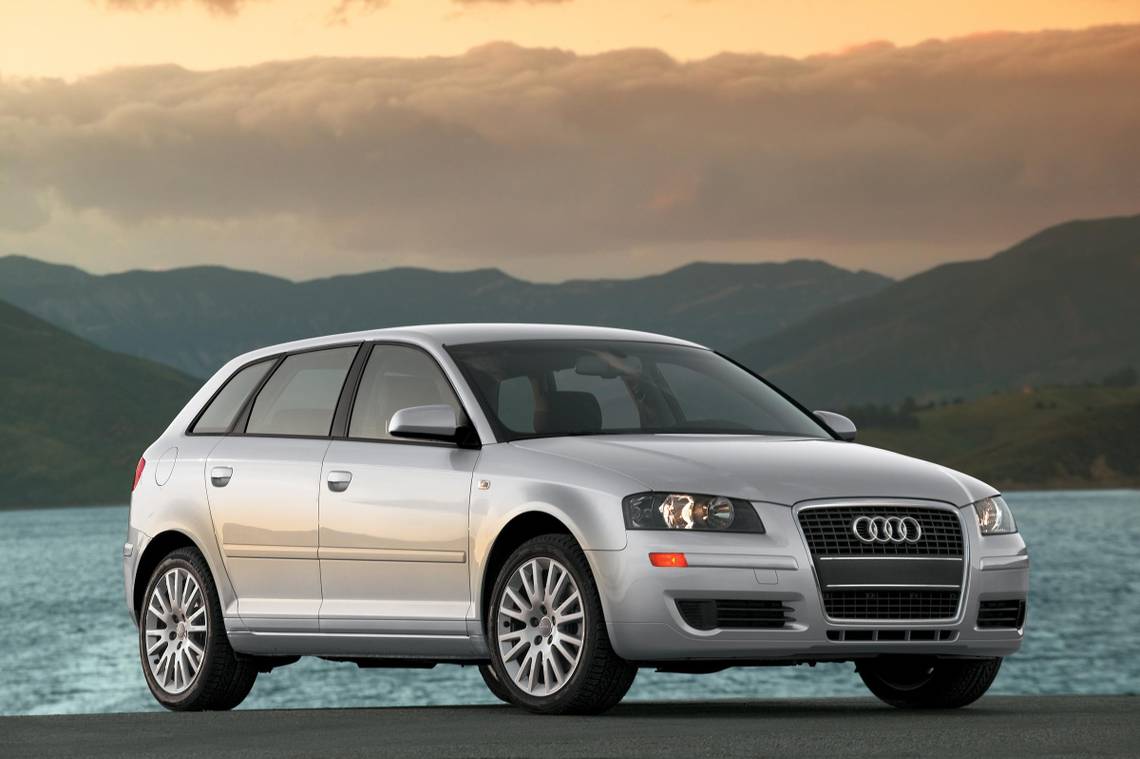
Sportiness and dynamism, superior technology and high-quality appeal: all the attributes that Audi A3 drivers have cherished since the model was first launched. Thanks to its painstaking attention to detail, Audi has now been able to bring the strengths of its compact model even more to the fore, as well as enhance both its looks and engineering.
audi-a3
- Make: Array
- Model: audi-a3
2007 Audi A3


- Make: Array
- Model: 2007 Audi A3
- [do not use] Vehicle Model: Array
A new face and an extra dose of exclusivity
Audi A3 – extending the lead
The most striking example is the new single-frame grille which now adorns the front end of the three-door model. Numerous improvements have also been made to the car’s technology, comfort and convenience, making travelling in the A3 an even more enjoyable experience. With four and six-cylinder engines developing up to 184 kW (250 bhp), front-wheel or quattro permanent four-wheel drive and, as an option, the revolutionary Direct Shift Gearbox DSG transmission, the technology lives up to the expectations raised by the sporty exterior of this special compact car – namely driving pleasure in a sporty tailor-made suit. This applies to both the three-door model and the five-door A3 Sportback.

The three-door A3 now also features the new Audi face with the new single-frame grille, thus indicating all the more clearly that it is a member of the Audi family. But the front end is not the only visual change. For the first time, Audi is offering the S line exterior package – available from quattro GmbH – for the A3. This will appeal in particularly to sports-minded drivers. New colours and wheels provide even greater scope for customisation, as does the new Fine Nappa upholstery for the sports seats. The Audi exclusive line trim package, which enables the car to be upgraded still further, can also be ordered for the A3 for the first time. The design of the central element of the new three and four-spoke steering wheels is also based on the single-frame grille.
The A3 continues to set standards as regards the finish and choice of materials. Such exclusiveness is otherwise only to be found in higher vehicle classes in the premium segment. Audi’s new range of equipment is even more exclusive than before.
As well as numerous visual changes, there have also been considerable technical modifications. The A3’s safety equipment, which was already rated as good, has been supplemented by a new function in the improved ESP.
This comes to the driver’s aid in critical situations by providing steering assistance. If the car threatens to swerve and the driver decides to steer to stabilise it, steering resistance is reduced. If the critical situation is exacerbated by an incorrect steering manoeuvre, steering resistance is increased.

Audi hill hold assist combines convenience and safety by preventing the car briefly from rolling back when performing a hill start.
A six-cylinder engine, FSI petrol direct injection, the world’s first turbocharged FSI engine in a production vehicle, high-torque TDI engines with high-pressure pump-injector fuel injection, the Direct Shift Gearbox DSG with twin clutch, 5-speed and 6-speed manual gearboxes, the innovative 6-speed tiptronic automatic transmission and quattro permanent four-wheel drive: offering a wide range of choice but dedicated throughout to sporting performance – this philosophy characterises the range of engines and transmissions for the Audi A3. A diverse range that covers every requirement.
-----
Design
Exterior
Design and exclusivity: the Audi A3
The Audi A3 is the compact car in the premium segment that perfectly combines sporty driving characteristics with a spacious interior. This is complemented by an impression of quality and materials otherwise only to be found in higher vehicle segments. Audi has now improved the A3 in several areas and extended its equipment.

The most obvious change can be seen at the front end of the vehicle. The three-door A3 now also sports the new single-frame grille which makes the latest Audi models so unmistakeable. The new Audi face enhances the dynamism of the three-door model even more significantly than before. The coupé-like line which combines tautness and athleticism has been retained. The gently rising baseline of the window area and the coupé-like roof line converge in the powerful tail end. This is also where the visual centre of gravity of the three-door A3 is, the powerful tail making the whole car look as if it is about to leap forward.
The side view of the Audi A3 is characterised by two striking contour lines, the very essence of Audi’s new design language: the shoulder line and the dynamic line. The latter extends between the wheel arches above the sill and emphasises the car’s sporty appearance.

At the same time, the angle opened up discreetly to the rear between the dynamic line and the shoulder line accentuates the gentle wedge shape of the car’s taut, athletic silhouette. This impression is further enhanced by the gently rising baseline of the windows, together with the coupé-like curve of the roofline. This creates the impression that the entire car is about to leap forward.
With the number of lines significantly reduced and the individual surfaces split up graphically, the rear-end styling is noted for its explicit clarity. One striking feature underlining the dynamic character of the car are the visible, high-quality tailpipes. The Audi A3 has one or two of these depending on engine version.
Drivers who prefer an even sportier look can take advantage of the S line exterior package from quattro GmbH which is now available for both the three-door A3 as well as the A3 Sportback. This comprises bumpers with an even sportier design, a roof spoiler, front fog lights and the S line logo in the door sill strips, on the grille and on the sides of the vehicle. Two extremely attractive wheel designs have been added to the existing range. A polished, two-colour 17-inch wheel of 16-spoke design is the first new addition.
The wheel’s matt grey inner surfaces make the polished outer surfaces stand out even more. The second new wheel is an 18-inch, 20-spoke version. The two exterior colours Phantom Black, pearl effect and Garnet Red, pearl effect are also new.
Interior
The interior design of the Audi A3 is distinguished by two features: sportiness and elegance. This impression is the result of the low seat position, the high and wide centre console and the clear subdivision of the dashboard.

The three-door A3 now also features the new generation of steering wheels. The impact absorbers of the three-spoke and four-spoke steering wheels cite the single-frame design of the radiator grille. The interior surfaces and each individual detail are noted for their first-rate material quality and a superbly crafted finish. Sports seats with Fine Nappa leather upholstery in the colours black, light grey and red are new to the range.
The flush transition from the dashboard to the door window sill is also typical of the Audi brand. This line rises gently as it tapers dynamically towards the rear end. The instrument cluster is housed within an almost round cover, an element that consciously echoes the design of other sporty Audi models such as the TT and the A4 Cabriolet.

Ergonomically refined design is combined with equally outstanding aesthetic qualities throughout the car’s interior: typical examples are the round air vents, the rotary controls for the automatic air conditioning, the inside door handles and glove box release lever which are all trimmed with aluminium. Two slender bars connect the centre tunnel with the vertical plane of the console. Typically found on sports cars, these elements additionally emphasise the sportiness and dynamism of the A3.
The steering column with longitudinal and height adjustment as well as the driver’s seat with the same adjustment options ensure an optimum seating position. Generous adjustment ranges enable occupants of practically any build to find a comfortable and safe position.

All occupants benefit from the ample dimensions of the interior. Rear passengers enjoy additional knee room and headroom. The wide opening angle of the rear doors and an outstanding amount of leg room for a car in the compact class make access to the rear compartment a straightforward affair.
-----
Engines and transmissions
Offering a wide range of choice but dedicated throughout to sporting performance: this philosophy characterises the range of engines and transmissions offered for the Audi A3. Audi relies here on ultramodern injection technology, for both its diesel and its petrol engines. As well as the two TDI engines, Audi offers three petrol units with direct injection. These include the 2.0 TFSI. Turbocharger and intercooler have been combined with petrol direct injection for the first time on the A3, once again demonstrating the company’s proverbial “Vorsprung durch Technik”.

The range of engines at a glance:
- 3.2 V6 developing 184 kW (250 bhp), 320 Nm
- 2.0 TFSI developing 143 kW (200 bhp), 280 Nm
- 2.0 FSI developing 110 kW (150 bhp), 200 Nm
- 1.6 FSI developing 85 kW (115 bhp), 155 Nm
- 1.6 developing 75 kW (102 bhp), 148 Nm
- 2.0 TDI developing 103 kW (140 bhp), 320 Nm
- 1.9 TDI developing 77 kW (105 bhp), 250 Nm
Depending on the chosen engine, a 5-speed or 6-speed manual gearbox is fitted; tiptronic is a further option. Incorporating six speeds, this automatic transmission is absolutely unique in the compact segment.
As an alternative to the manual gearbox, the 2.0 TDI, 3.2 quattro and 2.0 TFSI can be ordered with the new Direct Shift Gearbox DSG. This innovative transmission, inspired by motor racing technology, has a twin-clutch design with electro-hydraulic control that permits exceptionally rapid gear changes without interrupting the flow of power from the engine – ultimately resulting in maximum dynamic driving pleasure.
quattro permanent four-wheel drive remains unparalleled in the premium compact class, serving to translate the performance of the most powerful A3 models into supreme driving force on the road. Audi quattro drive therefore provides the basis for outstanding dynamic handling and active driving safety.
Audi has been demonstrating its proverbial “Vorsprung durch Technik” in this field for the last 25 years. A new addition to the A3 model range is the 2.0 TDI with quattro drive – the ideal complement to this high-torque, free-revving diesel engine.
The 2.0 TFSI four-cylinder engine
The 2.0 TFSI has become a firmly established member of the Audi engine range. Audi is the first manufacturer to combine FSI petrol direct injection with a turbocharger. The result is an extremely free-revving and economical engine which develops 200 bhp (147 kW).
The injector of this petrol direct injection unit is served by a high-pressure pump driven by the camshaft and a pressure reservoir shared by all cylinders – the common rail system. The injector regulates fuel delivery with millisecond precision, at injection pressures of up to 110 bar. By comparison, classic manifold injection operates at a maximum of four bar.
Compared with the 2.0 FSI without turbocharger which is also available for the A3, a great many components have been adapted to suit the substantially higher operating pressures and also the higher dynamic loads of the turbo engine.
A mass balance transmission improves the acoustics. Two balancing shafts rotating at double the speed of the crankshaft compensate for the engine’s inertial forces. The power is transmitted by the crankshaft by means of a triangular-layout chain which drives the oil pump as well as the balancing shafts. Perceptible vibrations and irritating humming frequencies under load are both effectively suppressed as a result of these measures.
The intake manifold of the 2.0 TFSI is made from a high-tech plastic. It also integrates the charge movement flaps whose position is adjusted by a continuous-action pilot motor. The optimum movement of the airflow, or tumble, can thus be controlled on the basis of the engine-speed and charging conditions.
The four-valve cylinder head with low-friction roller cam follower drive has a modified inlet duct geometry that produces even higher tumble values than the FSI engine. This brings about both greater refinement and superior knock resistance, and therefore improved efficiency. The result is a compression ratio of 10.5 : 1 – a figure that is only otherwise achieved by sophisticated naturally aspirated engines.
This engine’s performance data are impressive to say the least. Its maximum torque of 280 Nm is available at just 1,800 rpm and remains constant up to 5,000 rpm. This enables an economical driving style without changing gear too often, coupled with amazing pulling power, even if the throttle is only touched lightly. For example, the A3 2.0 TFSI completes the typical intermediate sprint from 60 to 120 km/h in fourth gear in just 5.4 seconds. Fitted with the DSG transmission, the Audi A3 2.0 TFSI sprints from 0 to 100 km/h in 6.9 seconds, and on up to a top speed of 236 km/h.
The 1.6-litre four-cylinder engine
The 1.6-litre four-cylinder engine with variable intake manifold and overhead camshaft delivers 102 bhp (75 kW). The cylinder head with valves operated by roller cam followers keeps internal friction extremely low. The other engine components are also optimised for minimum friction in the interest of enhanced fuel economy.
In conjunction with the 1.6-litre engine and a 5-speed manual gearbox, the new Audi A3 uses only 7.1 litres of premium-grade fuel per 100 kilometres (overall) and is decidedly nimble at the same time. Thanks to a power output of 75 kW (102 bhp) and a torque of 148 Nm, it accelerates to 100 km/h in 11.9 seconds and achieves a top speed of 185 km/h. Its responsiveness and acoustic refinement are further arguments in favour of this ultramodern power unit: an ideal basis for the Audi A3.
The 2.0 FSI four-cylinder engine
This two-litre engine with FSI technology and petrol direct injection unit has a common rail injection system and a single-piston high-pressure injection pump. The four valves per cylinder are actuated by low-friction roller cam followers. The intake camshaft can be continuously adjusted.

The 2.0 FSI in the A3 develops an output of 110 kW (150 bhp) and a torque of 200 Nm at just 3,500 rpm. With this kind of power, the A3 2.0 FSI with 6-speed manual gearbox accelerates from 0 to 100 km/h in just 8.9 seconds and reaches a top speed of 214 km/h.
But an FSI engine is not only noted for its dynamic character, its remarkable efficiency is equally outstanding. In view of the performance figures achieved, an average consumption of just 7.2 litres of Super Plus petrol per 100 kilometres (overall) is more than impressive. The A3 2.0 FSI is available in combination with a 6-speed manual gearbox or 6-speed tiptronic.
The 3.2 V6
The most powerful engine for this model and also the sportiest petrol engine for the A3 is the four-valve V6 engine with a displacement of 3.2 litres.
Through its outstanding torque and power characteristics, this six-cylinder unit is a particularly good match for the most dynamic version of the Audi A3. It delivers a maximum output of 184 kW (250 bhp) and an impressive torque range, peaking at 320 Nm between 2,500 and 3,000 rpm.
This is just perfect for powerful pulling at all speeds as well as nimble acceleration – regardless of whether the driver opts for a 6-speed manual gearbox or the new, sporty Direct Shift Gearbox DSG.
The performance figures are correspondingly impressive: the A3 3.2 quattro with DSG accelerates from 0 to 100 km/h in just 6.2 seconds and reaches a top speed of 250 km/h (governed). This makes this new six-cylinder version the sportiest A3 ever.
With its cylinder angle of 15 degrees, the V6 is extremely compact – a basic requirement for installation transversely to the direction of travel. The valve control process generates only little friction thanks to the use of roller cam followers with hydraulic adjustment. In order to reduce emissions and further improve efficiency, the inlet and exhaust camshafts are continuously adjustable.
Throttle valve actuation is designed for an exceptionally agile, spontaneous engine response to accelerator pedal movements. Particularly the interaction of the engine with the ultra-fast and precise control of the new Direct Shift Gearbox DSG provides an entirely new feeling of power and performance on the road.
The A3 3.2 comes as standard with quattro permanent four-wheel drive and is available in conjunction with a 6-speed manual gearbox or, as an option, the new Direct Shift Gearbox DSG.
The TDI engines
The 1.9 TDI four-cylinder engine
One of Audi’s most successful engines is also to be found in the new A3: the four-cylinder 1.9-litre TDI with pump-injector direct injection. The current version develops a power output of 77 kW (105 bhp) and a maximum torque of no less than 250 Nm at just 1,900 rpm.
The A3 1.9 TDI takes just 11.4 seconds to accelerate to 100 km/h. And with a top speed of 187 km/h, the entry-level TDI model is the ideal car for long stretches on the motorway at high average speeds. This is especially the case considering that its fuel consumption of around just 4.9 litres per 100 kilometres means that a distance of over 1,000 kilometres can be covered before having to stop for fuel.
This once again demonstrates the superior maturity and efficiency of TDI technology in conjunction with the pump-injector unit. Indeed, this system produces injection pressure of up to 2,050 bar – equivalent to the weight of a car on an area as small as a fingernail.
This high pressure assures ultra-fine atomisation of fuel within the combustion chamber, thus providing excellent thermodynamic efficiency. On the road this means outstanding fuel economy and, at the same time, a high torque yield. And thanks to pilot-injection control, the performance spectrum of a pump-injector engine includes good engine acoustics and efficient emissions control. This likewise applies to the 1.9 TDI, which easily undercuts the EU4 emission limits. The A3 1.9 TDI is available in combination with a 5-speed manual gearbox.
The 2.0 TDI four-cylinder engine
There can be no doubt about it: the 2.0-litre TDI, which Audi first offered for its A3, has all the virtues of its smaller brother – high power output, superior fuel efficiency and low emissions.

A maximum output of 103 kW (140 bhp) and peak torque of 320 Nm, available between 1,750 and 2,500 rpm, make this the most powerful and dynamic four-cylinder diesel that Audi has even installed in its cars. Performance on the road is correspondingly impressive: the front-wheel-drive 2.0 TDI with 6-speed manual gearbox accelerates to 100 km/h in just 9.5 seconds and continues briskly on up to its top speed of 207 km/h. It goes without saying that this model is economical, consuming 5.5 litres of diesel per 100 km.
In terms of design, this power unit is distinguished from its 1.9-litre counterpart not only by its larger capacity, but above all by its cylinder head.
Two overhead camshafts and low-friction roller cam followers with hydraulic valve-play compensation help to optimise the valve management process. The pump-injector units are operated by roller rockers running on the exhaust camshaft. Another feature of the 2.0 TDI is the rapid-starting diesel system allowing the driver to start the engine immediately in all outside temperatures, without a long preheating process.
-----
Chassis and gearboxes
Suspension and steering
A highly sophisticated suspension design provides the second foundation for the excellent driving dynamics of the new Audi A3: the McPherson front suspension and the four-link independent rear suspension.
The suspension is designed for sporty and agile handling, offering a high standard of stability and producing an excellent cornering performance in conjunction with both front-wheel and quattro drive. An additional forte is the high standard of ride comfort provided by the suspension.

16-inch, 17-inch or 18-inch wheels (the 17-inch wheels are standard on Ambition models) improve performance on the road and also contribute a visibly sporty touch. The power of the engines is reflected by the equally powerful brake system with large-diameter brake discs.
The electro-mechanical steering with speed-dependent power assistance combines optimum feedback from steering movements with a low level of sensitivity to vibration from the road surface, and consumes far less energy than a conventional system. A new system integrated into the further improved ESP assists the driver in critical situations. If the car threatens to swerve and the driver decides to steer to stabilise the vehicle, steering resistance is reduced. If there is a risk of the driver exacerbating the critical situation by an incorrect steering manoeuvre, steering resistance is increased.
Handling performance: dynamism and comfort
The chassis of the Audi A3 offers a combination of sports performance and comfort. This by no means applies merely to the car’s straight-line stability, but also when steering: the initial subjective impression is confirmed immediately by the exemplary precision with which the Audi A3 follows every movement of the steering wheel, every bend in the road. It is this manoeuvrability and agility that A3 drivers have come to know and appreciate. The Audi A3’s suspension responds sensitively, absorbing surface impacts at any speed. The steering, too, remains unerringly calm even on bumpy surfaces, consistently providing a good feel for and contact with the road.

Movement of the car’s body remains strictly within limits even on bumpy roads and in bends, and does not influence the car’s driving characteristics. The self-steering behaviour remains neutral right up to a very high handling limit, which signals itself to the driver through just slight understeer. Even provoked load alteration effects remain very moderate, allowing the driver to keep the car under control without any problems.
This behaviour is the result of a relatively firm but comfortable spring setting, combined with efficient damping and moderate tuning of the anti-roll bars. These are the very characteristics that, together with the axle geometry and kinematics, provide the basis for the driving pleasure so typical of the Audi A3 – driving pleasure that can be experienced in all A3 versions, irrespective of engine version.
quattro permanent four-wheel drive
In the year that celebrates 25 years of quattro, it goes without saying that the A3 is also available with permanent four-wheel drive. Like the previous model and the Audi TT quattro, the Audi A3 quattro models feature a hydraulic multi-plate clutch which varies the distribution of power between the front and rear axles. This technical solution is indeed particularly suitable for cars with the engine fitted transversely, incorporating all the well-known advantages of an Audi quattro.
Offering a permanent, situation-specific distribution of propulsive power between all four wheels, quattro drive guarantees maximum traction and, as a result, optimum acceleration at all times. At the same time, there are still ample reserves for transmitting cornering forces in the interest of directional stability and cornering safety.
The heart of this sophisticated drive system is the multi-plate clutch fitted between the driveshaft and the rear differential. A package of plates running in an oil bath within the clutch housing can be pressed together by controlled hydraulic power, thus providing variable torque distribution between the front and rear axles.

The more pressure is able to build up on the multi-plate clutch, the more drive torque can be transferred to the rear axle. The electronically controlled system responds instantaneously to any change in traction.
With the engine at the front and the four-wheel-drive multi-plate clutch at the rear, axle load distribution benefits accordingly. Indeed, this weight distribution is crucial to the excellent driving stability and good handling of the Audi A3 quattro.
quattro permanent four-wheel drive is available for the Audi A3 3.2 quattro (standard) as well as for the A3 2.0 TFSI and A3 2.0 TDI (optional).
Gearboxes
The A3 2.0 TDI comes with front-wheel drive in combination with a 6-speed manual gearbox. The top-of-the-range diesel model is also available optionally with quattro permanent four-wheel drive or the Direct Shift Gearbox DSG. Audi offers a diesel particulate filter as an option for front-wheel-drive versions of the 2.0 TDI.
The Direct Shift Gearbox DSG
The Direct Shift Gearbox DSG combines the advantages of a conventional 6-speed manual gearbox with the qualities of a modern automatic transmission to produce a superior drive concept. The driver benefits from supreme agility and driving pleasure combined with harmonious and dynamic acceleration without any interruption to the flow of power from the engine. This is coupled with good economy thanks to low fuel consumption, and convenient operation.

The basis for this revolutionary transmission is a three-shaft 6-speed manual gearbox which offers considerable variability in the selection of the transmission ratio. Thanks to the use of a twin multi-plate clutch with ingenious electro-hydraulic control, one gear is engaged whilst another is pre-selected.
Apart from its high standard of efficiency and the ability to transmit high levels of torque, a further advantage of this wet multi-plate clutch are the various options it offers the driver when pulling away. In other words, the driver is able to control the multi-plate clutch as required, varying from particularly gentle acceleration on slippery ground all the way to sporty full-power acceleration – and with every conceivable scenario covered between these two extremes.
The gearshifts it produces feel spontaneous and crisp, as if executed at the push of a button. The electronically controlled throttle blip in the manual and S modes reinforces the impression of ultra-dynamic gearshifts.
-----
Standard equipment
The Audi A3 sets standards with an equipment specification befitting of a premium model. Standard items on Attraction models include front seats with easy entry function, electric front windows and central locking with radio-operated remote control. The driver's seat has height adjustment as another standard feature.
It goes without saying that safety features such as the advanced electronic stabilisation program ESP with new steering assistance, front seats with active head restraints and the sideguard head-level airbag system are inclusive on the new A3.

Audi sets a distinctive signal with its range of colours for the exterior – from Artic White to Brilliant Black, from Toucan Yellow to Liquid Blue. Three of a total of 15 of the paint finishes are offered are standard. All A3 models are fully painted in the body colour.
Attraction, Ambition, Ambiente
Individual character and style – two concepts that play a central role in the A3’s success story. Three extremely different trim lines – the Attraction version full of character, the particularly sporty Ambition model and the highly exclusive Ambiente version – enable the customer to turn each A3 into their personal dream car.
Attraction: This is the modern and charismatic interpretation of the A3 theme. From the outside Attraction models are clearly recognisable with their 16-inch wheels – as an option in alloy – running on 205/55 tyres. “Module” cloth for the seats comes in four colours (black, beige, light grey or deep blue) as standard. The surfaces and trims are available in matt-painted plastic in the colours black or deep blue. The Attraction specification likewise includes an easy-grip 4-spoke steering wheel.
Ambition: The even more dynamic interpretation of a sporty vehicle. Ambition models are equipped with 7.5J x 17-inch cast aluminium wheels of 5-arm design, with 225/45 tyres. Five colour combinations of “Matrix” cloth are available for the interior: black/grey, black/blue, black/red, deep blue and light grey. The inlays are in high-gloss black or deep blue.

In addition to the standard equipment on all A3 models, the Ambition versions come with sports suspension, sports seats at the front, a three-spoke leather-covered steering wheel and a height-adjustable passenger’s seat. Other standard features are front fog lights, aluminium door sill trims, the driver information system and the sun screen on the luggage cover.
Ambiente stands for luxury and comfort. 16-inch cast aluminium wheels of 7-arm design with 205/55 tyres clearly identify the third line in the A3 range from the outside. Inside, there are four colours to choose from (black, beige, light grey and deep blue) for the “Metric” cloth upholstery. The noble wood Vavona Bernstein is a highly stylish material that gives the inlays a special note of distinction.
A four-spoke leather-covered steering wheel and a centre armrest at the front are further visible attributes of the Ambiente models. The standard range of equipment also includes the height-adjustable front passenger's seat, an interior mirror with automatic anti-dazzle adjustment and incorporating a light/rain sensor with coming-home/leaving-home function, cruise control, an outside temperature gauge, a storage package and an interior lighting package.
Optional extras
Over and above the various features specific to the three model lines, A3 drivers can choose from a vast array of other options. The quality and diversity of these options reflect the declared objective of the Audi A3 to also offer the high standard of larger and more luxurious cars in the compact segment. The following list represents just a selection of the options available:
A3 drivers can choose their preferred tone from a total of 15 different colours.
Various cast aluminium wheels in the sizes 6.5J x 16, 7.5J x 17 or 7.5J x 18 inches add a sporty touch to the outside of the car – and not only as far as its looks are concerned. And A3 drivers do not even have to forego attractive design in winter: they can choose from two cast aluminium wheels and one steel wheel measuring from 6J x 16 to 7.5J x 17 inches.
An electric glass sunroof offers additional versatility and maximum convenience. The open sky system is offered for the A3 Sportback. The large glass roof allows light to flood into the cabin and, thanks to its all-glass look, gives the car a fascinating appearance.
The sports suspension – standard on Ambition models – lowers the entire body by about 15 millimetres and makes the suspension and damping decidedly dynamic and firm. Ambition models can also be ordered with standard suspension.

Xenon headlights, an immediately visible feature offering improved visibility, can now also be ordered in the compact class: both headlight range and intensity are increased considerably as a result. This equipment features also comprises a headlight cleaning system as well as automatic dynamic headlight range control.
The interior mirror with automatic anti-dazzle function including a light/rain sensor, automatic headlight activation and coming-home/leaving-home function (standard on the Ambiente model) serves to raise visibility and convenience to an even higher level. The compass display in the interior mirror is a new optional extra.
The driver information system (standard on Ambition models) comprises an on-board computer, radio frequency display, outside temperature gauge and radio-controlled clock.
The navigation system with acoustic route guidance offers the driver additional convenience and even greater driving safety. The voice dialogue system for the navigation system plus is a new option. In conjunction with the optional multifunction leather steering wheel, key basic functions of the navigation system, radio system, mobile phone preparation and CD changer can be operated by voice control.
The audio systems offer the ideal combination of high convenience and extensive features for every customer:
- chorus radio with cassette player, eight loudspeakers and aerial diversity for optimum reception;
- concert radio, as for concert radio but with CD player (instead of cassette player);
- symphony radio, as for chorus radio but with cassette player and integrated 6 CD changer.
The Bose sound system (in conjunction with the chorus, concert and symphony audio systems) provides a concert hall atmosphere in the A3.

Deluxe automatic air conditioning with sun sensor offers the driver and front passenger individual temperature adjustment and comes in addition with an air quality sensor which switches automatically to air recirculation as soon as the quality of the outside air drops below a certain level. One remarkable feature is that the deluxue automatic air conditioning filters the cabin air even in the recirculation mode.
Audi hill hold assist helps the driver perform a hill start. When the foot brake is pressed for some time when stationary, the braking pressure that has been built up is retained momentarily after the foot brake is released. Thanks to this automatic brake intervention, the system makes it easier to perform a hill start without rolling backwards.
-----
Safety
An electronic stabilisation program of the latest generation ensures active safety reserves at all times. With its self-learning capacity, this ESP system constantly observes the driving situation, thus permanently adapting the intervention point to the prevailing conditions. ESP is consequently able to intervene much earlier in critical situations and also prevents unnecessary actions. The A3’s safety equipment, which was already rated as good, has been supplemented by a new function in the improved ESP. This comes to the driver’s aid in critical situations by providing steering assistance. If the car threatens to swerve and the driver decides to steer to stabilise it, steering resistance is reduced. If the critical situation is exacerbated by an incorrect steering manoeuvre, steering resistance is increased.

The optional Audi hill hold assist system combines convenience and safety by preventing the car briefly from rolling back when performing a hill start.
Within the passenger compartment, precise coordination of all restraint systems as well as the kinematic action of the steering column and pedals keep the loads to which occupants are subjected to a minimum. Full-size front airbags for the driver and front passenger as well as belt tensioners and belt-force limiters reduce the forces acting on the occupants’ bodies in a head-on collision.

Special padding on the steering column and in the footwells as well as the footrest and the bottom-hinged accelerator pedal protect the driver’s lower extremities, particularly the sensitive ankle and knee joints.
In a collision from the side, the occupants in the A3 benefit from the particularly solid structure of the bodyshell. Inside the car, passengers are protected by seat-integrated side airbags.
The sideguard head airbag system, which covers almost the entire window area from the A-post to the C-post and significantly reduces the impact forces to which passengers are subjected, is standard in all Audi A3 and A3 Sportback models in Western Europe. The A3 even achieved top marks in an unusual crash test involving a heavy truck.

In this side impact at 60 km/h, the A3 occupant cell was barely deformed; the risk of injury for the occupants was minimised.
The compact Audi is also protected with maximum efficiency from the effects of an impact from the rear. Indeed, the Audi A3 already meets the requirements of future standards. In other words, it withstands impact with a deformable barrier at up to 80 km/h and with at least a 70 percent overlap with outstanding results. In such a collision both the passenger cell and the fuel tank remain outside the actual deformation area.