| | ||||||||||||||||||||||||||||||||||||
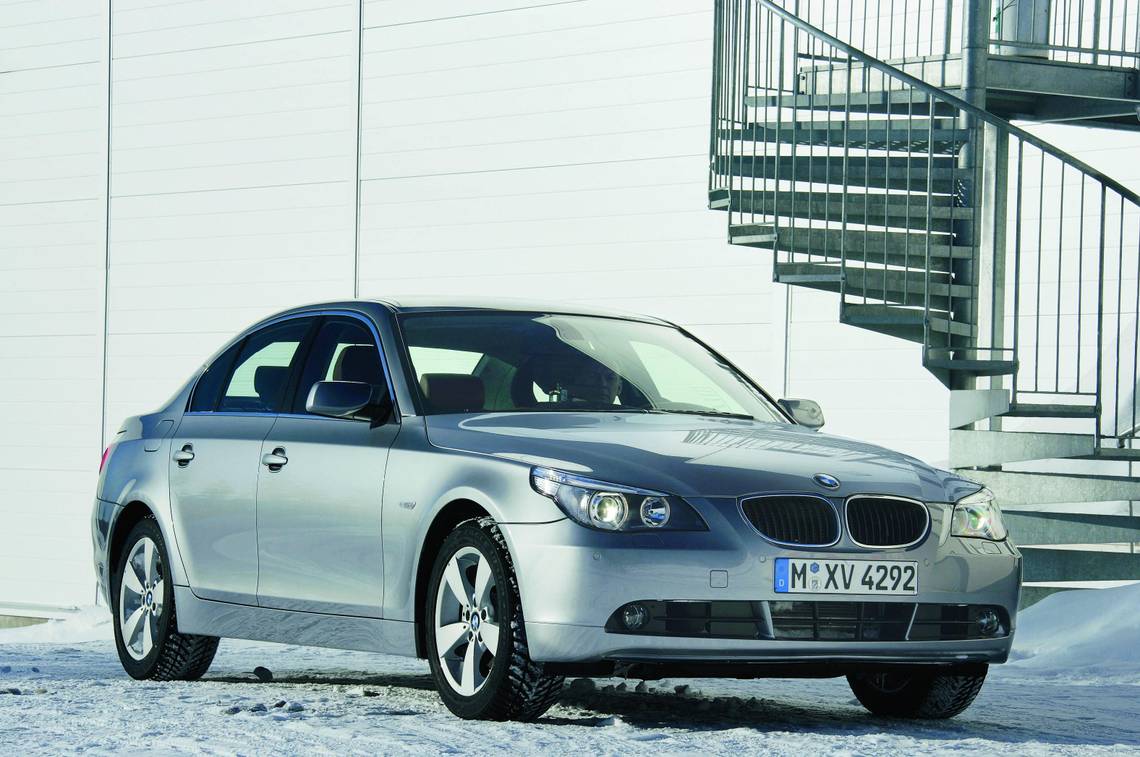
After a significant update in 2006—including new 6-cylinder and V-8 engines—the evolution of BMW’s 5 Series performance/luxury lineup continues with even more new features for ’07. These range from new comfort and convenience items to a significant advancement in driving safety, all designed to maintain the position of the 5 Series sedans and wagon as the leaders in their class. Headlining those changes is the availability of Night Vision, a major boost for nighttime driving safety. The system uses thermal imaging to provide a real-time, long-distance view of the road ahead, regardless of weather conditions. Night Vision uses Far Infra-Red (FIR) technology to provide an accurate image at a distance far greater than any conventional high-beams can illuminate, and almost twice as far as other nighttime vision systems. Nigh Vision offers particular benefits when driving over land, down narrow lanes, through gateways leading into courtyards, and into dark underground garages, significantly enhancing driving safety at night. The system is particularly beneficial in deeply wooded areas where deer, elk, moose or other large animals are common, as Night Vision “illuminates” a larger area than conventional headlights—even bi-xenons. Additional changes for 2007 include revised Sport Package contents, which include a new 3-spoke sport steering wheel and 20-way Multi-contour seats. The Multi-Contour seats also include Active Head Restraints as a further safety feature. A Tire Pressure Monitor replaces the previous Flat Tire Monitor. New entertainment enhancements for ’07 include the availability of HD radio, with improved digital audio sound offered by more than 1,000 radio stations. FM reception becomes CD quality, and AM reception is comparable to analog FM. Finally, the onboard navigation system now includes Real Time Traffic Information, which is a particular boon to drivers in urban areas. As in 2006, the ‘07 5 Series lineup consists of six models, five sedans and a sports wagon with a mix of rear-drive or all-wheel-drive configurations. The two entry-level models, the rear-drive 525i Sedan and the all-wheel-drive 525xi Sedan, are powered by BMW’s N52 aluminum/magnesium composite inline-6 in 215-hp form. The 530i and AWD 530xi Sedans include additional standard equipment and the 255-hp version of BMW’s inline-6. BMW’s 530xi Sport Wagon features the same drivetrain and equipment as the 530xi sedan, with the additional cargo capacity and utility of a traditional wagon. The V-8-powered 550i Sedan sports a 4.8-liter V-8 with 360-hp and an array of standard features including full leather interior and Park Distance Control. This year all BMW automobiles and SAVs include BMW Ultimate Service, which includes 4 year, unlimited mileage Roadside Assistance, 4 year / 50,000 mile New Vehicle Limited Warranty and the BMW Maintenance Program at no extra cost. In addition, all 5 Series BMWs also include a 4 year membership in BMW Assist Safety Services as standard equipment. What’s new for ’07As of 3/06 Production:
Night Vision:Adding a new dimension to nighttime driving securityBMW’s adoption of leading-edge lighting systems goes back more than two decades, with the introduction of projector-beam halogen headlamps on the 1986 7 Series. Six years later the 1993 750iL became the first to offer xenon headlights, which quickly became the industry benchmark for night driving. With Night Vision, BMW becomes the first to adopt Far Infra-Red (FIR) thermal techology to extend the driver’s vision past what conventional lighting systems can provide. The FIR thermal imaging camera covers a range almost twice as far as other systems. Simply put, Night Vision provides a new dimension of optical perception when driving at night. A thermal imaging camera detects people, animals and objects in front of the car before they become visible in the headlights. The image generated by the system is transmitted to the central Control Display within the car. Objects are presented with increasing brightness as a function of the heat detected by the camera – therefore making humans and animals particularly conspicuous. BMW Night Vision presents a high-contrast black-and-white night image to the driver on the Control Display in the middle of the instrument panel. Benefiting from FIR technology, the driver only has to briefly check out the Display in order to recognize a hazard. So using BMW Night Vision is comparable to looking into the interior mirror in the car. After comparative studies and careful observation of independent scientific examinations, BMW’s engineers opted in favor of innovative far infra-red technology (FIR) as being the most efficient in detecting people, animals and objects at night. FIR offers the following benefits:
---- The 2007 5 Series:Six models, three engines, two bodystyles, plus all-wheel-drive525i Sedan
525xi Sedan
530i Sedan
530xi Sedan
530xi Sports Wagon
550i Sedan
---- BMW 6-cylinder enginesworld’s first contemporary magnesium/ aluminum composite construction These days, most 6-cylinder engines are V-6s. By contrast, BMW’s “sixes” are inline engines, noted for exceptional smoothness and unique sound. BMW customers and independent critics treasure them for these attributes, and BMW has retained the inline-6 layout while developing it toward reduced weight, more compact dimensions and even more brilliant performance, smoothness and sound. Confirming all this, AutoWeek‘s February 28, ’06 issue noted (in the context of the 3 Series) that the new engine “sounds great, with an emphasis on clean mechanical noise from the engine bay rather than the tone of the muffler.“ Logically, BMW’s New Generation of 6-cylinder engines is designated N52. Compared to its illustrious predecessor, the M54 engine family, the N52 achieves notable progress on all fronts:
Here are some details of how this dramatic progress has been achieved – over an engine that was already outstanding in all these respects. Valvetronic variable valve lift. This patented innovation, already enhancing the performance and fuel efficiency of BMW’s V-8 and V-12 engines, now appears in a BMW 6-cylinder engine as well – and in evolved form. Valvetronic varies valve lift to a far greater degree than other variable-lift systems – so much, in fact, that it replaces the traditional engine throttle. Engine breathing is controlled entirely by the valves themselves. The Valvetronic mechanism acts on the intake valves, imposing an additional control element between the camshaft lobe and rocker arm for each cylinder, called an intermediate follower. Upon contact by the lobe, this follower actuates a finger-type rocker arm and, in turn, the valve. The follower’s pivot point is positioned by an eccentric shaft, rotated by a servo motor in response to the driver’s accelerator-pedal movements; this varies the valve lift. The system’s advantages include:
Compared to the 1st-generation Valvetronic system of BMW’s V-8s and V-12s, that of the N52 engine has evolved in several ways:
Additional developments contribute to the new engines’ performance:
Unique new magnesium/aluminum composite engine constructionRecent BMW 4-wheel vehicles (i.e. not motorcycles) have utilized three types of engine construction, all with aluminum cylinder heads:
With the N52 engine, BMW introduces a unique and pioneering engine structure: magnesium/aluminum composite construction, the first in a contemporary automobile. Structurally, the all-new engine block consists of three major castings: Bedplate (magnesium alloy ). This casting forms the lower portion of the block (crankcase), and is similar in concept to an element of some racing engines – as well as the 500-hp V-10 engine powering the new BMW M5. Upper crankcase (magnesium alloy2). Joining the bedplate at the level of the crankshaft (main) bearings, this too is a weight-saving casting. Mounted onto the bedplate from above; combines with the bedplate to form the block’s outer shell. The result is an ultra-rigid, yet remarkably light engine structure. Insert (aluminum alloy). Forms the cylinders and their coolant passages. Analogous to the entire blocks of BMW‘s V-8, V-10 and V-12 engines, silicon particles are cast into this insert; a “soft honing” machine removes just enough of the aluminum to leave the crystals as ultra-hard cylinder surfaces. How it goes together. First, the aluminum insert is cast by conventional methods. Then, during a newly developed die-casting method, the magnesium upper shell shrinks onto the insert while cooling; structural rigidity and stability are ensured by interlocking ribs where the two castings meet. In the next step, the upper crankcase, consisting of magnesium shell and aluminum insert, is mounted onto the magnesium bedplate from above. The sintered-steel main bearings’ lower halves are in place in the bedplate, the upper halves in the upper crankcase. After the bedplate and upper crankcase have been bolted together, a liquid sealant is injected into a groove on the contact surface between the two components. Special aluminum bolts are used to attach parts, such as engine mounting brackets, to the magnesium/aluminum castings. As the “conventional” part of this construction, the cylinder head is of aluminum; however, the head of an inline 6-cylinder engine must be cast with great precision because its length implies relatively large contraction during the cooling-down process after casting. The casting process used here is called “lost-foam.“ Because all BMW gasoline engines since the 1960s have had aluminum heads, BMW’s experience in this regard is long and successful; BMW has used the lost-foam method since 1997. This process, employing a polystyrene “dummy” of the head to form the mold into which the aluminum is poured, results in highly precise casting of this critical engine component. Other weight-saving materials. Though the magnesium/aluminum composite crankcase construction is the most conspicuous example, other materials and production innovations also help pare weight from the N52 engine. One is hollow camshafts, which save a remarkable 2.6 lb. Beginning as steel tubes, the camshafts are shaped in a hydroforming procedure, subjected from the inside to a water pressure of 4000 bar (58,000 lb./sq in.) against outer forms to achieve the cam profiles. All this takes place in a cold state – nothing melts – and as a final step the cams are polished to a finish quality of 1/1000 mm. The engine’s camshaft cover is of weight-saving magnesium. The VANOS sprockets, via which the camshaft chain drives the two variable-valve-timing mechanisms, are newly of aluminum. And the chain camshaft drive – a high-durability, low-maintenance feature of all current BMW engines – has an aluminum chain tensioner that also saves weight. Instead of being a separate casting, the camshaft drive’s housing is integrally cast into the magnesium structure, eliminating a production step and sealing components. As one final weight-reducing element, the exhaust headers’ flanges are formed from 2-mm-thick steel, lighter than the former 12-mm flanges; for a secure seal of this steel to the aluminum head, graphite rings are employed. Electric coolant pump. A conventional coolant (“water”) pump is driven by a belt, and always runs at a speed directly proportional to engine rpm. The N52 pump is electrically driven and electronically controlled according to the engine’s coolant and oil temperatures at any moment. Thus it runs only as much as needed, consuming a maximum of 200 watts vs. up to 2 kilowatts (10 times as much) for a conventional pump. This pump has further benefits:
Variable-volume oil pump. Conventional oil pumps, too, deliver oil in direct proportion to engine speed. In order to supply the VANOS system (which employs oil pressure to vary valve timing) at all speeds and temperatures without excess capacity at high engine speeds, BMW engineers developed a new type of oil pump. By varying the output of its pump element according to engine oil pressure, the engineers achieved a pump that always delivers sufficient pressure to lubricate the engine and operate VANOS, yet never pumps more oil than is necessary. Thus it –
Oil/coolant heat exchanger. Another aid to fast engine warmup; during this phase it transfers heat from the coolant to the oil circuit. Under conditions of high engine power and high oil temperatures, it performs the reverse, transferring heat from the oil circuit to the coolant to remove excess heat. ---- 525i/xi and 530i/xi: the two engine versionsA distinctive engine version powers each set of 5 Series models. Instead of the traditional correlation of model designation to engine size, each is a 3.0-liter N52, but equipped and calibrated for different levels of performance:
Significant differences between the 525i/xi and 530i/xi engines are as follows:
The 550i’s V-8The 550i’s predecessor was widely acclaimed by most who drove or tested the 545i, not merely for its strong, fuel-efficient power, but also for its highly pleasing sound. Car and Driver (May ’04) summed it up as “among the friendliest, most enthusiastic engines in existence.“ With 4.8 liters instead of the previous 4.4, the 550i’s new V-8 delivers even more brilliant performance. Peak power is up from 325 to 360 hp; peak torque is up from 330 lb-ft. to 360. With its standard 6-speed manual transmission or available Sequential Manual Gearbox, the 550i attains 60 mph in just 5.4 sec. from rest, vs. the 545i’s 5.7; with automatic, the new model does 0-60 in 5.5 sec. vs. 5.8 before. New-generation Dynamic Stability Control: remarkable new braking functionsAll BMW models are standard-equipped with Dynamic Stability Control, which provides a wide range of traction and stability functions. While retaining all the functions or the previous DSC, a revised system appeared in the 5 Series and other BMWs last year. This Enhanced DSC adds a wide array of customer-relevant functions that make driving even safer and more pleasant. They are:
Character of the 5 Series: the essence of sport and luxuryLong one of BMW’s true core products, the 5 Series elegantly defines the middle of the line with compact exterior dimensions, ample interior space and a masterfully calibrated blend of sport and luxury. Appearing in ’04 in its current generation, the Series maintained trim exterior size while increasing interior space and introducing new technologies – including an aluminum front-end structure, available Active Steering and Active Roll Stabilization, evolved suspension and a further developed iDrive control system. That the current generation carries on the 5 Series tradition brilliantly is supported by this quote from Motor Trend’s March ’05 issue: “Here’s a thoroughbred, the product of decades of setting the benchmark all other automakers’ sport sedans aspire to. Just look at the stance, the way the body sits on the chassis, ready to pounce on any opportunity to show its stuff on a challenging stretch of road. The smoothness and flexibility of BMW inline-sixes are legendary, and the 225 horses of the 2979-cc engine seem more spirited than their numbers might otherwise suggest. And BMW is one of the only automakers courageous enough to offer a 6-speed manual gearbox in a $50,000 sedan.” With even more powerful engines, available xDrive and the new Sports Wagon to extend its capabilities, the 5 Series is today’s representative of this fine tradition. ---- State-of-the-art safety and security featuresIn terms of safety and security, the 5 Series is a state-of-the-art vehicle from a state-of-the-art vehicle maker. There are no significant changes in this area of the ’07 5 Series – yet with its comprehensive safety features and great substance, the 5 Series remains an industry leader and fully representative of BMW’s safety values. Key features include:
Options: possibilities new and familiarChanges to the 5 Series array of Packages and stand-alone options are limited but still significant. In addition to the previously discussed Night Vision, options include the availability of HD radio. For 2007, Package highlights include substitution of 20-way Multi-contour seats for the previous sport seats, and the addition of a 3-spoke sport steering wheel in the Sport Packages. Stand-alone options:STEPTRONIC automatic transmission – 6-speed, like all 5 Series transmissions. Sequential Manual Gearbox (SMG) – 530i and 550i Sedans only; requires the Sport Package. Active Cruise Control. Employing a radar sensor unit at the front of the vehicle, ACC senses the speed of vehicles traveling ahead, adjusts the BMW driver’s speed to maintain following distance, and offers the driver additional control choices over the standard cruise control. Active Steering. Offered on RWD models only; offers unique benefits:
Xenon Adaptive headlights with auto-leveling. Stronger, daylight-like illumination; headlights “steer” to enhance the driver’s view around curves and corners. Optional on 525i/xi models, standard on 530i/xi models and 550i. Leather upholstery – though included in the Premium Package, also available as a stand-alone option. Standard on 550i. Maple Anthracite wood interior trim. With its gray color and “striped” grain, a distinctive alternative to the standard (and also elegant) Dark Poplar. 20-way front Multi-contour seats. In addition to the standard seats’ 10-way power adjustments, the 20-way power adjustments of these remarkable and comprehensive luxury seats include –
Heated front seats as a stand-alone option. Heated rear seats, available for all models in combination with the Cold Weather Package. BMW On-board Navigation System. The standard iDrive system has a 6.5-in. control display (color monitor) at dash center and a turn-and-push controller between the front seats. This option includes an 8.5-in., higher-resolution control display plus:
Night Vision. Previously described.Logic7 Sound System Upgrades the entire audio system with –
Sirius Satellite RadioAppealing path to entertainment, news and information channels. After the first year of ownership, a subscription fee is required for Sirius service. High-Definition Radio. Offers enhanced digital sound quality; FM reception becomes CD quality while AM reception becomes equivalent to analog FM reception. There are over 1,000 radio stations nationwide that currently offer high-definition broadcasts. Power rear-window and manual rear side-window sunshades. For the Sedans, the option includes both; for the Sports Wagon, only the side-window shades. The power rear-window shade is controlled from a console switch; the side-window shades are easily raised or lowered by rear-seat passengers. |
| |||||||||||||||||||||||||||||||||||
|
|
Forgot your password?