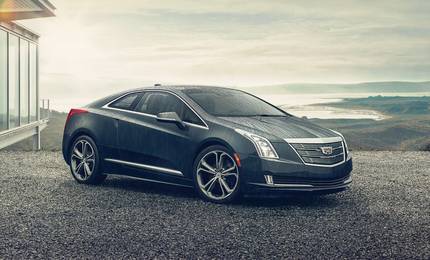
Cadillac unveiled a first ELR concept back in 2011 and ever since then everyone was pretty sure a production will also follow. Things got pretty clear in 2012 when a leak from OnStar confirmed Cadillac will dive into the hybrid realm with a vehicle not named "Escalade." The model finally made its world debut at the 2013 Detroit Auto Show and according to the first official details we have, it offers "an unprecedented combination of luxury, advanced engineering and progressive design."
However, this is not the first time in Caddy’s long history that it’s tread into the economy car world. The first one was the laughably Cavalier-like Cimarron. If you recall, Cadillac was so embarrassed by the Cimarron that the automaker refused to call it a Cadillac and instead dubbed it the “Cimarron by Cadillac” originally. GM later forced a name change to “Cadillac Cimarron.”
Needless to say Caddy does not want to relive those days, so they took things pretty serious with the ELR. The model is being powered by the latest GM EREV technology that combined a pure electric drive and an efficient, range-extending 1.4 liter gasoline-powered electric generator.
Updated 01/15/2013: This review has been updated with the official details, images and video.
Click past the jump to read the entire review to see if the ELR will end up on TIME’s “50 Worst Cars of All Time” list alongside the Cimarron.
UPDATE 4/14/2013: Cadillac has just revealed the details on the ELR’s unique regenerative-braking system that allows you to regen on demand. See more after the jump.
Full story
When Cadillac unveiled the new ELR at the 2013 Detroit Auto Show, the model arrived with a four-cylinder engine and electric generator that delivered a total of 207 horsepower. In the next two years, however, both the ELR and the Volt could adopt a new three-cylinder engine. The new engine would displace 1.0- or 1.2-liters and will be much more fuel efficient than the current 1.4-liter version.
This new engine will be developed in cooperation with one of the company’s Chinese partners, which asked to remain unnamed "due to the confidential nature of the subject." If approved for production, the new engine will be used for Volt starting 2015 and for the ELR in 2016.
The company announced no specifications for its new engine, but for sure the new engine is part of the company’s strategy to reduce weight by as much as 15 percent by 2016.
There are no details up to this point if the new engine will be offered in the U.S. A GM spokesman said: "We don’t have one right now for the U.S. and I wouldn’t be able to say that we have one planned for the U.S. at this point either. We have not announced any of that."
With just a few days before its official debut at the 2013 Detroit Auto Show, Cadillac photofraphed the production-version Cadillac ELR driving through the mountains of Southern California during development testing. Cadillac was kind enough to offer us this camouflaged image along with the promise that the ELR will "change the way people think about luxury and electrification."
The production-version ELR was previewed in 2011 with the ELR Concept and will likely be offered with the same electric powertrain used in the Chevrolet Volt. However, unlike Volt, the new ELR will offer an increased level of luxury and improved interior comfort. The production version will borrow most of its design elements from the concept version, including the Cadillac’s signature vertical headlights and the vertical LED taillights.
Full details on the production version ELR will be unveiled on January 15th. The model will go on sale as a 2014 model and will be priced at about $70k.
As if it wasn’t already obvious, given GM is about as good at holding its secrets as a tissue is at holding water, the Cadillac ELR has finally been confirmed for production. Production will kick off in late 2013 in the automaker’s Detroit-Hamtramck factory alongside the Chevy Volt, Opel Ampera, and Holden Volt. This will also bring about $35 million in updates to the plant in order to get it ready to handle the extra production and this high-tech extended-range EV.
There are still no exact figures on its driveline, but we all assume it will be based on the Chevy Volt’s platform. GM’s presser does let us know that the ELR will feature a T-shaped lithium-ion battery and will run primarily on electricity. Once the battery becomes discharged, a 4-cylinder engine will kick in to recharge the battery.
We’re all anticipating – maybe more like hoping – that if the ELR uses the Volt’s drivetrain, GM will retune the system to be a little more performance-oriented. Given the sporty look of the concept version of the ELR, it just wouldn’t sit right with us if the ELR takes over 9 seconds to get to 60 mph, like the Volt does.
We’ll keep an eye on the ELR’s progress and relay its official specs to you just as soon as GM leaks – err – releases them.
Click past the jump to read GM’s full presser.
On the surface, the Chevy Volt is actually a pretty good looking car, if you are able to ignore the fact that it pumps out only 149 horsepower from its paltry1.4-liter engine and uses an electric motor for 30 miles before the gas engine ever kicks in. We’re not trying to say it’s a sports car, but it could certainly fall into the sports sedan area.
Unfortunately, we come right back to that 149 ponies and that immediately disqualifies this otherwise stylish car from sniffing the sports sedan segment. Well, GM obviously has noted the potential for the Volt and rumors are now swirling around that Chevy will start installing the turbocharged 2.0-liter engine that the all-new Buick Verano T is receiving into the Volt.
As of now, this is still a rumor, but given that the Cadillac ELR and its sexy exterior is due to debut any time now and will likely ride on the same platform as the Volt, it only makes sense to use the powerful boosted 2.0. The ELR with only 149 horsepower would be like dumping a Civic Si engine in a Ferrari, it just doesn’t quite fit the looks.
We are uncertain if the Volt receives the full-powered version of the 2.0-liter engine, or a detuned model, it will mean that the Volt could push up to 270 horsepower, if it receives the full-power 2.0. Also floating around is a rumor that this new engine will receive a larger electric motor for a little extra gasoline-free oomph.
All we can say is that we truly hope that these rumors are true, as the Volt in its current form is underwhelming, to say the least. We’ll keep you updated as more details roll out on this possible upgrade.