
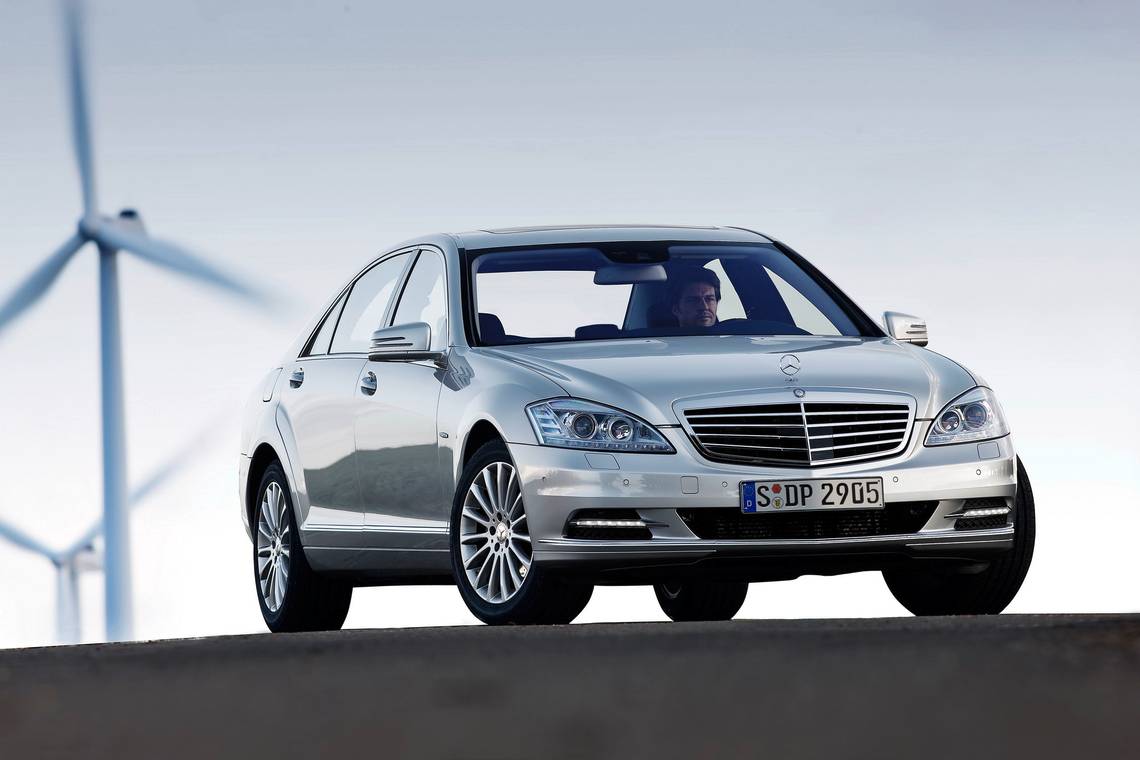
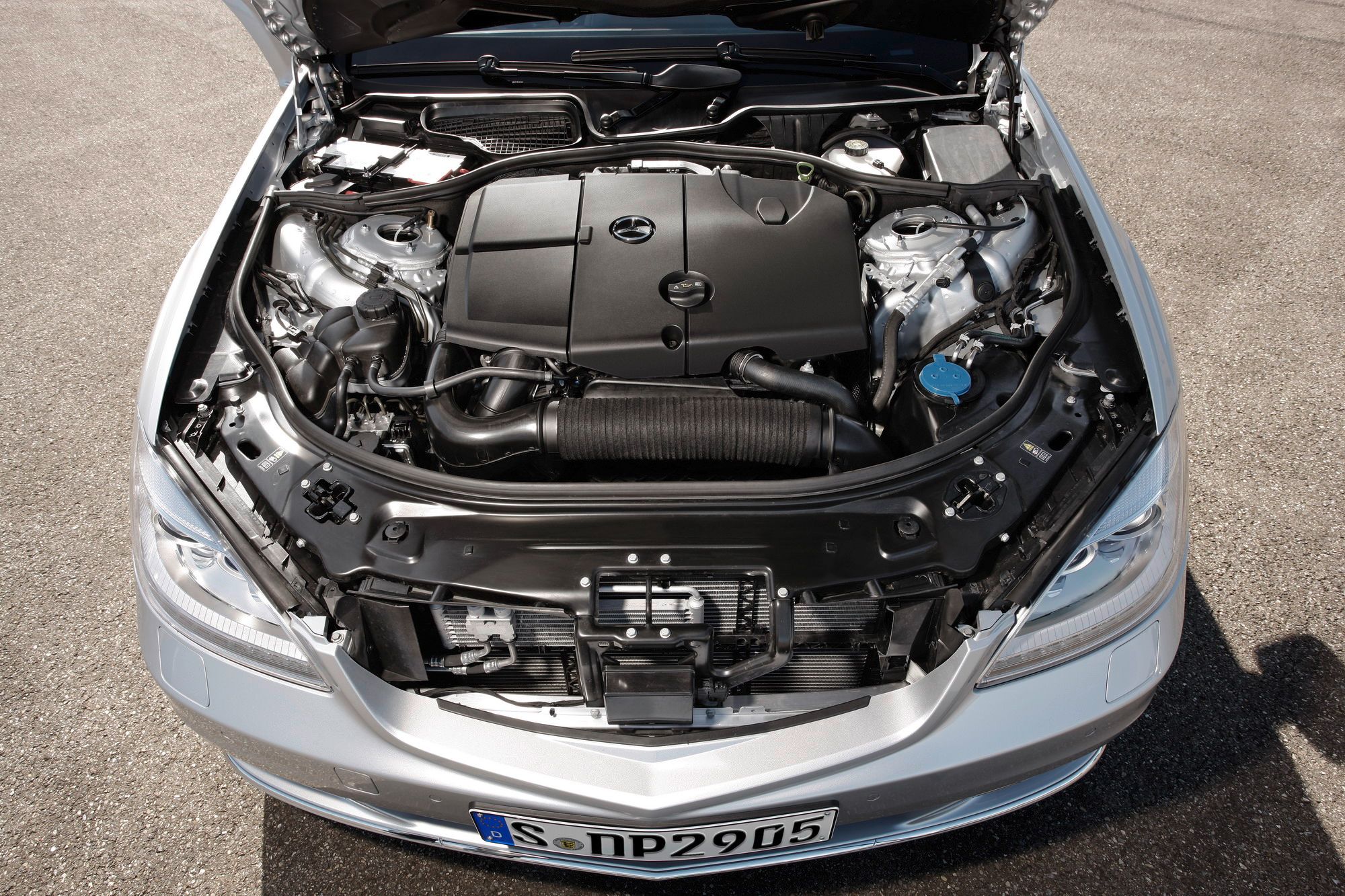
Mercedes->ke187 is popping the hood of their new S-Class models and dropping in four new diesel and petrol engines, including the S 250 CDI BlueEFFICIENCY, S 350 BlueTEC, S 350 BlueEFFICIENCY, and S 500 BlueEFFICIENCY.
The S250 CDI BlueEFFICIENCY features a 2.2-liter CDI engine that delivers 204 HP and 500 Nm at 1600 rpm. All of this power comes with a fuel consumption of only 5.7 liters per 100 kilometers. The S 350 BlueTEC is powered by a V6 engine that develops 258 HP and 620 NM of torque. This version has a fuel consumption of 6.8 liters per 100 kilometers.
The S 350 BlueEFFICIENCY is powered by a 3.5-liter V6 engine that delivers a total of 306 HP and 370 NM of torque, all with only 7.6 liters per 100 kilometers. The S 500 BlueEFFICIENCY gets a new V8 biturbo engine with an impressive output of 435 HP and 700 NM of torque. All versions have a top speed limited to 155 mph.
In order to achieve better fuel efficiency and consumption, Mercedes also added an extensively revised, high-efficiency 7G-TRONIC PLUS 7-speed automatic transmission and the ECO start/stop function. The start/stop function comes standard in the S 250 CDI BlueEFFICIENCY as well as the S 350 BlueEFFICIENCY and S 500 BlueEFFICIENCY models.
Check out full details on all of the new engines in the press release after the jump.
Press release
With a total of four new diesel and petrol engines, the Mercedes-Benz S-Class defines the efficiency standard in its segment. The accolade of "the world's most economical luxury saloon" goes to the new S 250 CDI BlueEFFICIENCY. This high-tech turbodiesel is the first four-cylinder engine in the almost 60-year success story of the S-Class. Developing an output of 150 kW (204 hp), the S 250 CDI BlueEFFICIENCY achieves a fuel consumption of just 5.7 litres per 100 kilometres (NEDC), corresponding to CO2 emissions of 149 grams per kilometre. The likewise new V6 diesel in the S 350 BlueTEC delivers 190 kW (258 hp) and has a combined consumption of 6.8 litres per 100 kilometres (177 g CO2/km). Thanks to AdBlue® emission control, it is one of the world's cleanest diesel engines. With 225 kW (306 hp) in the S 350 BlueEFFICIENCY and 320 kW (435 hp) in the S 500 BlueEFFICIENCY, the new BlueDIRECT engine generation is now entering the lists in the form of V6 and V8 petrol variants.
"The new highly efficient petrol and diesel engines in the S-Class demonstrate that our customers are also able to drive a luxury class car with a clear conscience," says
Dr. Thomas Weber, the member of the Daimler AG Executive Board responsible for corporate research and development at Mercedes-Benz Cars. "More than ever before, the luxury saloon combines the leadership claim of Mercedes-Benz with respect to efficient drive systems with the classic brand strengths in the realms of design, safety, comfort and effortlessly superior performance".
All the diesel and petrol engines have direct injection
 Mercedes-Benz achieves the considerable reduction in fuel consumption and improvement in efficiency with an intelligent combination of technical innovations that take effect throughout the entire powertrain: in addition to direct injection in the diesel engines, as well as in the new V6 and V8 BlueDIRECT petrol engines, these include the extensively revised, high-efficiency 7G-TRONIC PLUS 7-speed automatic transmission and the ECO start/stop function. This high-tech package is supplemented with other specific BlueEFFICIENCY measures such as the load-controlled oil pump and tyres with lower rolling resistance.
The four-cylinder diesel in the S 250 CDI BlueEFFICIENCY is equipped with latest-generation common-rail direct injection. The high rail pressure of 2000 bar enables output and torque figures at the level of a six-cylinder diesel to be achieved. In the S 350 BlueEFFICIENCY and S 500 BlueEFFICIENCY, the newly developed BlueDIRECT technology package ensures a lower fuel consumption together with increased power. The key factor is third-generation spray-guided direct petrol injection with multiple injection and multi-spark ignition. With the innovative V6 and V8 petrol units, Mercedes-Benz is founding a family of engines with a wide range of displacements and outputs. This is based on a flexible, modular concept that allows the integration of turbochargers, and combination with 4MATIC all-wheel drive as well as hybrid modules.
Fuel economy: ECO start/stop function
The excellent consumption and emission figures are also due to the new ECO start/stop function. This is standard equipment in the S 250 CDI BlueEFFICIENCY as well as the petrol-powered S 350 BlueEFFICIENCY and S 500 BlueEFFICIENCY models. The ECO start/stop function switches the engine off as soon as the vehicle stops - for example at traffic lights – and the driver keeps the brake pedal depressed after coming to a halt. The engine restarts immediately when the driver takes his foot from the brake pedal. The ECO start/stop function will not switch the engine off if e.g. the desired interior temperature has yet to be reached, if the driver has switched off the system or if drive modes "S" or "M" are active. An intelligent control system ensures that all functions and comfort systems otherwise remain in operation during the stop phase.
S 250 CDI BlueEFFICEINCY: first 5 litres/100 km car in the luxury segment
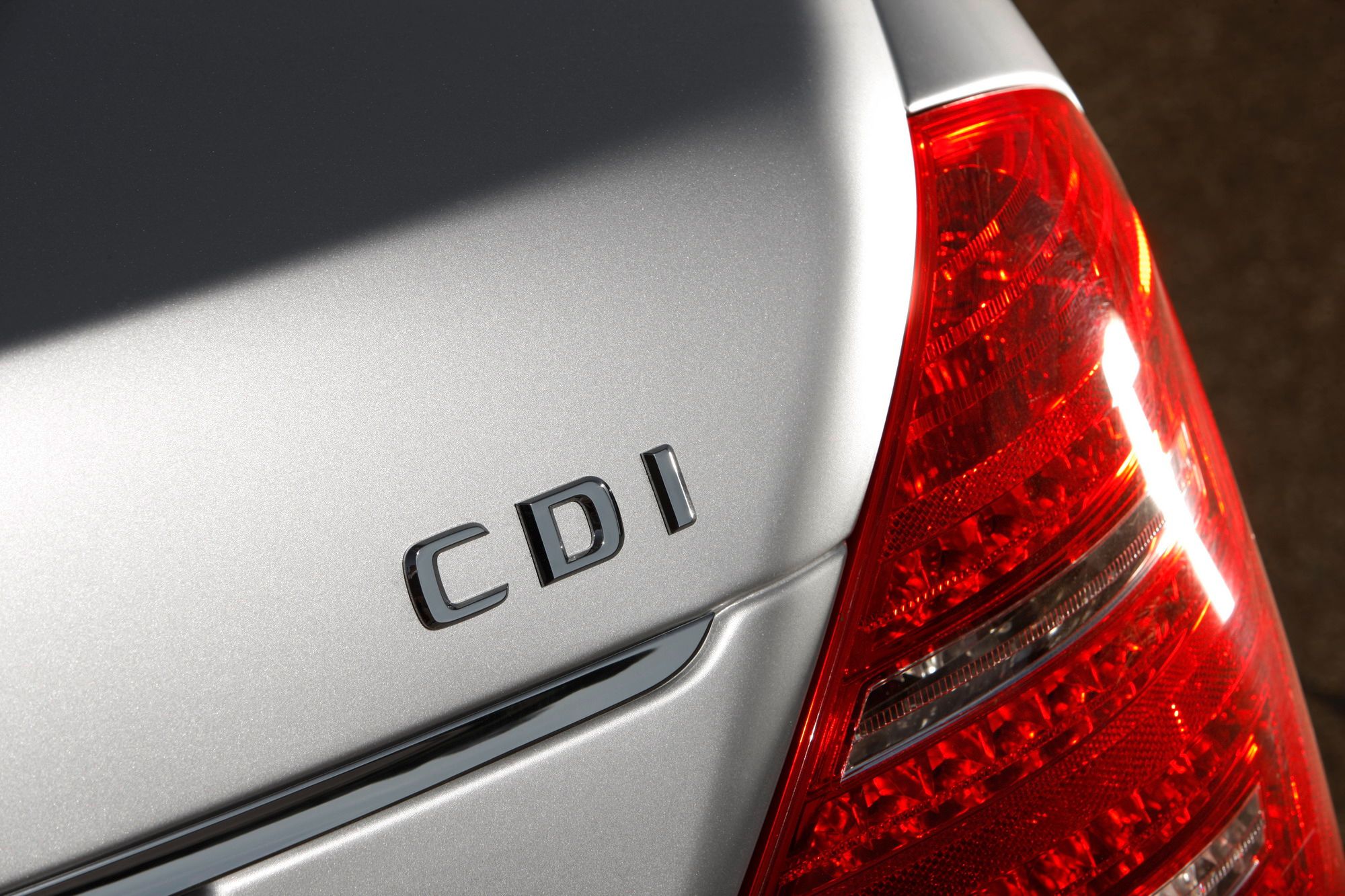
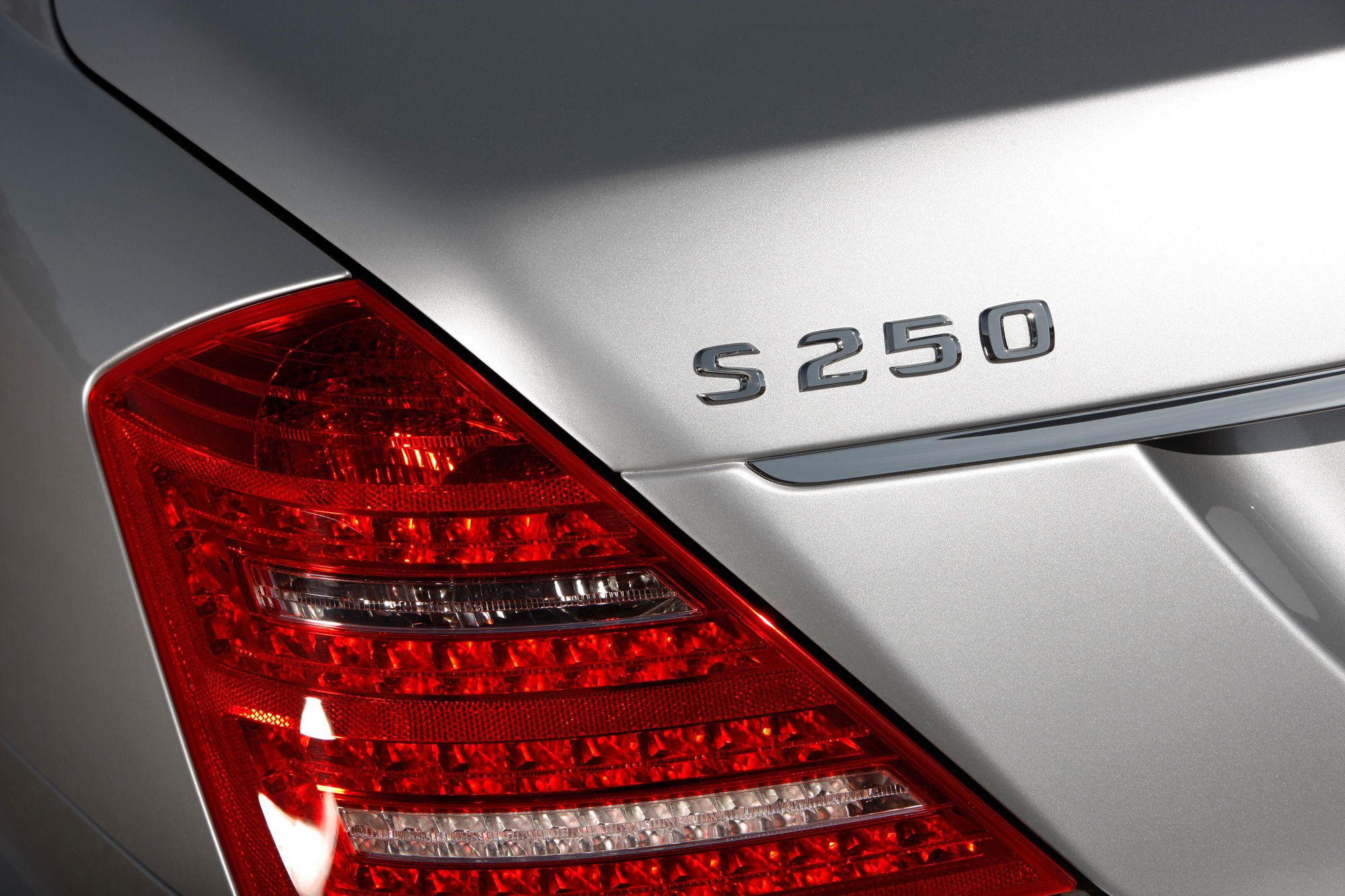 With the new S 250 CDI BlueEFFICIENCY, Mercedes-Benz is now launching the world's most fuel-efficient luxury saloon. The first four-cylinder engine in the more than 60-year success story of the S-Class attains a fuel consumption of just 5.7 litres per 100 kilometres, corresponding to CO2 emissions of 149 grammes per kilometre. This makes the new S 250 CDI BlueEFFICIENCY the first car in the luxury segment to run on under 6 litres of fuel per 100 km, and the first vehicle in its class to attain CO2 emissions below the 150 gramme mark. With a peak power output of 150 kW (204 hp) and maximum torque of 500 Newton metres, the four-cylinder CDI guarantees the superior performance which is a hallmark of the S-Class. It accelerates the large saloon from 0 to 100 km/h in 8.2 seconds, and attains a top speed of 240 km/h.
The 2.2-litre CDI engine already delivers its maximum torque of 500 Nm at 1600 rpm. The high torque at low engine speeds is a result of two-stage turbocharging. This technology, which is employed in a series-production passenger car diesel engine for the first time in the C and E-Class, is predominantly responsible for the high output at the level of a six-cylinder power unit.
The compact module for the two-stage turbocharger consists of a small high-pressure (HP) turbocharger and a large low-pressure (LP) turbocharger. These are connected in series, and each has a turbine and a compressor driven by this turbine. The HP turbine is located directly at the exhaust manifold and initially allows exhaust gas to flow through it; it then rotates at up to 215,000 revolutions per minute. The HP turbine housing features an integral bypass duct, which can be opened or closed by means of a charge-pressure control flap triggered by a vacuum cell. If the flap is closed, the whole exhaust stream flows through the HP turbine, so that the exhaust-gas energy is available solely for the HP turbine drive. This means that the optimum charge pressure can be built up at low engine revs.
Improved cylinder charging even at low rpm
 The two compressors are likewise connected in series, and are in addition connected to a bypass duct. The combustion air from the air filter first flows through the low-pressure compressor, where it is compressed as a function of the LP turbine's output. This pre-compressed air then passes into the high-pressure compressor, which is coupled to the HP turbine, where it undergoes further compression. The result is a genuine two-stage turbocharging process. The major advantage of this sophisticated, demand-related control of the combustion air supply using two turbochargers is improved cylinder charging, and therefore high torque even at low engine speeds. Fuel consumption is also reduced. When the car is driven, this concept makes itself felt by harmonious driving characteristics with no turbo-lag, a favourable torque curve across the entire engine speed range, great responsiveness and excellent performance.
Fourth-generation common rail technology
A further feature of the innovative and highly efficient diesel engine is fourth-generation common rail direct injection. The rail pressure of 2000 bar is essential for the delivery of 150 kW (204 hp) of engine output and maximum torque of 500 Nm, while achieving low untreated emissions.
Dynamically controlled engine mounts dampen vibrations
To ensure hallmark S-Class comfort, dynamically controlled engine mounts feature as an innovation in the new S 250 CDI BlueEFFICIENCY. The rigidity and damping of these mounts alter according to engine speed, load and vehicle speed, thus preventing the transmission of unwanted vibrations and noise from the engine to the body.
S 350 BlueTEC: highly efficient, clean, powerful
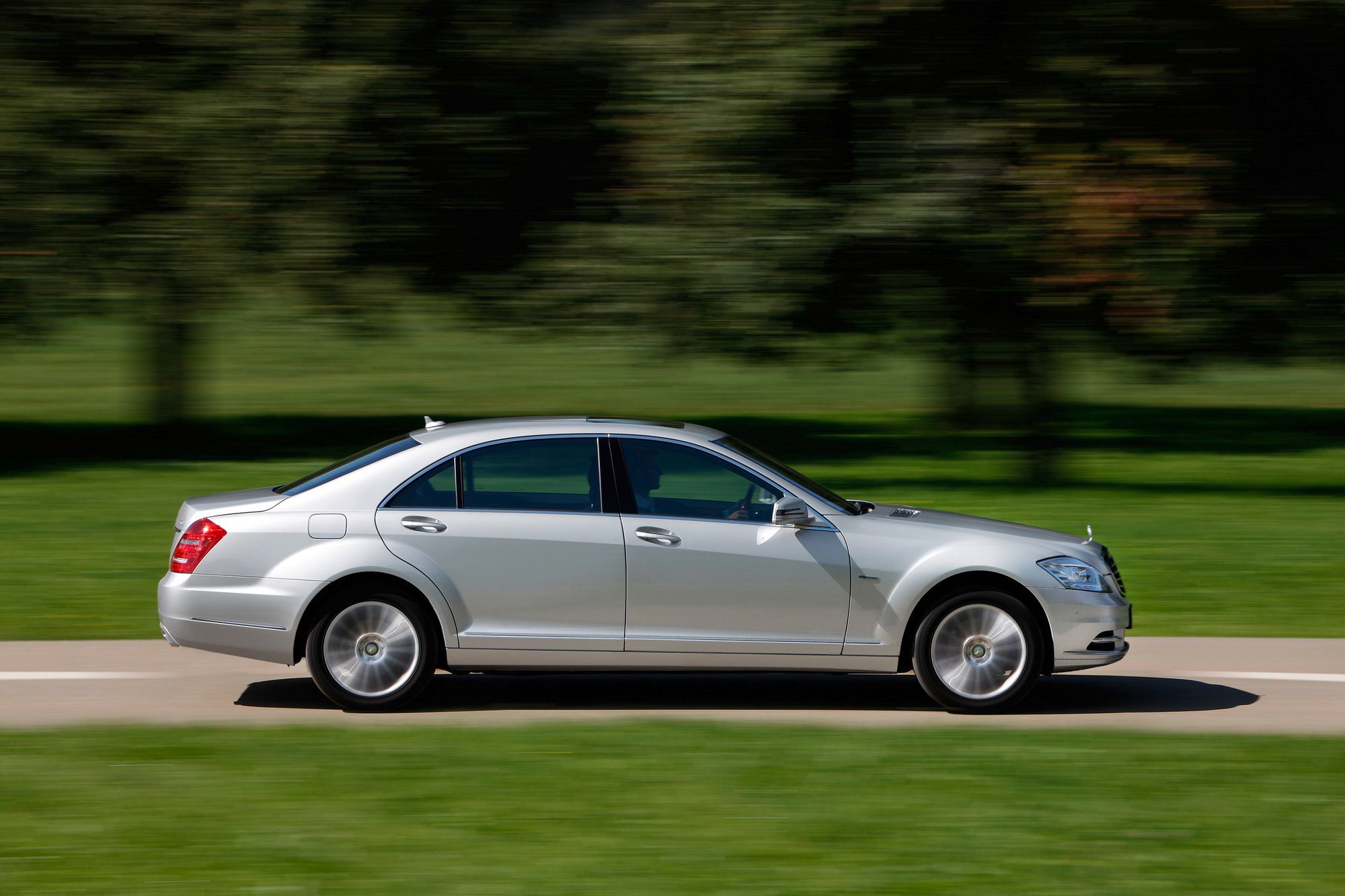 The second new diesel model in the S-Class is the S 350 BlueTEC. Its V6 develops an output of 190 kW (258 hp) from a displacement of 2987 cc. This is ten percent more than the previous model, which delivered 173 kW (235 hp). The torque of the V6 diesel has increased by 15 percent from 540 to 620 newton metres. Despite much improved performance, with a combined consumption of 6.8 litres of diesel fuel per 100 kilometres the S 350 BlueTEC betters its predecessor by 0.8 litres or eleven percent. CO2 emissions have likewise fallen by eleven percent, from 199 to 177 grams per kilometre. The highly efficient V6 diesel gives the luxury saloon effortlessly superior performance: it sprints from zero to 100 km/h in 7.1 seconds and has a top speed of 250 km/h.
Moreover, the S 350 BlueTEC ranks among the world's cleanest diesel models: BlueTEC is a technology developed by Mercedes-Benz to reduce emissions from diesel vehicles, in particular nitrogen oxides. To this end AdBlue®, an aqueous urea solution, is injected into the exhaust flow. This releases ammonia, which converts up to 80 percent of nitrogen oxides into harmless nitrogen and water in the downstream SCR (Selective Catalytic Reduction) catalytic converter. As a result, the S 350 BlueTEC already complies with the emission levels which are planned for 2014 with the introduction of the EU6 standard. The AdBlue® tank is installed under the boot floor and has a capacity of 25.7 litres. The supply is replenished at the regular maintenance intervals, every 25,000 kilometres.
BlueDIRECT technology makes V6 and V8 engines fit for the future
With the two BlueDIRECT power plants of the S 350 BlueEFFICIENCY and S 500 BlueEFFICIENCY, Mercedes-Benz is once again raising the bar when it comes to efficiency in the luxury saloon segment. They are representatives of a new generation of BlueDIRECT V6 and V8 engines. With its new generation V-engines, Mercedes-Benz is clearly demonstrating that with concerted further development, internal combustion engines still have a great deal of potential, and that V6 and V8 engines with their high level of refinement also have a future.
Centrepiece of the BlueDIRECT technology package is the improved third-generation direct petrol injection with spray-guided combustion and piezo injectors. In combination with multi-spark ignition it taps further possibilities for improving consumption – in the V8 unit through a further developed homogeneous combustion process ("homogeneous split"); in the V6 engine through a new stratified combustion method with a much larger useful engine characteristic map and lean-burn combustion for optimum consumption ("homogeneous stratified mode"). As the name indicates, the HOS method is a combination of homogeneous-lean and conventional stratified combustion. The first injection takes place during the intake stroke so that a homogeneous base mixture is formed. The "stratified" injection proper takes place during the compression stroke prior to ignition, as map-controlled single or double injection.
Multi-spark ignition: best possible ignition to suit requirements
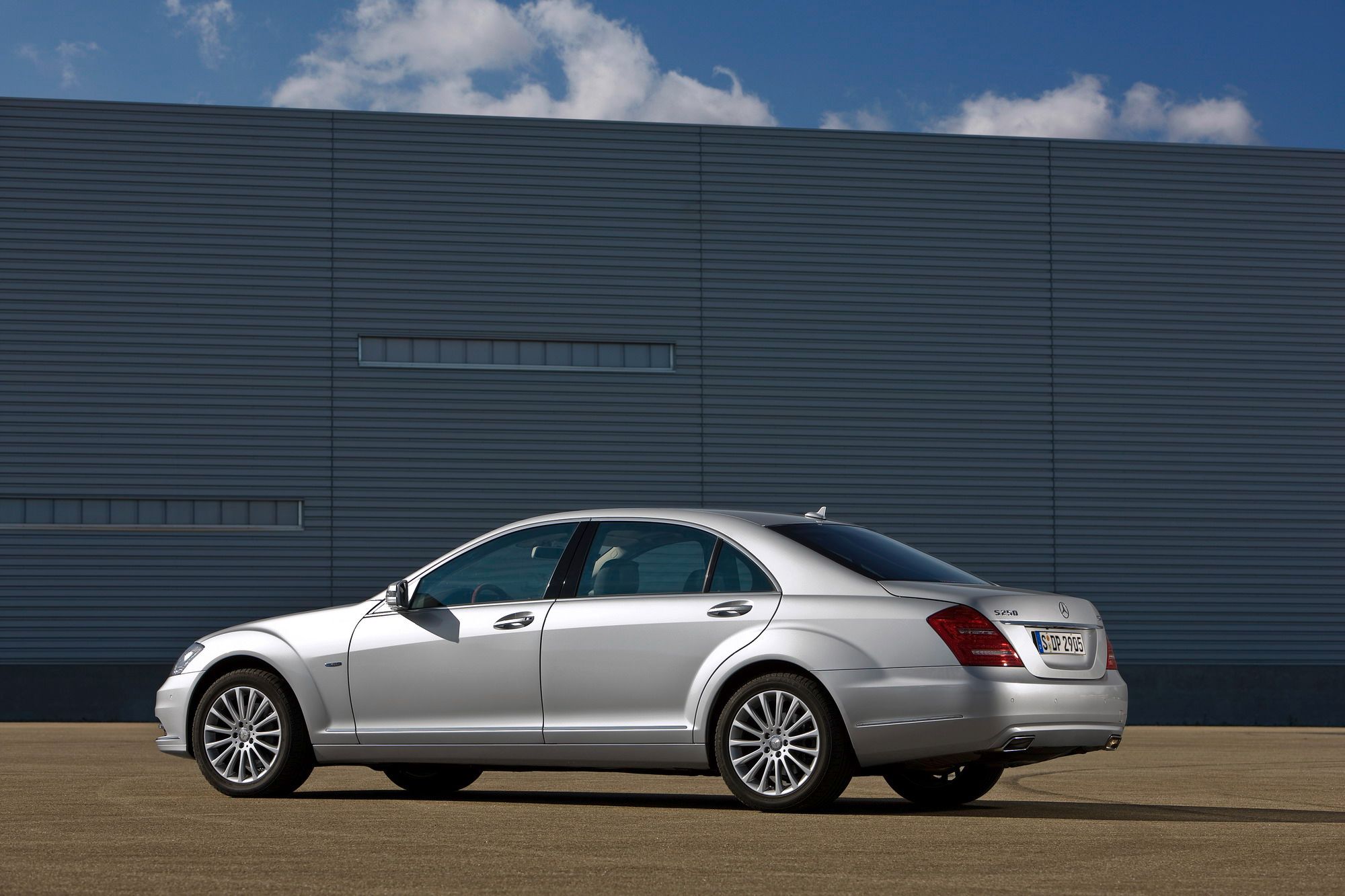 The third-generation direct injection system also features rapid multi-spark ignition (MSI). Following the first spark discharge and a brief combustion period, the coil is rapidly recharged and a further spark is discharged. The MSI system enables up to four sparks to be discharged in rapid succession within one millisecond, creating a plasma with a larger spatial expansion than conventional ignition. Controlling this rapid multi-spark ignition enables both the time lapse before the next spark and the combustion duration for the relevant operating point to be optimally adjusted. This provides scope for optimising the centre of combustion and improving residual gas compatibility, especially during stratified charge operation. Fuel consumption can be reduced by roughly two percent in this way.
Depending on the driving cycle, fuel savings of up to four percent are possible alone by the use of piezo-electric injection technology in combination with multi-spark ignition.
S 350 BlueEFFICIENCY: up to 24 percent lower consumption
The ultra-modern 3.5-litre V6 engine of the S 350 BlueEFFICIENCY and S 350 4MATIC BlueEFFICIENCY is naturally aspirated, but also suitable for the future use of a turbocharger thanks to the modular design concept. The most striking change between the new V6 unit and its predecessor is a reduction in the V-angle between the cylinder banks from 90 degrees to 60 degrees. This enables the primary balancer shaft to be omitted, and as a result the driver registers an outstanding level of comfort.
The design highlights of the 3.5-litre V6 include a completely new air intake and exhaust system in conjunction with a variable resonance intake manifold and optimised inflow and outflow. Result: with the same displacement, the output compared with the previous 200 kW (272 hp) model is increased by 12.5 percent to 225 kW (306 hp), while maximum torque has increased by 5.7 percent to 370 Newton metres (predecessor: 350 Nm) and now is available over a broad engine speed range from 3500 to 5250 rpm.
In parallel with this substantial increase in power, Mercedes engineers have achieved an even more impressive reduction in fuel consumption. The predecessor's NEDC consumption was already good at 10.0 litres of premium petrol per 100 kilometres, but has now been cut by almost a quarter. The new V6 petrol engine in the S 350 BlueEFFICIENCY is content with 7.6 litres per 100 kilometres. That adds up to savings of 2.4 litres or 24 percent, and makes the S 350 BlueEFFICIENCY the most economical petrol model in the luxury class. CO2 emissions have also fallen by 24 percent – from 234 to 177 grams per kilometre (short wheelbase) and by 23.5 percent to 179 grams per kilometre (long wheelbase). The S 350 BlueEFFICIENCY combines excellent consumption figures with dynamic performance, accelerating from standstill to 100 km/h in 6.9 seconds. Top speed is 250 km/h (electronically limited).
S 500 BlueEFFICIENCY: more powerful, more economical, more efficient

The new V8 biturbo engine in the S 500 BlueEFFICIENCY and S 500 4MATIC BlueEFFICIENCY generates 320 kW (435 hp) with 15 percent less displacement (4663 instead of 5461 cc), and therefore around twelve percent more output than its 285 kW (388 hp) predecessor. Torque has risen from 530 to 700 newton metres – an increase of 32 percent.
Despite a considerable increase in power of 35 kW (47 hp), Mercedes developers have been able to reduce the combined fuel consumption of the S 500 BlueEFFICIENCY significantly. At 9.3 litres of premium petrol per 100 kilometres, this is 15.5 percent (short wheelbase) and 16 percent (long wheelbase) below the figure for the preceding model. An outstanding figure in the luxury class, this corresponds to CO2 emissions of 219 grams per kilometre. The excellent efficiency goes hand in hand with superior performance: the S 500 BlueEFFICIENCY sprints from zero to 100 km/h in impressive 5.0 seconds. Top speed is 250 km/h (electronically limited). The increase in output and torque despite the reduced displacement is mainly due to the use of two turbochargers – one for each bank of cylinders. These force the intake air into the eight combustion chambers at a pressure of up to 0.9. The turbochargers are configured to provide a high torque at low engine speeds, and an outstanding 600 newton metres are already available between 1600 and 4750 rpm.
The S 600, with its 380 kW (517 hp) 12-cylinder biturbo engine remains the top-of-the-line model: it accelerates the luxury saloon from a standstill to 100 km/h in impressive 4.6 seconds, and now also complies with the Euro 5 emission standard.
More efficiency thanks to demand-controlled ancillary units
In order to improve efficiency, Mercedes-Benz developers have also reduced the power consumption of the ancillary units for the new petrol and diesel engines. One of these is a newly developed, controlled oil pump. This operates at two pressure levels. At low engine speeds and loads the pump runs at a low pressure. The high-pressure stage is activated at the upper load and engine speed levels. Thanks to this innovative control concept, the lubrication and cooling points of the engine can be supplied with significantly lower drive energy than would be possible with an uncontrolled pump. In this way, the developers have particularly managed to lower fuel consumption in driving modes requiring less power, for example in urban traffic.
Another special feature is the switchable water pump. To enable faster engine warm-up, the pump is not activated until the optimum operating temperature is reached. This also contributes to the reduction in fuel consumption.
In the S 350 BlueEFFICIENCY and S 500 BlueEFFICIENCY, there is also intelligent generator management with braking energy recuperation.
Designed for maximum efficiency: the new 7G-TRONIC PLUS
All four new engines are combined with the new 7G-TRONIC PLUS 7-speed automatic transmission, which brings a further reduction in torque converter slip and optimised efficiency. A central role is played by the new torsion damper, which eliminates torsional eccentricities and vibrations in the transmission. The lower the rpm and the lower the number of cylinders, the more severe these can be. This results in a conflict of aims between comfort and fuel-efficient operation. Mercedes-Benz developers resolved this by using a so-called twin-turbine damper, which is also fitted with a centrifugal pendulum. Depending on the rpm, this moves the centre of mass and allows comfortable operation even in the most economical operating range.
The optimised damping allows a marked reduction in the slip of the torque converter lockup clutch even under low loads. In the fuel-efficient ECO transmission mode, this has enabled engine speeds to be lowered without compromising signature S-Class comfort. In addition, the optimised damping of rotational irregularities and vibrations in the transmission allows an even faster response to driver commands via the accelerator pedal.
The S 350 BlueTEC is already in the showrooms of Mercedes-Benz own-retail outlets and dealerships. The S-Class with the new BlueDIRECT petrol engines and the S 250 CDI BlueEFFICIENCY can be ordered with immediate effect.