
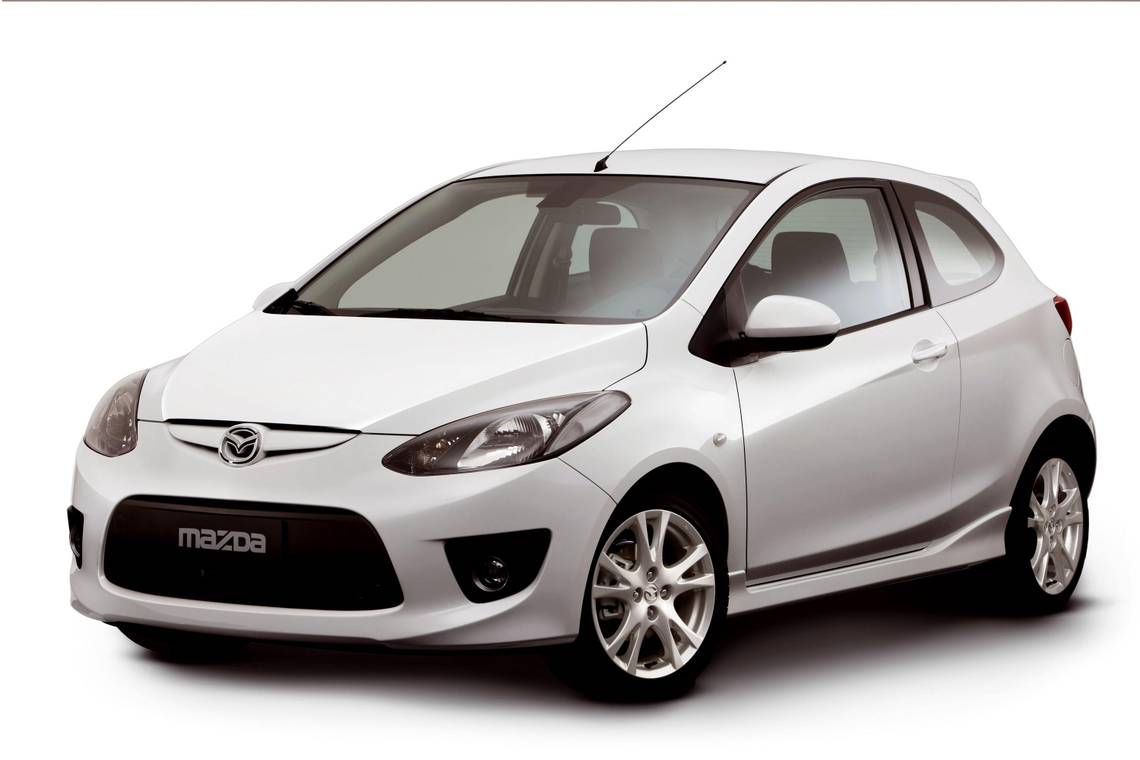
Mazda made official today the three-door version of the Mazda2 hatchback. The new Mazda2 three-door hatchback builds on the five- door hatchback’s exterior design – that evokes movement and athleticism using unique body panel articulation and compact dimensions – for even more sporty appeal.

Mazda2 three-door hatchback comes with the same petrol powertrain line-up as the five-door hatchback with engines that are lively and responsive, yet use low amounts of fuel and produce markedly less CO 2 than the engines of the outgoing model. The base MZR 1.3-litre aggregate has variable valve timing and comes in two power derivatives (depending on market): a Standard Power version producing 55 kW/75 PS and a High Power version producing 63 kW/86 PS. Both use just 5.4 litres of petrol per 100 km and produce a low 129 g/km of CO 2 emissions.

The largest petrol engine is an MZR 1.5-litre that produces 76 kW/103 PS of power, while using just 5.9 litres of fuel per 100 km and producing 140 g/km of CO . 2 Also onboard is a MZ-CD 1.4-litre common-rail turbo diesel, special for the European market, with high fuel efficiency and low emissions. It produces 50 kW/68 PS of maximum power at 4,000 rpm and 160 Nm of torque at a low 2,000 rpm for lively acceleration and driving fun. At the same time, it uses just 4.3 litres of fuel per 100 km (combined) and produces a very low 114 g/km of CO 2 for low operating costs, which is a vital criteria for B-car customers. All engines come with Mazda’s five-speed manual transmission with gear ratios that are between 3 to 10 percent higher than the outgoing five-speed, which contributes to lower fuel consumption.
2008 Mazda2 Three-Door


- Make: Array
- Model: 2008 Mazda2 Three-Door
2008 Volkswagen Golf TDI Hybrid
- Make: Array
- Model: 2008 Volkswagen Golf TDI Hybrid
- [do not use] Vehicle Model: Array
Press release
One of the keys to Mazda’s continuing growth in Europe and around the world has been a strategy of expanding the line-up with exciting vehicles that appeal to an ever- wider group of customers. In less than two years, Mazda introduced vehicles that were never in its portfolio before, like the high-performance Mazda3 MPS, the unique power retractable hardtop MX-5 Roadster Coupe and the sports crossover SUV, Mazda CX-7. This strategy continues at Geneva 2008 with the global premiere of the first Mazda2 three-door hatchback version.
Launched in October 2007 as Mazda’s first new-generation vehicle to be evolved to a new level, the all-new Mazda2 was an immediate hit with European customers, finding more than 18,000 owners through January 2008. In December last year, Mazda2 five-door hatchback was awarded five stars for adult occupant protection at Euro-NCAP crash testing. It won a host of automotive awards as well, including Car of the Year in Austria, Belgium, Croatia and Denmark. Now Mazda2 is about to get more popular with a new three-door hatchback model that has all the award-winning attributes of the five-door hatchback, and is even sportier and more affordable.
Design – sportiness enhanced
The new Mazda2 three-door hatchback builds on the five- door hatchback’s exterior design – that evokes movement and athleticism using unique body panel articulation and compact dimensions – for even more sporty appeal. Its rear side window has a unique shape that, when combined with Mazda2’s rising belt line and wedge shape, communicates an even more fun-to-drive character. Fresh and dynamic-looking, its overall design communicates a calm strength achieved through formal beauty and the highest levels of build quality yet seen on a Mazda B-car. And its eye-catching design is also 4 percent more aerodynamic than the old Mazda2 with a coefficient of drag (Cd) of only 0.31 and a coefficient of lift (CLF) of just 0.02, which helps reduce fuel consumption and operating costs, which is important to young, first- time buyers. For more sporty-minded customers, a sports appearance package is available with a special front bumper design and side sills that visually lower the car’s centre of gravity, and a rear roof spoiler. On the inside, a dark keynote colour contrasts nicely with white instruments, silver accents, a three-spoke steering wheel similar to the Mazda MX-5 roadster, a silver ringed driver cluster and centre-console mounted shift lever for an ambiance that is both sporty and high quality.
Mazda2 Three-Door Hatchback Show Car
Under the spotlights at the Mazda stand is a Mazda2 three-door hatchback created especially for the 2008 Geneva Motor Show that emphasises the car’s sporty nature. Its exterior design is even more eye-catching painted in the same special red mica colour as the Mazda concept car Ryuga shown at the Detroit Motor Show in 2007. It has the line-up’s exterior sports appearance package enhanced by a special lowered suspension and wider tread, projector-type headlamps and special 16- inch painted wheels.
On the inside, the sporty theme continues with Recaro® seats in racy red and black two-tone, and matching red stitching on the leather steering wheel with a painted bezel. The driver cluster has meter rings and the door trim has leather inserts and panels in special paint.
Comfort, Functionality and Equipment
As with the five-door hatchback version, the new Mazda2 three-door hatchback has a roomy interior, despite its compact and dynamic exterior design. The three-door version includes handy walk-in functionally, which tips the seatback forward and slides the passenger seat forward for one of the segment’s widest access widths for easy entry. It then returns to its original position. Once inside, passengers find themselves in a roomy and comfortable interior.
A relatively long wheelbase (2,490 mm), an innovative roof header shape, reduced roof-lining thickness and a lower rear hip point height combine to deliver plenty of head, shoulder and leg room both front and back. The driver’s seat can be slide adjusted up to 250 mm and height adjusted up to 55 mm. This is combined with adjustable steering wheel height and a centre console-mounted manual shift lever for a sporty, wrap- around cockpit with room for people of nearly all shapes and sizes.
The higher shift lever placement makes room between the front seats for a floor console with a drink holder in the front and a storage tray in the rear large enough for a woman’s handbag, along with an AUX jack for plugging in an MP3 player to use with the car’s audio system (depending on grade) and a 12 volt power socket that can be used to power or charge electrical accessories. Other handy storage compartments include a unique magazine rack in the glove compartment, front door pockets with space for a half-litre bottle and an A4 atlas, and three compartments in the dashboard for smaller items. The luggage capacities are unchanged compared to the hatchback version. Behind the rear seats is a 250 litre luggage compartment that can hold two suitcases or a baby buggy, and can be extended to 787 litres when the rear seats are folded (60/40 functionality for all grades except base) to take larger items.
Mazda2 three-door hatchback will be offered in three grades (depending on market) with a full slate of equipment for young, fun-minded drivers. The base grade includes remote central locking, electric adjustable side mirrors, electric power assist steering and ABS. The higher two grades include six airbags, heated and retractable door mirrors, 15 or 16-inch aluminium alloy wheels, manual or automatic air-conditioning, power front windows, rain and light sensor system, adjustable speed warning system, cruise control (1.5-litre petrol with board computer only), dynamic stability control (DSC), and keyless entry and start system, among other features.
Powertrains – low consumption and low CO 2 emissions
Mazda2 three-door hatchback comes with the same petrol powertrain line-up as the five-door hatchback with engines that are lively and responsive, yet use low amounts of fuel and produce markedly less CO 2 than the engines of the outgoing model. The base MZR 1.3-litre aggregate has variable valve timing and comes in two power derivatives (depending on market): a Standard Power version producing 55 kW/75 PS and a High Power version producing 63 kW/86 PS. Both use just 5.4 litres of petrol per 100 km and produce a low 129 g/km of CO 2 emissions. The largest petrol engine is an MZR 1.5-litre that produces 76 kW/103 PS of power, while using just 5.9 litres of fuel per 100 km and producing 140 g/km of CO . 2 Also onboard is a MZ-CD 1.4-litre common-rail turbo diesel, special for the European market, with high fuel efficiency and low emissions. It produces 50 kW/68 PS of maximum power at 4,000 rpm and 160 Nm of torque at a low 2,000 rpm for lively acceleration and driving fun. At the same time, it uses just 4.3 litres of fuel per 100 km (combined) and produces a very low 114 g/km of CO 2 for low operating costs, which is a vital criteria for B-car customers. All engines come with Mazda’s five-speed manual transmission with gear ratios that are between 3 to 10 percent higher than the outgoing five-speed, which contributes to lower fuel consumption.
Chassis and Safety – lightweight for low costs, with safety features equivalent to the five-door hatchback
The new Mazda2 three-door and five-door hatchback have a body shell that is nearly 100 kg lighter compared to the previous Mazda2. By keeping vehicle weight under the 1000 kg threshold, the new Mazda2 reverses a general trend in the automotive industry of making each new model heavier. This outstanding result was achieved mostly by engineering solutions – like employing large amounts of strong yet light high-tensile steels and reducing weight wherever possible – but also by reducing the car’s dimensions, making it agile with low fuel consumption and lower operating costs.
High tensile steel also delivers some of the B-segment’s best crash safety, as was shown when the Mazda2 five-door hatchback scored the highest possible ranking of five-stars on Euro-NCAP testing with 34 points for adult protection. Mazda2 five-door hatchback also received an outstanding four-star ranking for child occupant protection with 37 points, making it one of the few sub-compacts to achieve this level of child protection. And for pedestrian safety, it achieved an admirable 18 points and two-star ranking. The Mazda2 three- door hatchback‘s structure is reinforced around the B-pillar and in the doors, including specific side impact protection bars. Mazda2 three-door’s superior passive safety package includes six airbags (depending on grade), ABS, electronic brake-force distribution (EBD), emergency brake assist, DSC and a 40 mm lower beltline and lower side mirror placement for better visibility.