
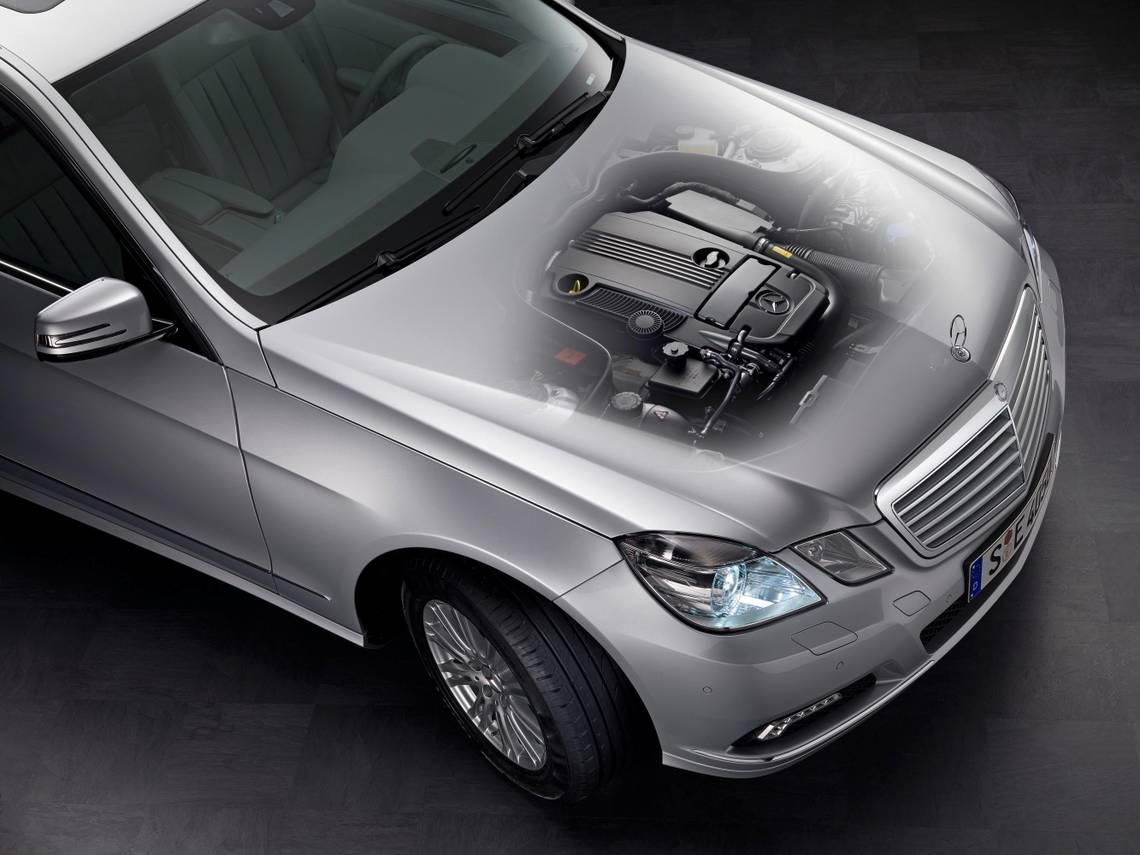
BlueEFFICIENCY - the most economical Mercedes technology made its way into the new E-Class. All the BlueEFFICIENCY models have an improved fuel consumption with almost 23%.
To improve fuel economy Mercedes developed a lightweight designs, new forms, more efficient control or enhanced functioning.

The aerodynamic drag of a car rises by the square of the car’s speed and, at just 80 km/h, accounts for around 50 percent of all drag and rolling resistance. These figures show just how important aerodynamics are when it comes to fuel consumption and CO2 emissions – especially when driving at higher speeds. Reducing the drag coefficient (cd figure) by 0.01 only brings about a fuel saving of 0.04 litres per 100 kilometres in the New European Driving Cycle (NEDC) due to the low average speed of 33 km/h; however, in the real world – for example at a motorway speed of 130 km/h – this reduction in the cd figure equates to a fuel saving of up to 0.15 litres per 100 kilometres.
Full details in the press release after the jump.
2009 Mercedes E-Class BlueEFFICIENCY


- Make: Array
- Model: 2009 Mercedes E-Class BlueEFFICIENCY
- [do not use] Vehicle Model: Array
Press release
BlueEFFICIENCY – the trademark for exceptionally economical and ecofriendly Mercedes passenger cars – is a package of measures compiled by development engineers across all disciplines, the main aims being to reduce weight, aerodynamic drag and rolling resistance, to further optimise the engine technology, and to make energy management even more efficient.
The Mercedes commitment to reducing fuel consumption and carbon-dioxide emissions targets actual driver usage profiles. As part of a large-scale field trial, the typical driving profiles of Mercedes customers were ascertained and combined in an in-house fuel-consumption test covering a total of almost two million kilometres. Hence the positive effects of the BlueEFFICIENCY concept are most noticeable during everyday use of the cars.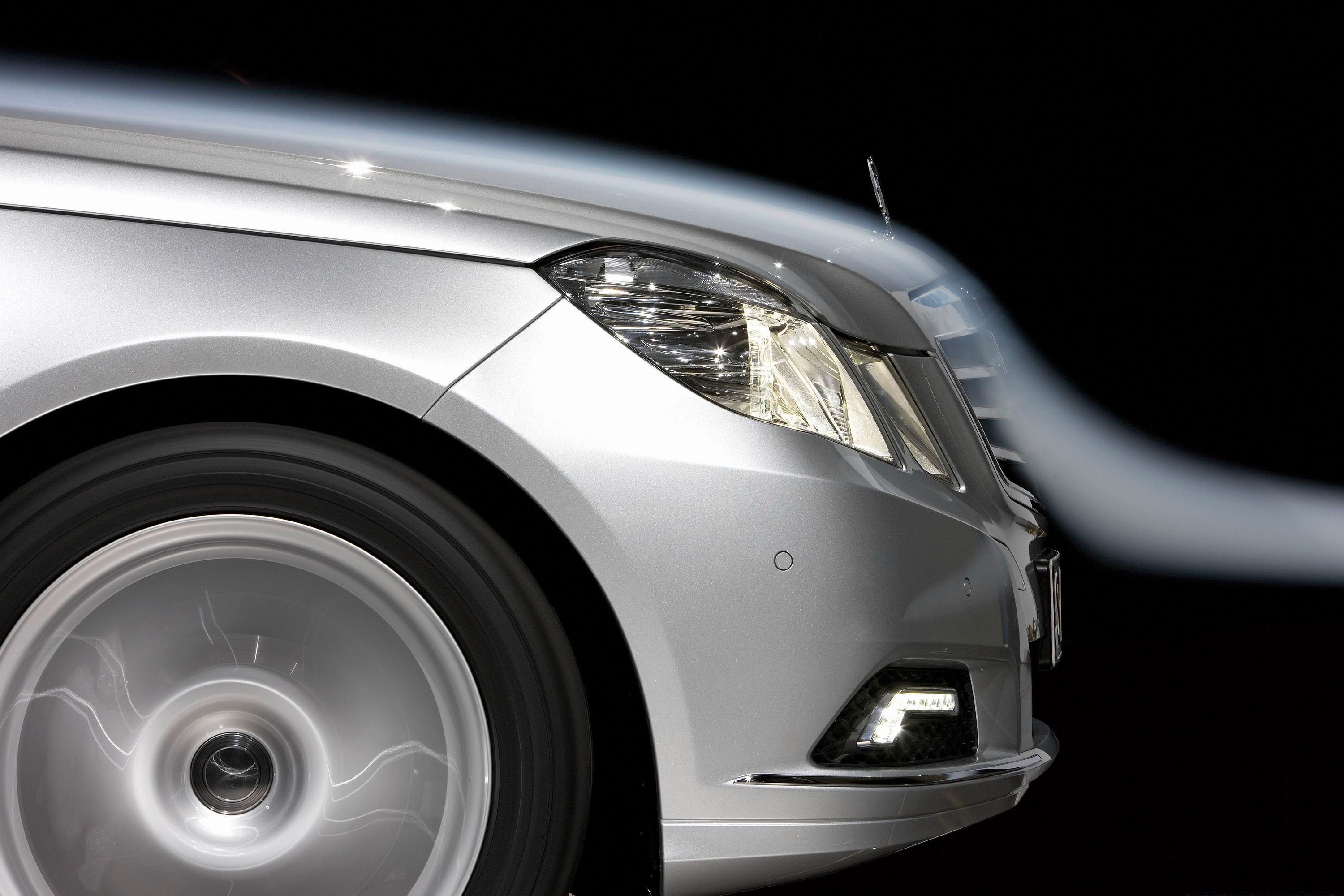 For the new E-Class, Mercedes-Benz has put together an extensive raft of measures, which is one of the key factors behind the reduction in fuel consumption of up to 23 percent. From the power steering to the tyres, from the fuel pump to the alternator, the development engineers scrutinised a wide range of components to determine if and how lightweight designs, new forms, more efficient control or enhanced functioning could be employed to save fuel. Although many of the individual measures only improved fuel economy by the odd percentage point or two, together they add up to a substantial saving.
Lower aerodynamic drag: fan shutter behind the radiator
The aerodynamic drag of a car rises by the square of the car's speed and, at just 80 km/h, accounts for around 50 percent of all drag and rolling resistance. These figures show just how important aerodynamics are when it comes to fuel consumption and CO2 emissions – especially when driving at higher speeds. Reducing the drag coefficient (cd figure) by 0.01 only brings about a fuel saving of 0.04 litres per 100 kilometres in the New European Driving Cycle (NEDC) due to the low average speed of 33 km/h; however, in the real world – for example at a motorway speed of 130 km/h – this reduction in the cd figure equates to a fuel saving of up to 0.15 litres per 100 kilometres.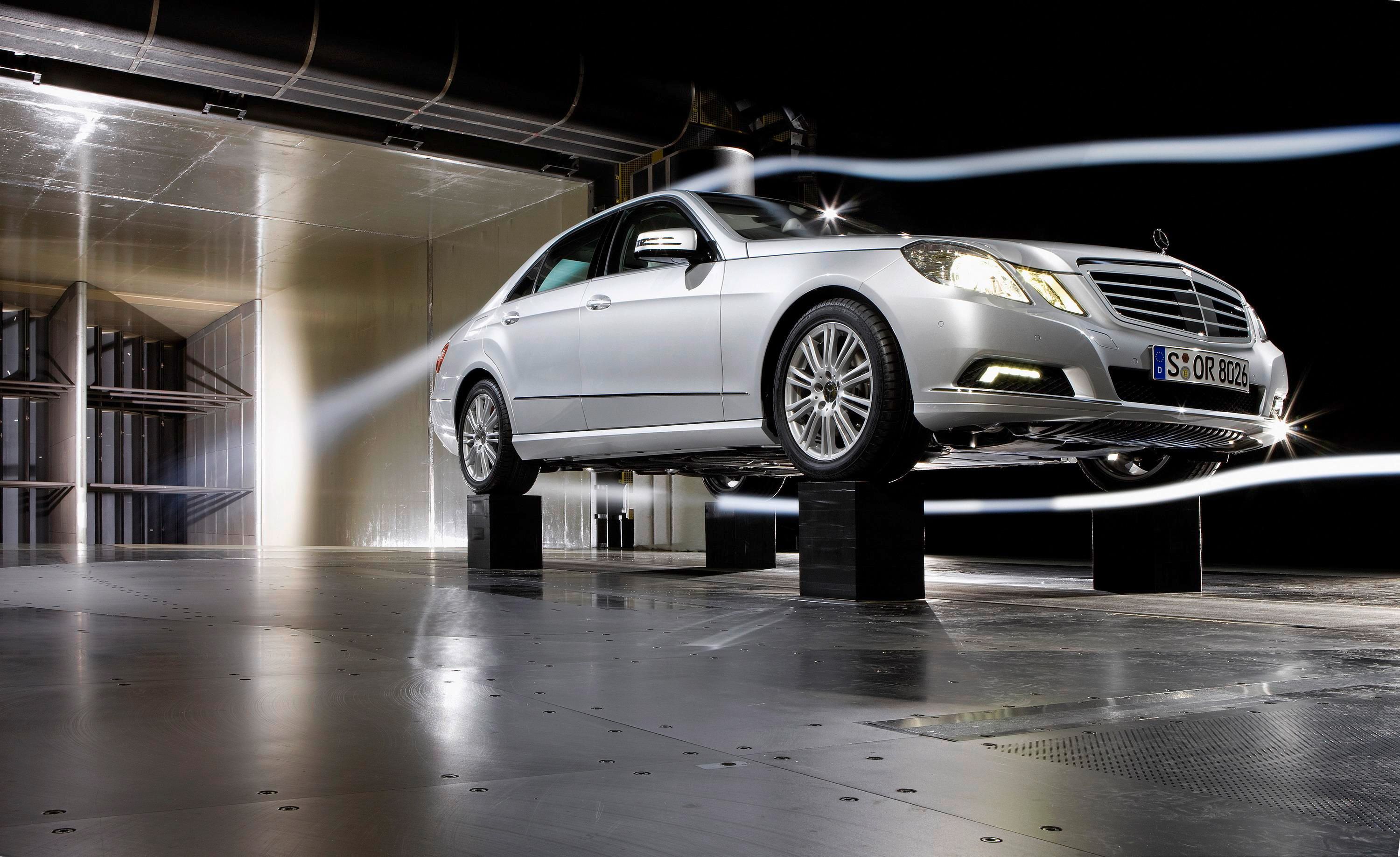 By performing computer calculations and meticulous work in the wind tunnel, the Mercedes engineers have succeeded in aerodynamically optimising the body of the new E-Class (also see page 49). The overall result is impressive to say the least: the cd figure for the Saloon is just 0.25 – significantly lower than the figures achieved by other saloons in this vehicle category.
One of the main reasons behind this outstandingly low drag coefficient is the new, electropneumatically controlled fan shutter. Its development is based on the knowledge that the air flowing through the radiator and the engine compartment accounts for up to ten percent of a car body's total aerodynamic drag. The fan shutter allows the engine's cooling air quantity to be limited in line with requirements, thus saving fuel. In essence, this means that, when the engine is running under part load and requires relatively little cooling, the radiator grille is closed by a circular system of louvres located behind the radiator. For minimum cooling, the shutter allows just a small amount of residual air to enter the engine compartment, but opens completely when the sensors signal that more cooling air is required.
The fact that the area around the radiator is hermetically sealed ensures that the fan shutter works extremely effectively, allowing precise control of the air flowing into the engine compartment.
When the fan shutter is closed, the cd figure falls by 0.013, which is equivalent to a fuel saving of up to 0.2 litres per 100 kilometres when travelling at the motorway speed of 130 km/h. The fan shutter is fitted as standard on the four-cylinder models and on the E 350 CGI BlueEFFICIENCY model.

Energy management: intelligent detail solutions beneath the bonnet
The most important aspect when trying to save fuel and reduce CO2 emissions is to avoid unnecessary energy losses – both internal losses caused by friction in the powertrain and losses due to drag and rolling resistance.
By way of example, the use of a turbocharger in place of the previous mechanical supercharger in the new models with direct petrol injection allows more efficient energy management, since the mechanical drive power from the belt drive required to operate the supercharger is no longer needed. The biggest plus point in favour of the new four-cylinder engines is the homogeneously operated direct injection system, which brings about a major increase in thermodynamic efficiency compared to the previous port injection system.
The fuel vaporising in the cylinders lowers the temperature in the combustion chambers, thereby reducing the engine's tendency to knock and allowing higher compression. The engine developers have succeeded in cutting fuel consumption further still by incorporating an intelligent thermal management system which prevents coolant from being pumped through the cylinders when the engine is cold, meaning that the combustion chambers heat up more quickly.
Part of the BlueEFFICIENCY concept involved optimising the automatic transmissions for the new E-Class: the newly developed converter for the five-speed automatic transmission reduces hydraulic losses and, therefore, uses up less fuel. For the 7G-TRONIC seven-speed automatic transmission in the E 350 CDI BlueEFFICIENCY model, Mercedes-Benz has developed a standstill decoupling function: when the car is stationary at traffic lights or in a traffic jam, for example, the transmission switches to "N" position so as to reduce the engine load.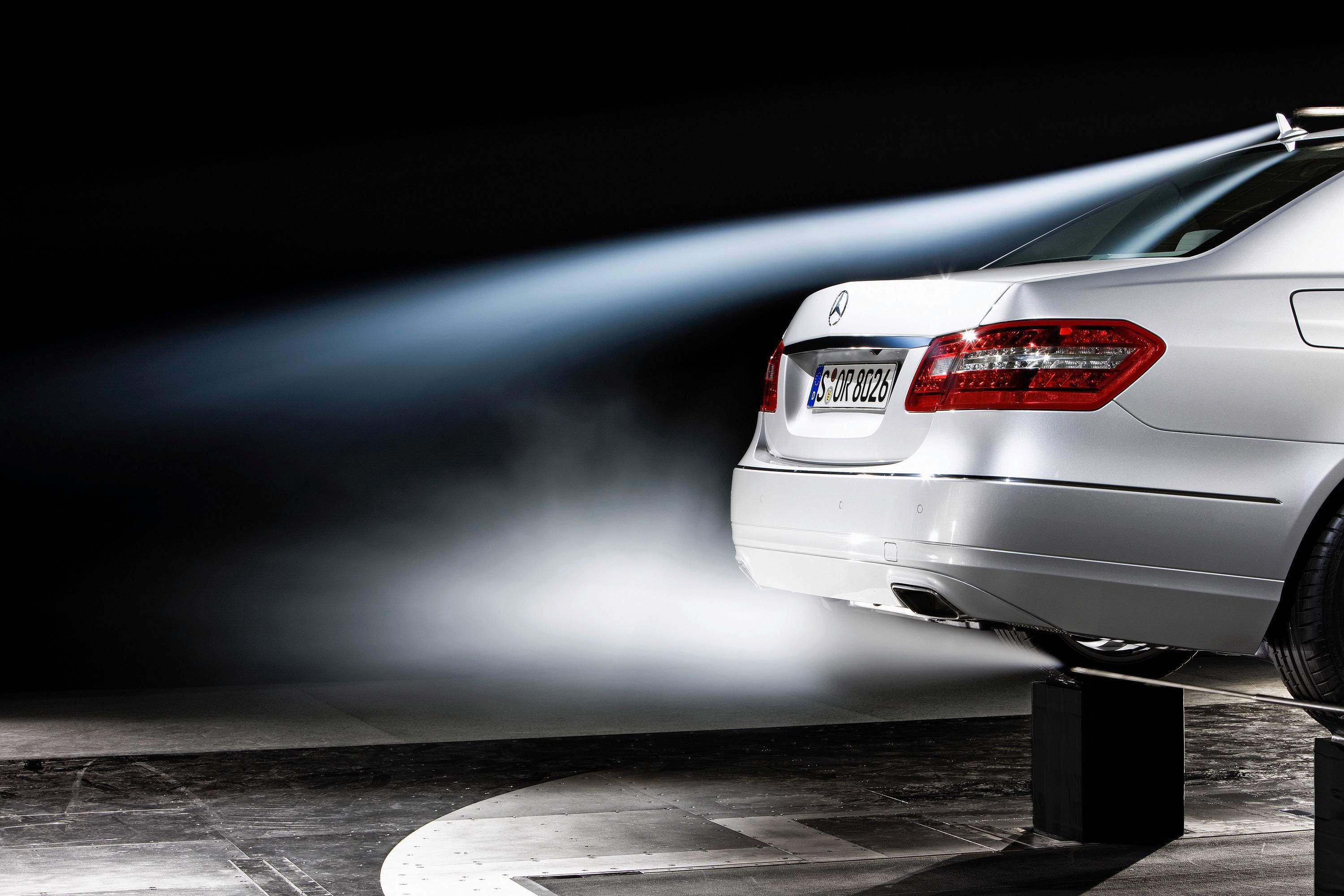 The standard-fit power steering system is based on an intelligent solution designed to prevent energy losses and, therefore, cut fuel consumption. Unlike conventional steering systems, in which the power steering pumps operate at full power on a permanent basis, the power steering pump in the new E-Class features an additional valve for on-demand control. This means that, when the driver does not require steering assistance – when driving straight ahead, for example – an electronic control unit minimises the operating power of the power steering pump. The advantage of this system is that the engine does not need to provide energy (or only needs to supply very little energy) to drive the pump. However, the delivery rate of the power steering pump is increased again spontaneously when the driver moves the steering wheel. In this instance too, the system operates on-demand, adjusting itself in line with the current steering angle, engine speed and vehicle speed.
The same basic principle applies to the automatic climate control system in the new E 200 CDI BlueEFFICIENCY model: if the air conditioning system does not require any cooling power, the air-conditioning compressor is disengaged from the engine's belt drive.
In order to ensure on-demand energy management, Mercedes-Benz uses controlled fuel pumps in the petrol engines for the E-Class (the diesel engines will also incorporate this feature from autumn 2009 onwards). In this setup, the engine control unit only calls for the maximum pump output during full-load operation. In other driving situations, the pump adapts the delivery volume and pressure in line with requirements, resulting in a fuel saving of 0.15 litres per 100 kilometres (NEDC).
Energy recuperation: power from braking energy
 Each time the car is braked, kinetic energy is converted into heat and therefore goes to waste. This is why the E-Class incorporates efficient alternator management. This means that, whenever the engine is coasting and whenever the vehicle is braked, the voltage level in the vehicle electrical system is increased and the battery is charged. This increased alternator load assists the driver with braking and also helps to recuperate part of the braking energy, which is converted into electrical energy. This is why the experts refer to recuperation. Conversely, the alternator switches to no-load operation in certain situations – for example when accelerating or when the battery charge level is high – thus relieving the strain on the drive system. This process saves fuel to the tune of around 0.1 litres per 100 kilometres on paper (NEDC) and up to 0.2 litres per 100 kilometres when on the road in city traffic, where coasting and braking are more frequent than in the NEDC test cycle.
Energy saving: engine switched off at traffic lights and tips for economical driving displayed in the cockpit
To reduce fuel consumption when the engine is idling, Mercedes-Benz has developed the ECO start/stop function for the new E 200 CGIBlueEFFICIENCY model: the direct-injection petrol engine is switched off as soon as the driver applies the brakes, shifts the manual transmission to neutral and releases the clutch; however, the engine is restarted as soon as the driver depresses the clutch. What's more, thanks to direct-start technology, the Mercedes-Benz-developed system operates spontaneously and with little noise: fuel is injected directly and ignited during the piston's compression stroke, allowing the engine to be started with only very little assistance from the starter. The E 200 CGI BlueEFFICIENCY model is only started conventionally – with longer starter assistance and fuel injection during the suction stroke – in operating ranges that do not allow an automatic start function to be used, for example when the engine is cold. The tyres also help to minimise fuel consumption. The E-Class is fitted with newly developed tyres whose rolling resistance has been reduced by up to 17 percent without impairing their outstanding handling and braking characteristics.
Finally, drivers can also help to save fuel, aided in the new E-Class by a display in the centre of the speedometer, which indicates the current fuel consumption – in litres per 100 kilometres. Drivers are therefore aware of whether they are driving fuel-efficiently or not. In addition to showing this information, the display also advises the driver when to change up a gear. Mercedes-Benz "ECO driver training" courses have shown that adopting an economical and energy-efficient driving style alone can cut fuel consumption by up to 15 percent on average.