
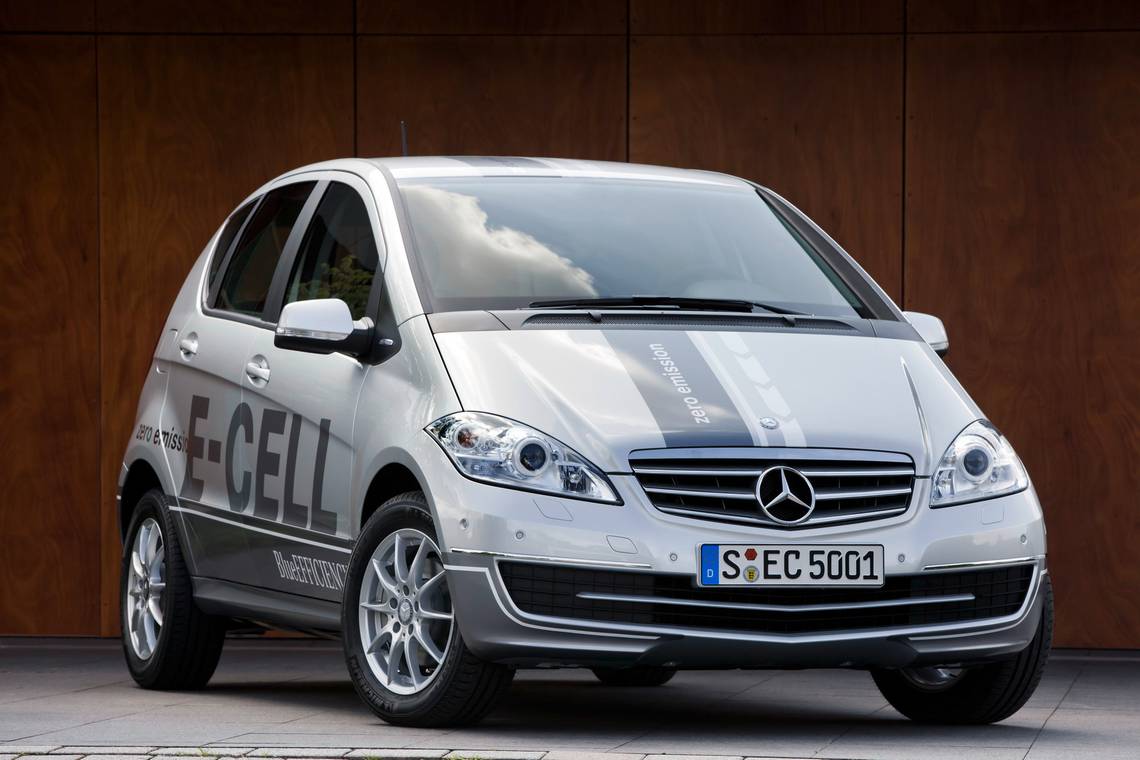
Almost a year after the B-Class F-Cell reveal, Mercedes is now on to their 2011 A-Class E-Cell production model. The electric vehicle will only be produced in a limited 500 units that will be leased to select customers in several European countries, including Germany, France, and the Netherlands.
The Mercedes->ke187 A-Class->ke452 E-Cell features a permanent-field synchronous unit developing a peak output of 70 kW (95 hp), a continuous power rating of 50 kW (68 hp), and a high maximum torque of 290 Nm. The sprint from 0 to 60 km/h is made in 5.5 seconds, while top speed is limited to 150 km/h. Two high performance lithium batteries will provide enough power for the family electric car to travel 100 km (124mph) while also providing a quiet, emission free ride.
The list of standard equipment will include bi-xenon headlamps, COMAND APS, an active park assist for automatic parking, and the THERMOTRONIC automatic climate control system.
Press release after the jump.
2011 Mercedes-Benz A-Class E-CELL


- Make: Array
- Model: 2011 Mercedes-Benz A-Class E-CELL
- [do not use] Vehicle Model: Array
Pess release
Following the B‑Class F‑CELL fuel-cell car, Mercedes‑Benz now introduces the new A-Class E-CELL as its second electric car built in series-production conditions. The five-seater with battery-powered electric drive meets all the requirements for a family car for everyday use. It is based on the five-door version of the current A‑Class, and features a generously dimensioned interior and luggage compartment for maximum versatility. No compromises have been necessary in terms of space and variability, with compact storage batteries that are located extremely well-protected and in a space-saving way in the vehicle underbase. The car’s two high-efficiency lithium-ion batteries provide a range of over 200 km (NEDC). The car is powered by a quiet, locally emission-free electric drive with peak output of 70 kW (95 hp), developing a high torque of 290 Nm. A total production run of 500 A‑Class E‑CELL cars will be built at Rastatt from autumn 2010. The vehicles will be leased to selected customers in several European countries, including Germany, France and the Netherlands.
Five doors, five seats, the same luggage compartment volume as in the internal combustion engine A‑Class (435 to 1370 litres), a 350‑kilogram payload measured as per the relevant EC directive and high variability of the interior and luggage compartment: this is what makes the new A-Class E-CELL a family car for everyday use. The sophisticated sandwich structure provides both an extremely comfortable in-car environment and maximum protection for passengers and components in the event of a collision.
“Over our almost 125-year history, we have accumulated extensive experience and knowhow in the area of electric vehicles, including both battery and fuel-cell. This knowhow has already provided the basis for getting two electric cars for everyday use onto the road: the smart fortwo electric drive, and the B‑Class F‑CELL. The story now continues with our third electric car, the A‑Class E‑CELL., whose start of production is scheduled for autumn this year. The new car is a battery-driven electric Mercedes that enlarges our portfolio and offers our customers the kind of driving pleasure, comfort and safety that they have come to expect”, says Dr Thomas Weber, the Daimler AG Board of Management member responsible for Group Research and Development Mercedes-Benz Cars.
Driving pleasure with zero emissions
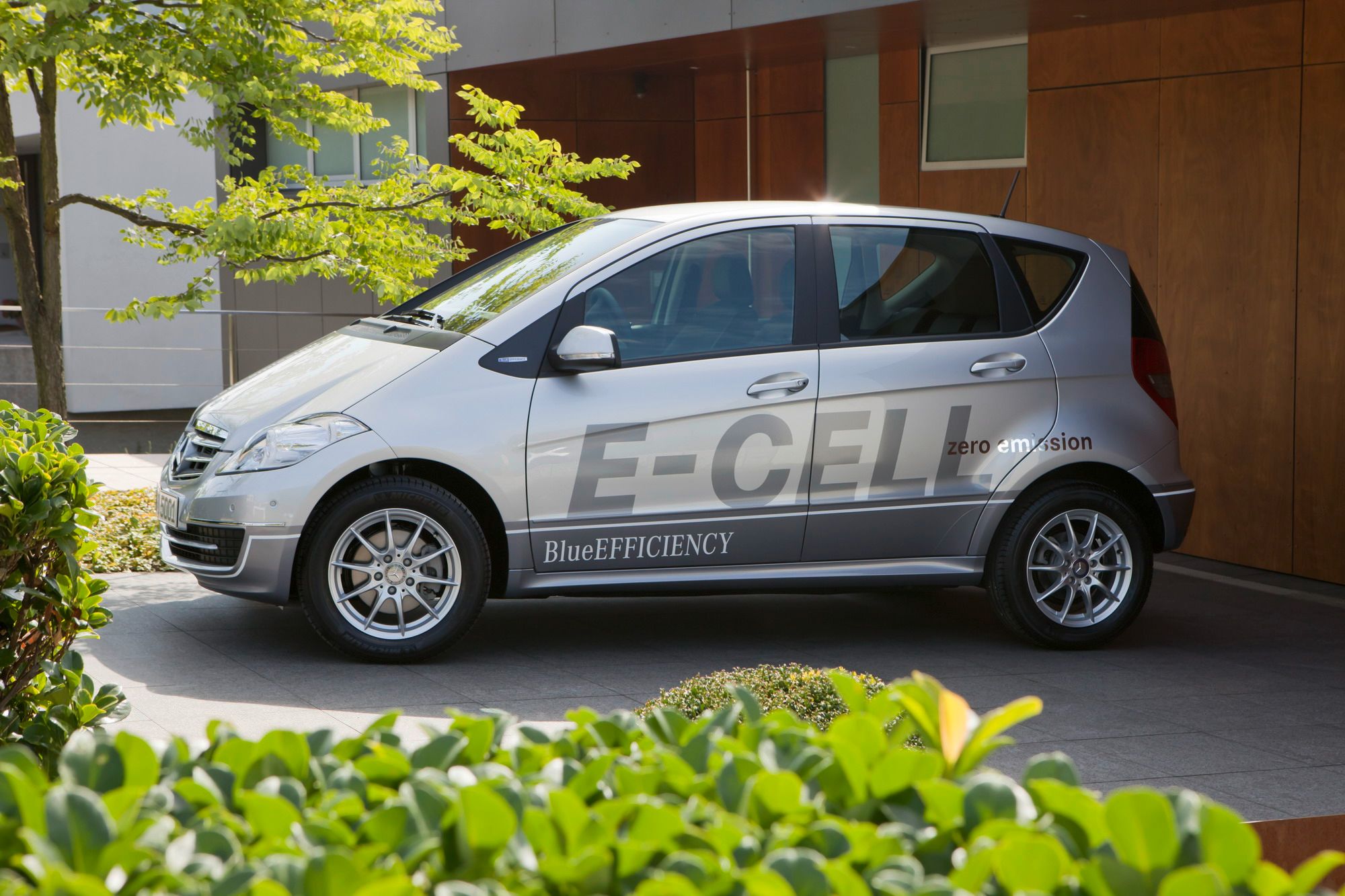 Along with exemplary safety, optimum comfort and a high level of suitability for daily use, the A‑Class E‑CELL also offers other strengths not always to be found in contemporary electric cars: agility and driving pleasure. The features are based on a low centre of gravity, partly the result of the installation of the batteries under the passenger compartment, in the “sandwich” structure of the vehicle floor. This gives the car excellent road-holding and sprightly handling characteristics – qualities that clearly set the A‑Class E‑CELL apart from other electric cars, which often have heavy and bulky storage batteries located in the boot or by the rear seat. Another benefit from this installation location is the provision of best-possible protection against the intrusion of structural components in the event of a head-on collision or impact from the rear. This is because the batteries are located outside the vehicle body’s deformation zones. The high-stability characteristics of the sandwich structure of the floor also provide outstanding protection for both battery and passengers in a lateral collision scenario.
High-performance electric drive with long range
The electric drive of the A‑Class E‑CELL is a permanent-field synchronous unit developing a peak output of 70 kW (95 hp), a continuous power rating of 50 kW (68 hp) and a high maximum torque of 290 Nm, as expected for an electric drive, available right from the first revolution. This makes the A‑Class E‑CELL an outstandingly assured and dynamic performer on the road, taking just 5.5 seconds to accelerate from zero to 60 km/h. A kick-down function is used to deliver maximum acceleration, according to the current charge level and battery temperature. Maximum speed is electronically set at 150 km/h.
The energy storage units are two high-performance lithium-ion batteries based on high-voltage technology. The advantages of lithium-ion batteries include their compact dimensions and significantly higher efficiency in comparison with nickel-metal-hydride (NiMH) batteries. They offer 30 percent more energy density than NiMH technology, and 50 percent more power density. Other benefits include high charging efficiency and a long service life. The combined energy capacity of the two lithium-ion batteries is a total of 36 kWh. With fully charged batteries, the A‑Class E‑CELL has a range of over 200 kilometres (NEDC).
Efficient battery cooling system
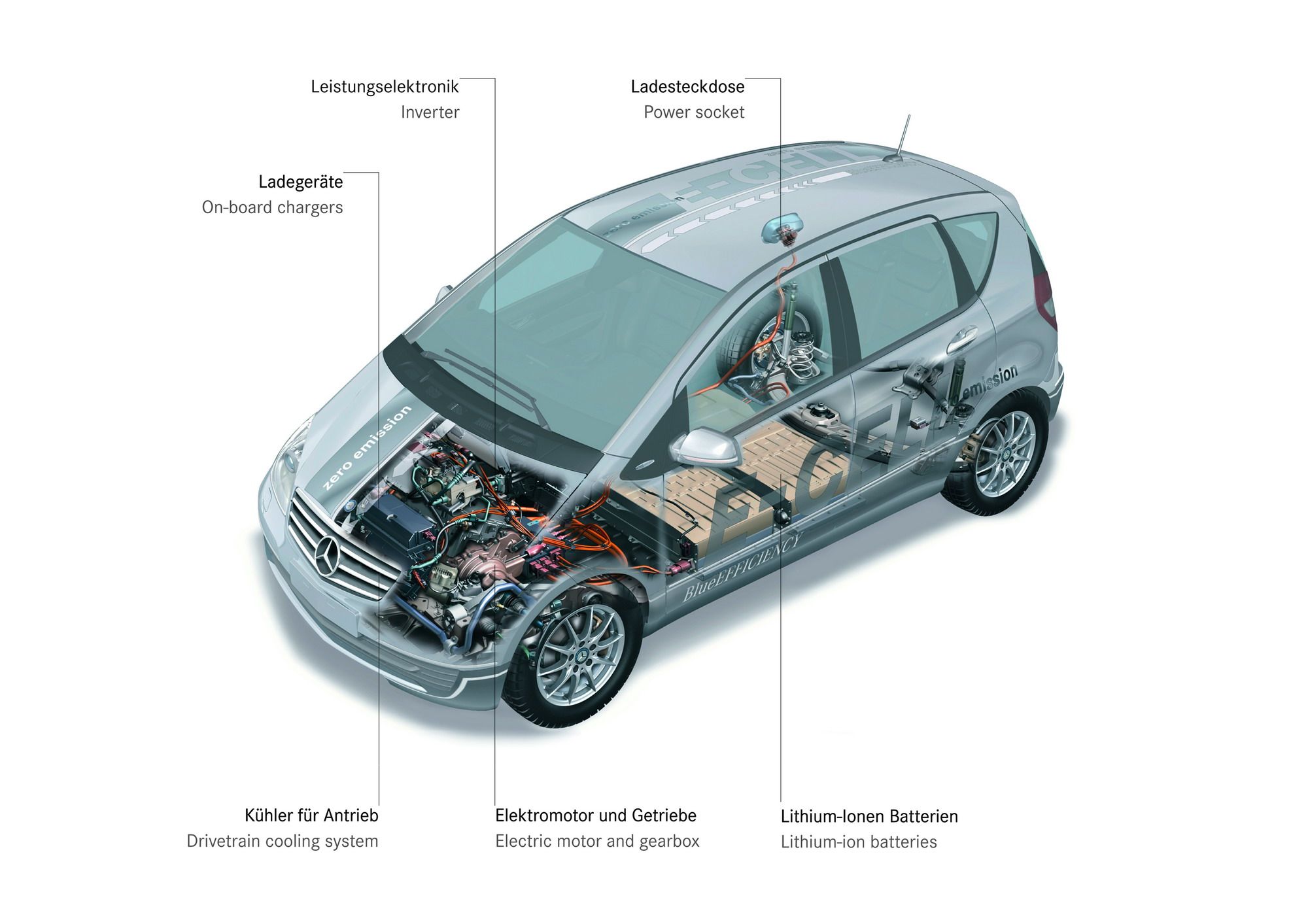 A special thermomanagement system keeps the high-voltage batteries cooled to within an optimum temperature window. The cooling system is based on a low-temperature cooling circuit. Fluid cooling with a water-glycol mixture ensures a stable operating temperature supporting the high degree of efficiency and the longevity of the energy storage. In very high ambient temperature conditions, the battery cooling system is boosted with the coolant circuit of the air-conditioning system. The electrical drive system and two on-board chargers are cooled with a high-temperature cooling circuit. This circuit keeps the units working at optimum operating temperatures, with maximum power delivery from the drive system. The car’s power electronics supply the 12-volt vehicle electrical system via a DC/DC converter with electric current from the high-voltage system. The electronics system also controls other functions such as the heating and air-conditioning systems in order to minimise the load placed on the battery for this purpose.
Flexible charging options
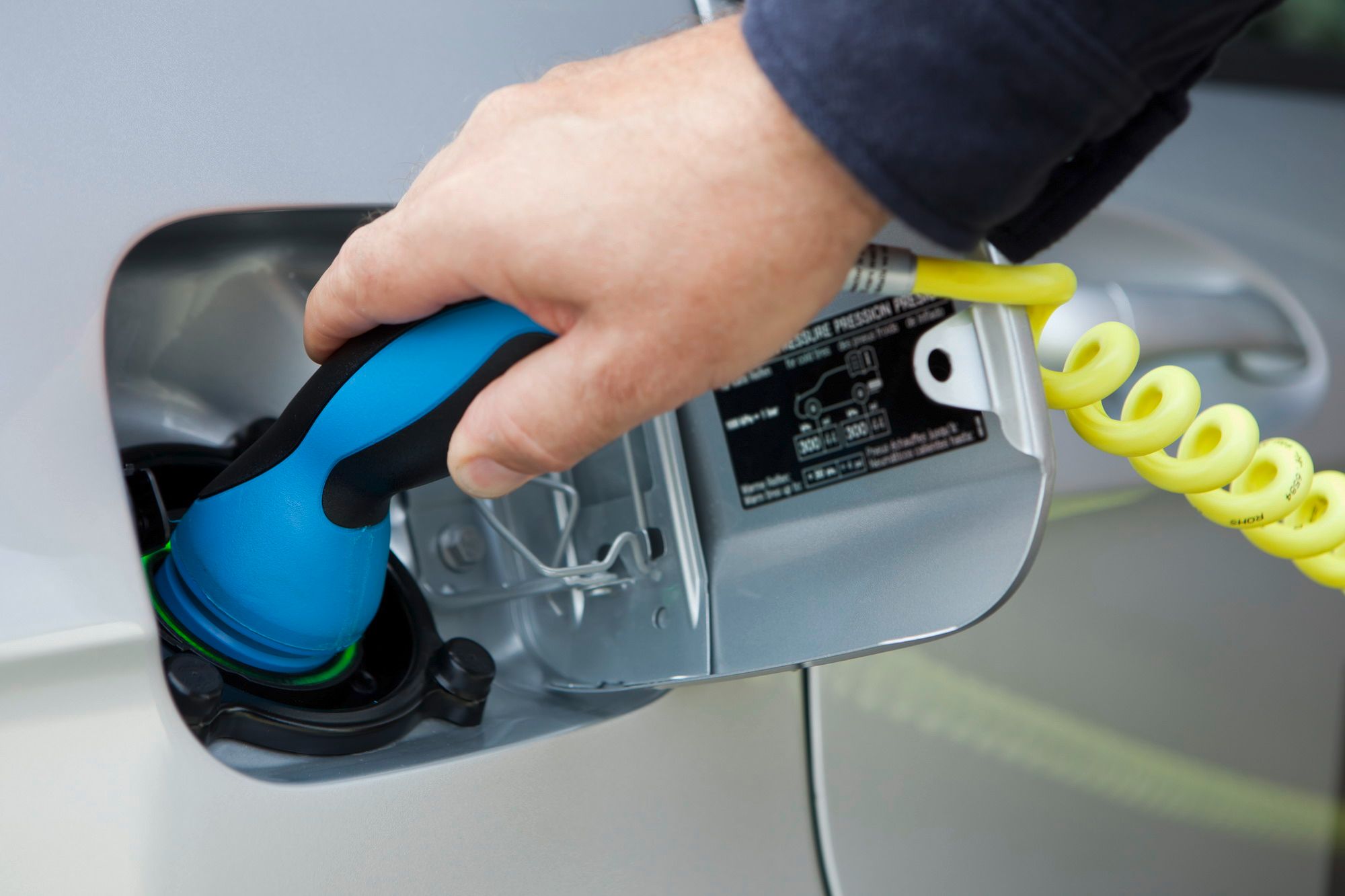
The batteries of the A‑Class E‑CELL can be either replenished at public charging points or plugged into an ordinary household power socket. A range of charging options are available, including single-phase 230-volt sockets, three-phase sockets in a household wall-box, and public recharging points. Using a single-phase 230-volt network, it takes around eight hours’ charging time to accumulate the energy required for a range of 100 km (NEDC). This time is reduced to just three hours in the case of charging from a wall-box or at a roadside recharging point.
Daimler and a number of other European automakers and energy utilities have agreed on standardised charging plugs and sockets, with an ultimate aim of worldwide standardisation. This makes the technology more customer-friendly, and is seen as a key prerequisite for the rapid spread of electric mobility.
Intelligent charging management
 Like the smart fortwo electric drive in its category, the A‑Class E‑CELL is the world’s first vehicle in its class to be fitted with an intelligent charging management system based on “SmartCharge Communication”. Via the vehicle electronics system, all relevant information – such as the electricity supply contract identification data – is exchanged with the charging point. Benefits include a convenient, simple and totally reliable billing system.
Other intelligent features of the car include pre-start climate control. While the A‑Class E‑CELL batteries are being charged at home or at a roadside charging point, the interior can be pre-heated or cooled to a temperature set by the driver. Another function enables the driver to monitor charging progress and therefore the present range available, via the internet or a smartphone, for example.
The A‑Class E‑CELL electronics also provide for proactive control of the charging operation. So if the electric car is parked for a long period, recharging can be set to take place at times when electricity is cheaper, for example during the night. The intelligent interface in the A‑Class E‑CELL provides a range of billing, control and monitoring functions, making electric mobility convenient and safe, and therefore very customer-friendly. The vehicle is automatically immobilised on connection of the charging cable to the socket, preventing any possibility of driving off by mistake while charging is in progress. This makes the recharging operation even safer and more convenient for the user.
“Everything under control” when out on the road
To make vehicle handling and control as easy, safe and transparent as possible for the driver, the A‑Class E‑CELL has its own control and display concept specifically designed for the requirements of an electric car. The multifunction display in the vehicle shows the battery charge status, trip data such as kilometres driven, travelling time, average speed and average fuel consumption, along with the remaining range and residual electrical energy capacity (SoC = state of charge).
Another detail specific to the system is a display of the currently available drive power. Meanwhile, the rev counter normally to be found on the instrument panel is replaced with an indicator showing the instantaneous drive power demand or recovery power. Green, white and red-coloured segments show whether the drive system is currently operating in charge, economy or boost mode.
High-quality equipment typical for Mercedes
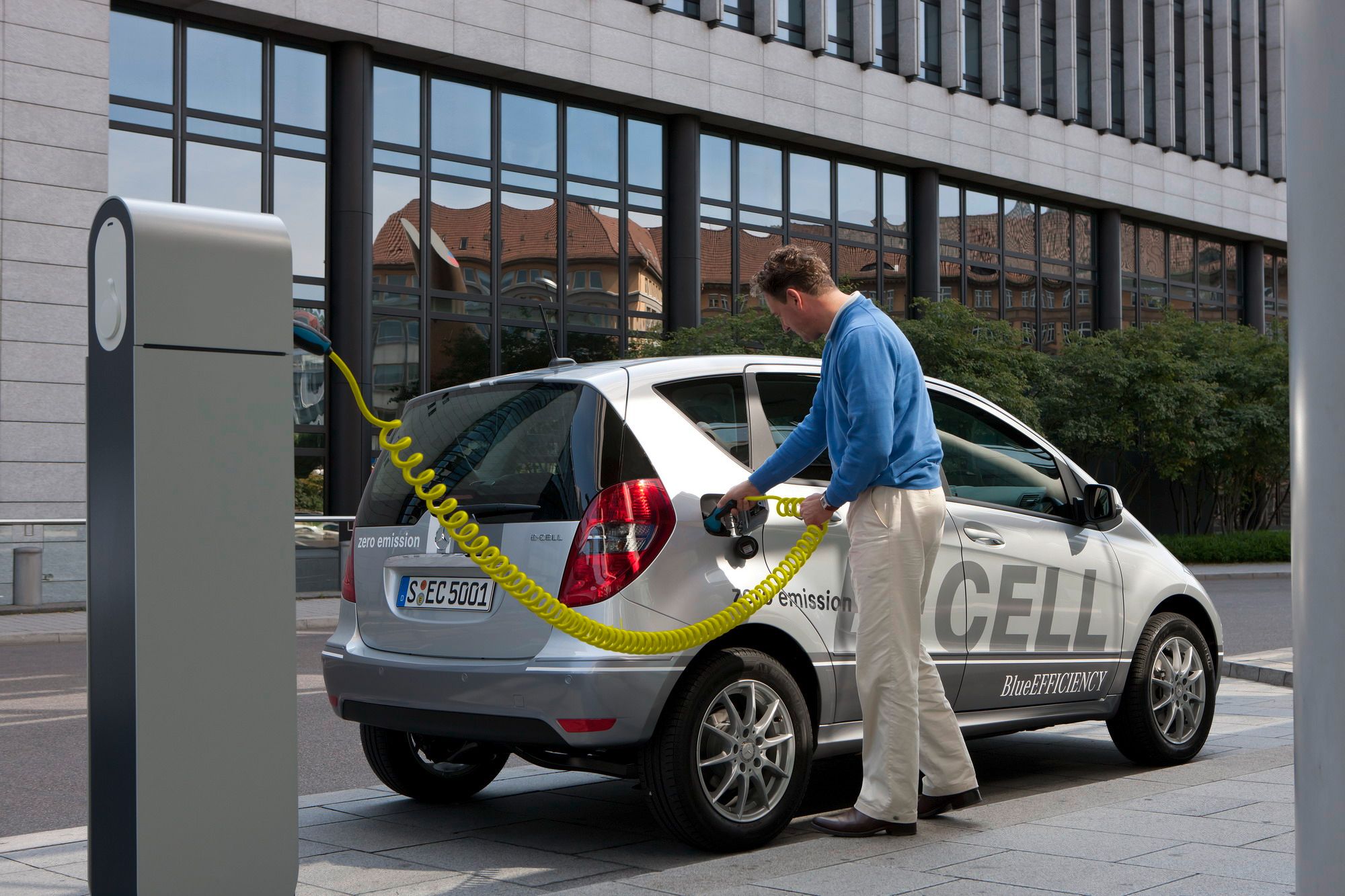 The new A‑Class E‑CELL also has plenty to offer in terms of Mercedes-quality equipment. Standard highlights in the premium quality “AVANTGARDE” version of this innovative electric car include bi-xenon headlamps, COMAND APS, an active park assist for automatic parking and the THERMOTRONIC automatic climate control system. A special additional function is the ability to preset the interior climate during charging, i.e. raising or lowering the compartment temperature according to the weather conditions. The car also has a comprehensive range of safety features, including rear window bags and sidebags, and sophisticated seating and lighting packages.
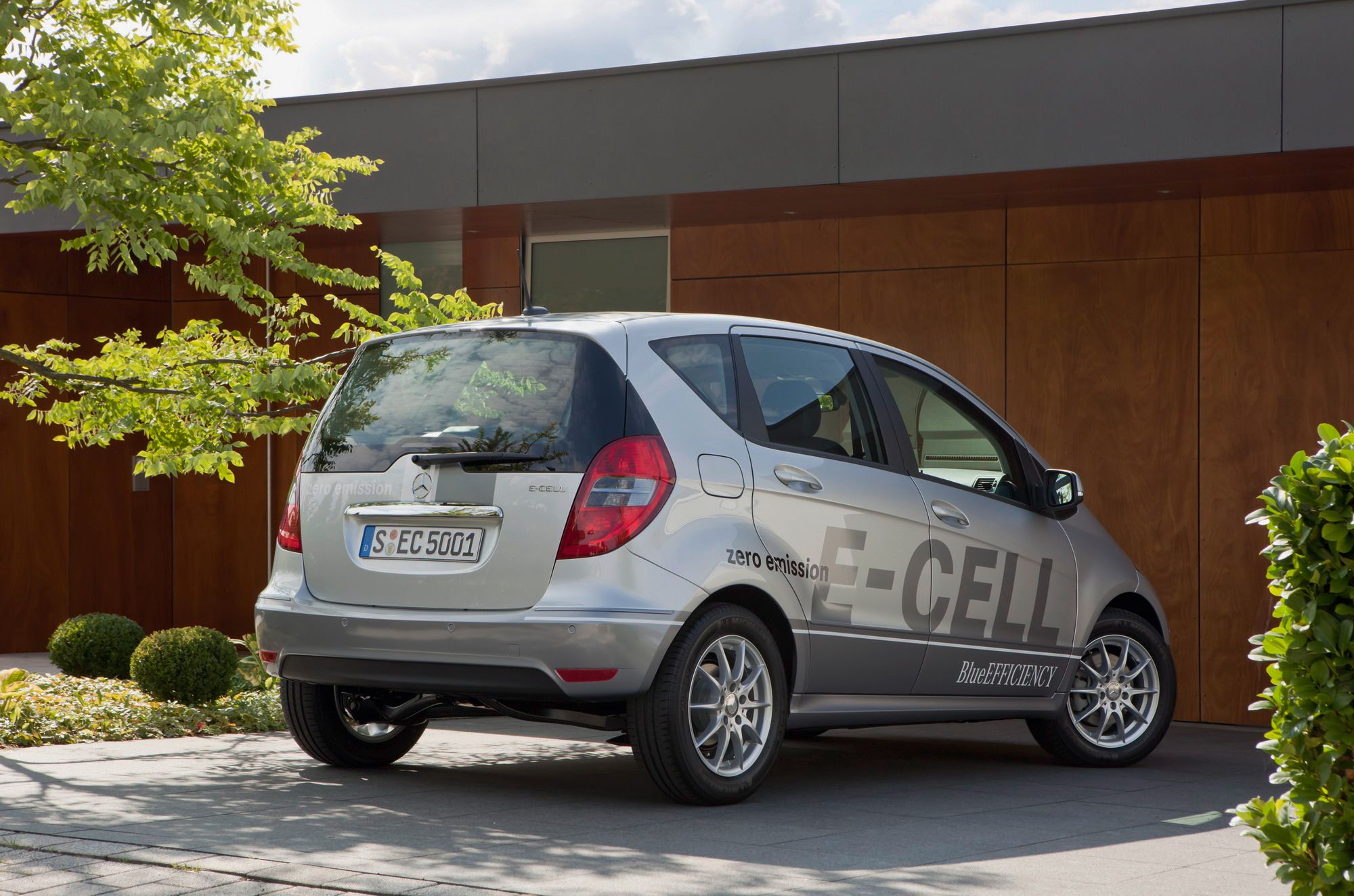
External features of this battery-powered electric car include the standard polar silver painted body and an “E-CELL” sign in silver lettering on the boot.
Highest safety standards
Mercedes‑Benz applies the same high safety standards in the A‑Class E‑CELL as in all its other series-produced vehicles. The electric drive system has demonstrated readiness for series production in extensive practical testing programs. Key components have also been proven in Mercedes‑Benz fuel-cell vehicles, for example, allowing Mercedes engineers to draw on the experience gained from more than 4.5 million test kilometres in everyday use. The integrated safety concept reflects the specific characteristics of the vehicle’s innovative drive system. The lithium-ion batteries and high-voltage system of the A‑Class E‑CELL are protected with a comprehensive safety concept:
- All cables are clearly colour-coded, and safety warnings are placed on high-voltage components.
- Generously dimensioned insulators and special plugs provide full contact protection for the entire system.
- An electronic controller continuously monitors safety requirements and immediately alerts the driver to any malfunctions in the high-voltage system.
- All high-voltage components are connected in an electric loop. This means that the high-voltage system is automatically completely disconnected in the event of a malfunction or an accident.
- The high-voltage system is also automatically completely disconnected when the ignition switch is placed in the “off” position, or in the event of possible faults.
- The system is continuously monitored for short circuits.
- An automatic drive disabler activated when the charging cable is connected prevents any possibility of the car being driven off by mistake.
Modular system for electric cars
 In line with the strategy used for hybrid development, Mercedes engineers have also developed a modular system for electric vehicles with battery and fuel-cell. The benefits include the efficient use of shared parts in all the brand’s electric vehicles. All the key components of electric cars are appropriate for a modular approach – for example, the electric drive of the A‑Class E‑CELL is also used in the B‑Class F‑CELL. Both energy storage units in the electric A‑Class are the same as the battery in the smart fortwo electric drive.