
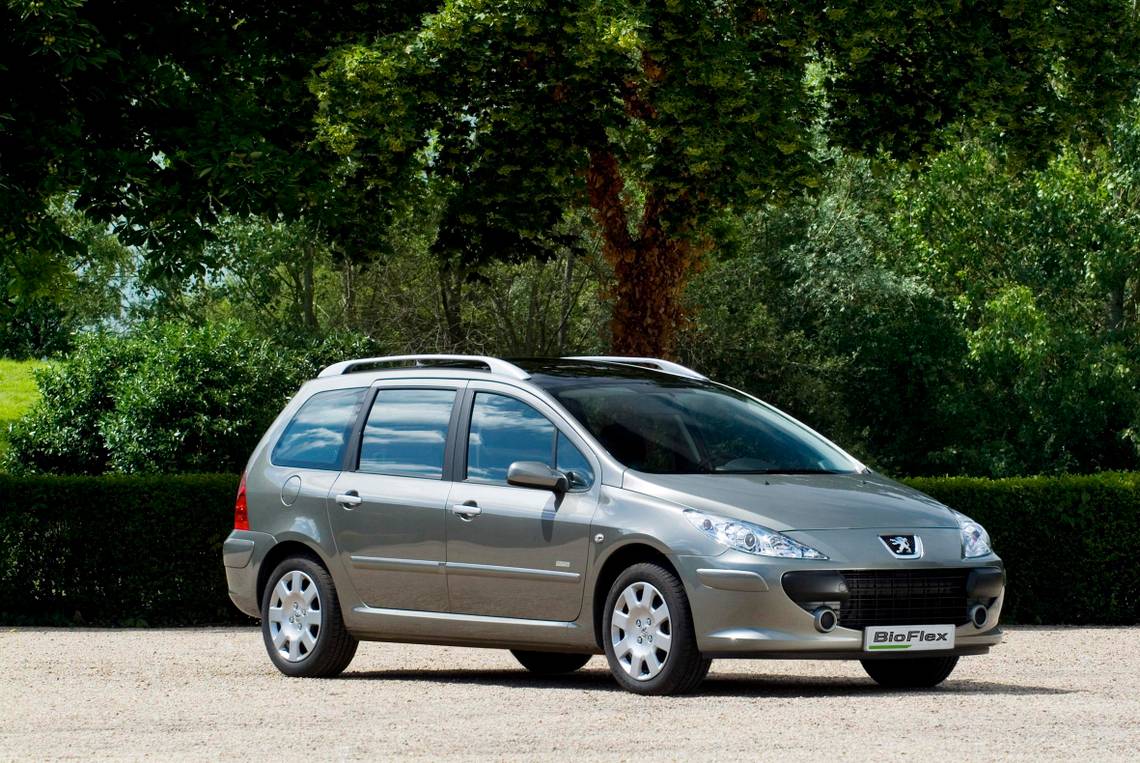
France, and also Europe, have undertaken to develop the biofuel option with ambitious objectives in the short term: to encourage the use of biofuels as from now, in order to reduce the proportion of fossil fuels used. To achieve this, a new fuel called superethanol (E85), consisting of a mixture of 15 % lead-free petrol and 85 % agricultural ethanol, is progressively being made available at service stations all over France. The distribution of this fuel at competitive prices for customers is now possible thanks to exemption from a portion of the taxes on petrol.
peugeot-307-sw-bioflex
- Make: Array
- Model: peugeot-307-sw-bioflex
2007 Peugeot 307 SW BioFlex


- Make: Array
- Model: 2007 Peugeot 307 SW BioFlex
- [do not use] Vehicle Model: Array
Bit this new fuel is not compatible with standard petrol engines. It attacks certain materials and its specific physico-chemical characteristics require changes to be made to the fuel system and the engine injection system, among other things. Only vehicles that have been specially adapted can use superethanol. These vehicles can run on petrol, superethanol or any combination of the two (petrol / superethanol).
Based on the know-how it has acquired in Brazil, Peugeot will be marketing vehicles that run on superethanol in Sweden, the Netherlands and France as from September 2007; these vehicles will be called BioFlex. For France, the first models to be proposed are the 307 SW and Estate 1.6 l BioFlex 110, featuring the distinctive BioFlex logo specific to this technology.

Orders will be taken in France as from July, for delivery during the course of September. Despite the extra cost of the technical adaptation, Peugeot is doing everything to promote this technology by proposing the Comfort Pack versions of the 307 SW and Estate 1.6 l BioFlex 110 for the same price as the corresponding petrol versions, i.e. € 20,400 and € 19,500, respectively.
Why choose a BioFlex engine?
An ecological choice The reduced CO2 emissions obtained by using superethanol are based on the balance obtained over the entire cycle, from production to combustion (principle known as "from well/field to wheel"). According to some experts, the maximum total gain in CO2 obtained through the use of E85 could amount to 70 %.
The production of agricultural ethanol results in a gain in CO2 that corresponds to the amount absorbed by the plants during their growth (photosynthesis process). The gain obtained through the production of ethanol is therefore significantly dependent on the plants used, on their production, and on the method of transformation.
In itself, the combustion of E85 fuel in the engine emits approximately 5 % less CO2 than that of lead-free petrol, and in the case of the 307 BioFlex working on a combined cycle, this corresponds to 169 g of CO2 per km as opposed to 178 g in the case of petrol.

Tax advantages
In France, both for the general public and for professional users, the cost of vehicle registration papers could be reduced by 50 %, or could even be completely free of charge in some regions. Professional users also have the advantage of exceptional amortisation conditions, total exemption from TVS (Corporate Vehicle Tax) for 2 years, and VAT that can be claimed back to the extent of 80 % on the E85 fuel consumed.
Other advantages
The first advantage for the customer is freedom of choice. As Peugeot is eager to promote biofuels, there will be no additional cost for the customer to cover the extra outlay for technical adaptation: the 307 BioFlex models will be available at the same price as the corresponding petrol versions. The tax reduction on superethanol has made it possible to obtain a price at the pump of approximately € 0,80 per litre, which compensates the increase in consumption of approximately 35 % due to the fact that ethanol has a lower energy value than petrol.
These engines adapt themselves automatically to all mixtures of lead-free petrol and superethanol. So the customer can run the car only on lead-free petrol if he/she wishes, in which case the 307 BioFlex will not consume any more than the equivalent 307 equipped with the standard petrol engine. The final advantage is a slight improvement in performance obtained with E85 compared to petrol, estimated at + 4 % torque and + 2.5 % power.
Proven technology
Since March 2005, in Brazil, Peugeot has been selling the 206 1.6 l capable of running on petrol, on "pure" ethanol (E100), or on any combination of the two. The original modifications made to the TU5JP4 engine, to make it compatible with ethanol, mainly concerned the injectors, the spark plugs, the valves, the throttle butterfly valve control unit, the piston rings and the supply hoses. Since that time, in Brazil, this technology has been extended to the 1.4 l engine for the 206 and also to the saloon versions of the 307 with 1.6 l engines, and approximately 60,000 vehicles have been sold to date.
The 307 Estate and SW 1.6 l BioFlex 110 marketed in Europe use the TU5JP4 engine of the Brazilian 206 and 307, modified to meet the Euro IV standard applicable in Europe.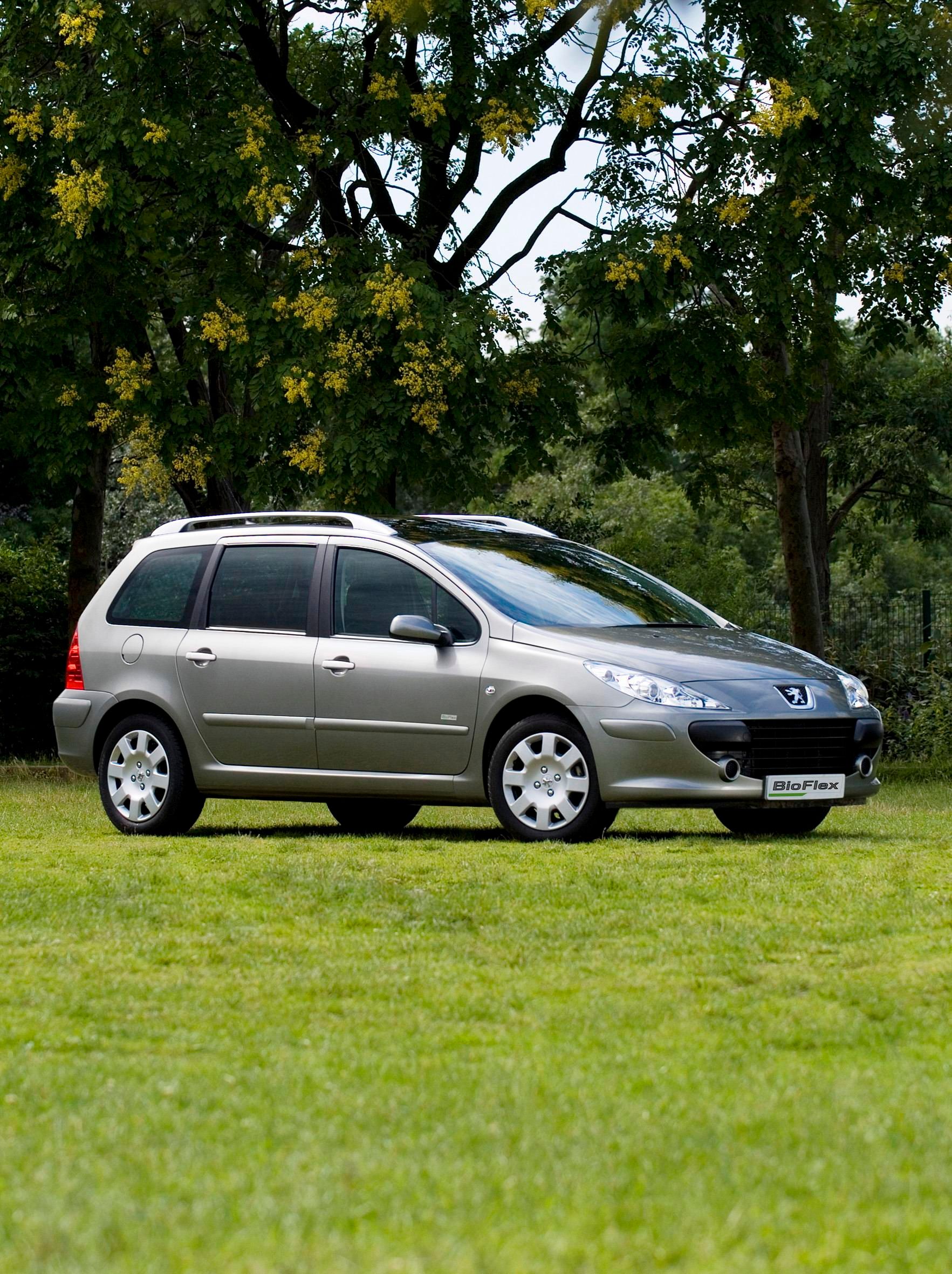 With a displacement of 1,587 cc, this engine develops a maximum power of 80 to 82 kW (110 to 112 hp EEC) at 5,800 rpm, and a maximum torque of 147 to 153 N.m at 4,000 rpm depending on the petrol / ethanol mixture used as fuel. This engine is coupled to a five-speed manual gearbox. This means that 307 BioFlex vehicles running on lead-free petrol obtain identical results in terms of both performance and fuel consumption, as compared to the standard petrol engine. When running on superethanol, 307 BioFlex vehicles are slightly more powerful, with slightly improved standing-start and passing acceleration figures.
In addition to the initial changes to the engine, modifications specific to European 307 BioFlex vehicles have been made to the functions that are directly connected with fuel. The digital engine control unit specific to 307 BioFlex vehicles manages the fuel supply according to the fuel composition measured by the lambda (EGO) sensor. The fuel tank is identical, but the minimum fuel level warning software has been changed in order to take the type of fuel used into account, in consideration of the additional fuel consumption due to the presence of ethanol results, which results in reduced autonomy.