
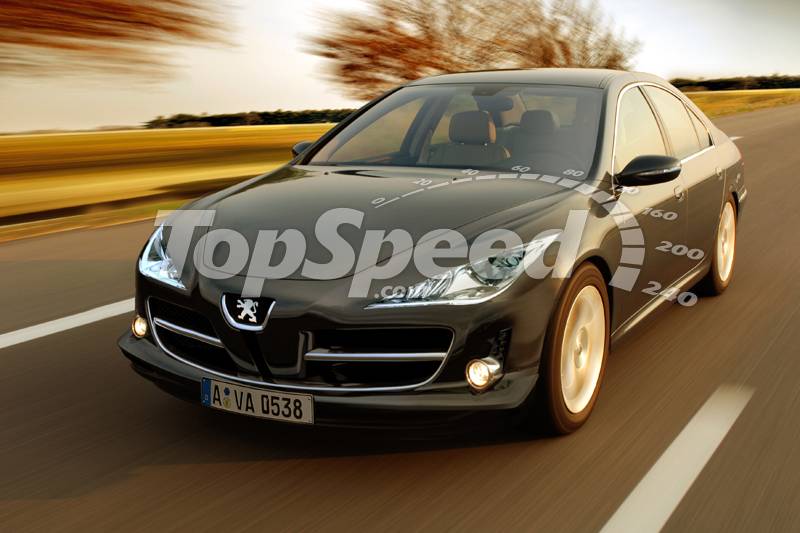
Peugeot is working on a replacement for the current 607. Peugeot will inspire the 608's design from the 908RC concept car's shown at 2006 Paris Auto Show. The frontal shape of the 908 should give you some ideas of the new Peugeot 608. The 608 will be developed from the Citroen C6 platform. It will debut at this year's Paris Motor Show.
The 607 is suffering from a deficit of notoriety and also from a lack of top-of-the-range motorizations. The new top-of-the-range from the french carmaker will use a lengthened platform of 407 and should also have the same traveling trains.

The 608 will be slightly longer than the 607, but it will remain under the 5 m length bar. The design will be an evolution of the 607 following several themes presented in recent concept cars. The front design of the next 608 is not accurate but the side profile is representative of a subtle approximation to the 4-door coupe class pioneered by Mercedes in the CLS model.
The gasoline versions will be animated by a 2.2 engine with 16 valves and 163bhp and the V6 with 215bhp. A revised version of the 2.7 HDi V6 will also make an appearance but with power boosted above the current 200bhp as well as an all new petrol V6. You can also expect an AWD model. The diesel engines will be: a 2.2 HDI biturbo delivering 170 hp and a V6 HDI with an output of 207 hp. There is also a possibility that Peugeot will add a V8 engine under the hood of this car. The car will feature a six-speed automatic transmission.
2008 Peugeot 608


- Make: Array
- Model: 2008 Peugeot 608
- Engine/Motor: V8
- Horsepower: 420@7800
- Torque: 317@4500-6000
- [do not use] Vehicle Model: Array
Interior design will be inspired by current Peugeot designs, namely the 407: simplicity in the general shape and attention to detail in order to transmit a quality appearance. The current 607 is already a very good effort and Peugeot will be able to pull-off a quality interior.
Design-wise it will indeed be very influenced by the CLS. Peugeot know their stuff and during the last 10 years the learned that design is the most important thing for the success of a car. They have had home-runs in many of their designs, leading to a great sales success: 206, 307, 407 are good examples. The also favor a conventional and elegant 4-door design for their top of the range and watching the failure of Renault VelSatis certainly proved how much Peugeot is right about their choices.
-----
History
Peugeot 604 (1975–1985)
The Peugeot 604 was an executive car produced by the French manufacturer Peugeot from 1975 to 1985. 153,252 examples of the 604 were sold during its 10-year production life.
The car was designed by Pininfarina and was unveiled at the Geneva Motor Show in March 1975, with sales beginning in September of that year. The car was based on the Peugeot 504, using its doors, and mostly powered by the then-new 145 horsepower 2.7 V6 PRV engine, developed in conjunction with Renault and Volvo, the car was Peugeot's first entry into the large luxury sedan market for 40 years.

The 604 was a commercial failure. Contemporary journalists attributed this to a variety of reasons, such as the unambitious styling, the lack of technical innovation, modest performance, and a reputation for problems with rust.
Peugeot 605 (1989–1999)
The Peugeot 605 was an executive car produced by the French manufacturer Peugeot between 1989 and 1999. The 605 was based on the Citroen XM, and was successor to the unsuccessful Peugeot 604 which went out of production some ears earlier. The popular Peugeot 505 model was thus replaced by two cars - the large family car 405, and the executive car 605.

The 605 features a luxurious interior, a smooth ride, and exceptional handling. But the car was to similar in design with the smaller Peugeot 405 to command a price premium, while its dashboard also drew criticism for its uninspired design. Also 605 suffered from grave build quality issues that resulted in a large number of breakdowns or malfunctions, which severely damaged the car's reputation.
The car was launched with an option of four petrol engines and three diesel engines. The car delivered from 120 hp to 200 hp and had a top speed of 146 mph.
Peugeot 607 (1999 - present)
The 607 was launched in 1999, to replace the 605. It used its predecessor's chassis but had an all-new, more modern exterior design. The engine range (2.2 and 3.0 petrol, and 2.2 diesel) was completely new. Equipment levels were also high, with all models getting air conditioning, CD player, electric windows, airbags, anti-lock braking system and central locking as standard.

The suspension features electronically variable damping, with nine different settings, or the suspension can be locked in Sports mode.
Under the bonnet is a high-tech quad cam, all-alloy 3.0 litre V6 engine with variable intake timing. This engine produces 152 kW, which happens to be the same figure as produced by Holden’s 3.8 litre V6 engine.
The 607 was restyled in 2004, most notable modifications being the new front end and the 2.7 HDi V6 engine engine, capable of more than 200 bhp, mated to a new 6-speed automatic gearbox, which is now also available on the V6 petrol model.
-----
Competitors
2007 Citroen C6
The latest addition to a historic line of great Citroëns, with a stunning look in keeping with the Marque’s reputation for style, the C6 takes the grand tourer concept and incorporates the latest cutting-edge technology.
The C6 adds the crowning touch to a wider and more complete Citroën range, extending from the C1 to the C8. The presence, styling and executive features of the C6 clearly identify it as an executive model. It is a car inspired by great Citroëns of the past – the DS, CX and SM – whose design and innovative technologies have helped the Marque to establish a strong heritage in large cars.

The C6 combines high levels of passive safety for passengers (active headrests and nine airbags amongst other features) and pedestrians (active bonnet system) with impeccable road manners based on new running gear with active suspension and electronically controlled springing and damping.
The top-of-the-range positioning of the Citroën C6 is reflected by its engine line-up. Two V6 engines, one petrol and one diesel, place the emphasis on driving pleasure and refinement. The 3-litre petrol engine develops 215 bhp DIN (155 kW), while the new 2.7 litre HDi diesel engine develops 208 bhp DIN (150 kW) and is equipped with a particulate filter. Both engines are mated to 6-speed automatic gearboxes.
2008 Honda Accord
The design of the 2008 Accord will be inspired by the new Civic design philosophy, with a wide stance, large wheels, and clean, flowing styling. The car is said to be larger overall than the current model and will include a new coupe.

The 2008 Accord will be powered by a 2.2-liter turbodiesel V4 engine. Also a more powerful and lower-emissions V6 engine will provide higher fuel efficiency with the incorporation of Honda’s next-generation Variable Cylinder Management (VCM) technology. The 2008 Accord will have an output of 250 hp.
With the addition of the next-generation Accord to the lineup of vehicles with ACE, more than 75 percent will be equipped with the technology on a sales-weighted basis after it goes on sale.
Vokswagen Passat
The Passat is now more than just a middle-class saloon. It has matured into a car with a character, into a perfect companion through more than three decades. The rational qualities of the product line have been consistently perfected in the new Passat. At the same time, however, the development team has breathed new passion and pulsating liveliness into this Passat through an uncompromising combination of shape, functionality, design and ergonomics.

The Volkswagen Passat is redesigned with a longer wheelbase and a wider body featuring a new medallion-shaped grille and clear high-tech headlights. Inside the Passat interior if more functional and ergonomic, with more rear-seat legroom and new rear vents heat and air conditioning. The Passat is powered by a new 200-horsepower 2.0-liter turbocharged intercooled engine delivering 207 lb-ft of torque from 1800 to 5000 rpm. The 280-hp VR6 narrow-angle V6 engine returns and is mated to a refined six-speed automatic transmission with Tiptronic and sport mode. The Passat wagon and 4Motion all-wheel-drive sedan will be available later in the model year.
The new Passat offers sportier handling than last year’s model. The steering is very precise with steering effort that automatically adjusts to the situation. The new 3.6-liter narrow-angle V6 growls when pressed and delivers robust torque, allowing the Passat to accelerate from 0 to 60 mph in just 6.6 seconds. The six-speed automatic is smooth and responsive and the brakes are excellent.