
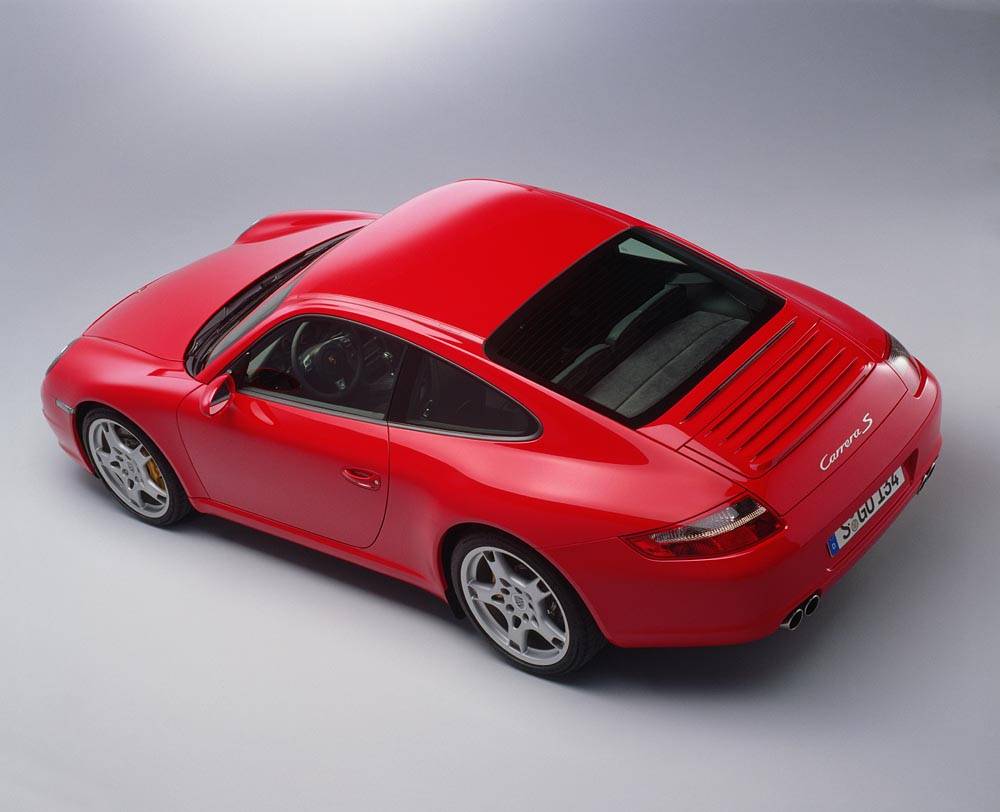
For the first time since 1977, the Porsche 911 Carrera now comes in two power versions with engines varying in size: the “basic" 911 Carrera displacing 3.6 litres and developing maximum output of 239 kW (325 bhp) at 6800 rpm, and the 911 Carrera S displacing 3.8 litres and with maximum output of 261 kW (355 bhp) at 6600 rpm. The 3.8-litre flat-six develops its maximum torque of 400 Newton-metres (295 lb-ft) at 4600 rpm, accelerating the Carrera S in 4.8 seconds from 0-60mph and ensuring a top speed of 293 km/h or 182 mph.
porsche-911-carrera-coupe
- Make: Array
- Model: porsche-911-carrera-coupe
2007 Porsche 911 Carrera Coupe


- Horsepower: 355 @6600
- Torque: 400 @4600
- [do not use] Vehicle Model: Array
Highlights

-----
Exterior
Powerful body with an even more distinctive waistline

Interiror
New interior architecture

-----
Engine

-----
Chassis and Driving
Updated chassis and suspension for active damping

Braking

-----
Safety

-----
Specifications
911 Carrera / 911 Carrera S*
Body:
- Coupé; monocoque structure;
- lightweight all-steel bodyshell hotgalvanised on both sides; full-size, side and head airbags for the driver and passenger; 2+2-seater.
Aerodynamics:
Drag coefficient Cd = 0.28 (Carrera), 0.29 (Carrera S)
Frontal area: A = 2.00 m2
Cd x A 0.56 (Carrera), 0.58 (Carrera S)
Power unit:
- Six-cylinder aluminium boxer engine;
- water-cooled; engine block and cylinder heads made of aluminium;
- four overhead camshafts;
- four valves per cylinder; adjustment of valve timing on the intake camshaft and modification of valve lift (VarioCam Plus);
- hydraulic valve play compensation;
- switchable intake manifold;
- integrated dry sump lubrication;
- two-stage cascade-type catalytic converter;
- two oxygen sensors with dual control;
- engine oil change 10.3 litres;
- coolant 31 litres;
- DME (Digital Motor Electronics) engine management for ignition, fuel injection and camshaft adjustment; electronic ignition with solid-state distributor system (six ignition coils); sequential multipoint fuel injection.
Bore:
96 mm (3.78") (Carrera), 99 mm (3.90") (Carrera S)
Stroke:
82.8 mm (3.26")
Capacity:
3596 cc (Carrera), 3824 cc (Carrera S)
Compression ratio:
11.3:1 (Carrera), 11.8:1 (Carrera S)
Max output:
239 kW (325 bhp) at 6800 rpm (Carrera)
261 kW (355 bhp) at 6600 rpm (Carrera S)
Max torque:
370 Nm (273lb-ft) at 4250 rpm (Carrera)
400 Nm (295 lb-ft) at 4600 rpm (Carrera S)
Output per litre:
66.5 kW (90.4 bhp) (Carrera)
68.3 kW (92.9 bhp) (Carrera S)
Max engine speed:
7300 rpm
Fuel grade:
Premium Plus (98/88 RON/MON), unleaded
Electrical system:
12 V, 2100 W alternator, battery capacity 70 Ah
*Specifications may vary from one country to another
Power transmission:
Engine and gearbox bolted to form one drive unit; engine powertransmitted via double driveshafts to the rear wheels.
Transmission ratios: Manual Tiptronic S
1st gear 3.91 3.60
2nd gear 2.32 2.19
3rd gear 1.61 1.41
4th gear 1.28 1.00
5th gear 1.08 0.83
6th gear 0.88 –
Reverse 3.59 3.56
Final drive ratio: 3.44
Clutch diameter: 240 mm (9.45")
(self-adjusting on the Carrera S)
Chassis and suspension:
-
Front axle: Spring strut configuration (optimised by Porsche) with wheel-guiding and independent suspension on track control and longitudinal arms; cylindrical springs with inner damping;twin-sleeve gas pressure shock absorbers (with active control on the Carrera S)
-
Rear axle: Multi-arm configuration; independent wheel suspension on five arms; cylindrical coil spring on each wheel with coaxial inner damper; single-sleeve gas pressure damper (with act ive
control on the Carrera S)
Brakes:
- Twin-circuit brake system with circuits split by axles;
- four-piston aluminium monobloc brake callipers;
- cross-drilled, inner-vented brake discs on the front wheels measuring 318 x 28 mm(12.52 x 1.10") diameter x thickness (Carrera) and 330 x 34mm (13.00 x 1.34") diameter x thickness (Carrera S), and 299 x 24 mm (11.77 x 0.94") diameter x thickness (Carrera) and, respectively, 330 x 28 mm (13.00 x 1.10") diameter x thickness(Carrera S) at the rear;
- PSM 8.0;
- vacuum brake servo.
Wheels and tyres:
Front:
- 8 J x 18 on 235/40 ZR 18 (Carrera);
- 8 J x 19 on 235/35 ZR 19(Carrera S)
Rear:
- 10 J x 18 on 265/40 ZR 18 (Carrera);
- 11 J x 19 on 295/30 ZR 19 (Carrera S)
Weight:
Unladen DIN
- 1395 kg (Carrera)
- 1420 kg (Carrera S)
Max permissible
- 1810 kg (Carrera)
- 1820 kg (Carrera S)
Roof load 75 kg
Dimensions:
- Length 4427 mm
- Width 1808 mm
- Height 1310 mm (Carrera)
- 1300 mm (Carrera S)
- Wheelbase 2350 mm
Track
- front 1486 mm
- rear 1529 mm (Carrera)
-
1511 mm (Carrera S)
Luggage compartment
capacity to VDA standard: 135 litres (4.72 cu ft), overall
Fuel tank capacity: 64 litres (14.1 Imp gals)
Performance:
Top speed
- 285 km/h (177 mph) (Carrera)
- 293 km/h (182 mph) (Carrera S)
Acceleration (sec)
0 – 62mph
- 5.0 (Carrera)
- 4.8 (Carrera S)
0 – 100mph
- 11.0 (Carrera)
- 10.7 (Carrera S)
0 – 124 mph
- 17.5 (Carrera)
- 16.5 (Carrera S)
Standing-start km
- 23.8 (Carrera)
- 23.4 (Carrera S)
Fuel consumption, Carrera*(EU standard):
- Urban 16.1 (16.5) litres
- Extra-urban 8.1 (8.1) litres
- Composite 11.0 (11.2) litres
Fuel consumption, Carrera S*(EU standard):
- Urban 17.1 (17.9) litres
- Extra-urban 8.4 (8.4) litres
- Composite 11.5 (11.7) litres
CO2 emissions, Carrera*(EU standard):266 (270) g/km
CO2 emissions, Carrera S*(EU standard):277 (283) g/km
* Figures in brackets refer to models with Tiptronic S
-----
Options
Prices
The prices start from :
- $ 72,400 for 911 Carrera
- $82,600 for 911 Carrera S
- $82,600 for 911 Cabriolet
- $92,800 for 911 Carrera S Cabriolet
- $78,200 for 911 Carrera 4
- $88,400 for 911 Carrera 4S
- $88,400 for 911Carrera 4 Cabriolet
- $98,600 for 911 Carrera 4S Cabriolet
Exterior
- Park Assist Syste - Parking aid with four distance sensors integrated discreetly at rear of car. $530
- Aerokit - Includes new front apron with integrated front spoiler and new engine cover with rear spoiler and fixed wing profile. Caution: substantially reduces entry angle to gradients. $6,990
- Rear Window Wiper$360
- Self Dimming Mirrors Automatically dimming interior and exterior mirrors $385
- Roof Transport System 165 lb. (75 kg) payload, can be used with all Porsche load carrier accessories. $400
Interior
- Black Mats - Porsche Lettering $115
- Sea Blue Floor Mats$115
- Cocoa Floor Mats$115
- Stone Grey Floor Mats$115
- Natural Brown Floor Mats$115
- Sand Beige Floor Mats$115
- Terracotta Floor Mats$115
- Instrument dials in Black$0
- Instrument Dials in Sand Beige$860
- Instrument Dials in Terracotta$860
- Instrument Dials in Natural Brown$860
- Instrument Dials in Guards Red$860
- Instrument Dials in Speed Yellow$860
- Instrument Dials in Carrara White$860
- Sport Seat Backs Painted$1,495
- Heated Seats$480
- Seat Belts in Silver$540
- Seat Belts in Guards Red$540
- Seat Belts in Speed Yellow$540
- Rear Center Console in Exterior Color$730
- Fire Extinguisher$140
- Footrest in Aluminum$250
- Supple Leather Front and Rear$395
- Leather Interior Natural Leather$0
- Leather Package Switch Panel$2,050
- Instrument Surround in Leather$260
- Steering Column in Leather$420
- Steering Wheel in Smooth Leather$240
- Sport Steering Wheel in Smooth Leather$490
- Thicker Steering Wheel in Leather$800
- Three-Spoke Multi-function Steering Wheel$740
- Door Finishers in Leather$360
- Sport Seat Backs in Leather$1,610
- Porsche Crest in Headrests$270
- PCM Handset Leather$415
- Rear Center Console in Leather$1,260
- Rooflining in Leather$1,180
- Sun Visors in Leather$560
- Dome Lamp Cover in Leather$335
- Inner Sill Finishers in Leather$585
Interior aluminium
- Aluminum Look Package Switch Panel$1,550
- Instrument Surround Aluminium Look$360
- Aluminium Look Multi-function Steering Wheel$1,060
- Door Finishers Aluminum Look$1,550
- Gear Shifter Aluminum$880
- Gear/Handbrake Lever in Aluminum$995
- Rear Center Console in Aluminum Look$730
- Seat Backs In Aluminum Look$1,495
- Door Entry Guards in Stainless Steel$415
Interior carbon
- Carbon Package$890
- Carbon Package Switch Panel$2,700
- Multi-function Steering Wheel in Carbon$1,110
- Door Finisher in Carbon$2,700
- Rear Center Console Carbon$1,625
- Door Entry Guards in Carbon$780
Interior wood
- Makassar Package$890
- Makassar Package Switch Panel$2,700
- Makassar Multi-function Steering Wheel$1,110
- Door Finishers Makassar$2,700
- Rear Center Console Makassar$1,625
- Sycamore Package$890
- Sycamore Package Switch Panel$2,700
- Sycamore Multi-function Steering Wheel$1,110
- Door Finishers Sycamore$2,700
- Rear Center Console Sycamore$1,625
Audio
- Navigation Module for PCM$2,070
- Extended Navigation Module$2,275
- Electronic Logbook$650
- Module for Telephone PCM$960
- Handset for Telephone Module$260
- BOSE High End Sound Package$1,390
- Remote CD Changer (6 Disc)$650
- Rod Antenna$0
Performance