
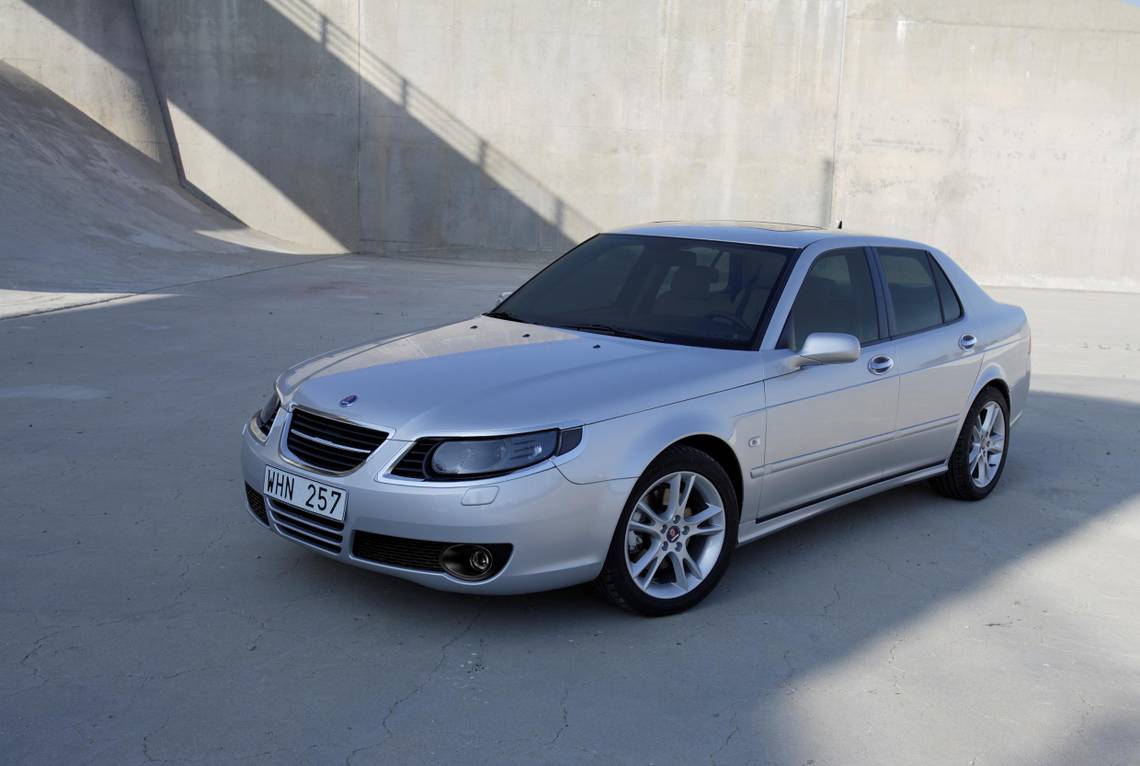
2007 Saab 9-5


- Make: Array
- Model: 2007 Saab 9-5
- Horsepower: 260/@5300
- Torque: 350 @1900-4000
- [do not use] Vehicle Model: Array
The Saab 9-5 Sedan and SportCombi range is a clear expression of the sporty and multi-dynamic appeal of the Saab brand. Distinctive styling and strong turbocharged performance are combined with outstanding ride comfort, responsive handling and class-leading levels of safety.

Positioned in the upper medium segment of the premium car sector, the Saab 9-5 range provides a more individual, self-expressive choice in a marketplace crowded with more commonplace competitors, such as the BMW 5-series, Audi A6, Mercedes E-class and Volvo S80/V70.
The all-turbo powertrain line-up leads the premium segment in offering a 'tri-fuel' choice of gasoline, diesel or bioethanol powered engines. The range is led by the high performance, 260 bhp/ 191 kW Saab 9-5 Aero and includes a powerful yet frugal 150 bhp/ 1.9TiD option and two Saab BioPower variants offering enhanced performance from E85 (85% bioethanbol/15% gasoline) fuel.
The model range highlights include:
Exterior Design
- Bold, distinctive exterior looks, including dramatic evolution of traditional three-port Saab 'face', heralding future Saab design direction.
- Saab styling cues: wedge-shaped profile, ‘clam shell’ hood, 'hockey stick' curvature to C-pillars, oval door handles and triangular 'cut-out' front indicator and rear light housings
- Color-keyed exterior detailing and integrated bumper moldings. Projector-style headlamp units and flush-mounted rear light clusters
- SportCombi designed as a separate model with unique bodystyling from B-pillar rearwards
- Raked, ‘wraparound’, rear window for SportCombi emphasises sporty character
- Highly competitive 0.29 Cd for sedan and 0.32 Cd for SportCombi

Interior Design and Features
The spacious interior features a ‘cockpit-like’ driving environment and superb seating. The bold, sweeping contours of the cabin and the matte chrome finish to the controls and instrumentation, complement the looks of the exterior styling.
- 'Black Room' interior design theme adds sporty interior ambience with all-black door cappings, front fascia and carpeting.
- Dual-zone Automatic Climate Control fitted as standard, allowing the driver and passenger to select a different temperature setting.
- 'ComSense' functionality minimizes potential for driver distraction through 'dynamic workload management', briefly suppressing in-car warning messages/phone calls when moments of high driver workload is detected.
- Saab ‘Night Panel’ restricts instrument illumination and visual ‘clutter’ to reduce distraction during night driving.
- Infotainment options include a choice of three audio systems, all with an auxiliary input socket, and DVD/GPS satellite navigation with a large 6.5-inch color monitor and touch-screen operation
- Twin air filtration through a combined electrostatically-charged and carbon filter which removes airborne particles as small as 4 microns (0.004 mm). It collects dust, soot and pollen, as well certain airborne chemicals, preventing odours entering the car.
- Double front sun visors include a second flap that unclips and can be swivelled to shield the upper side window, making driving into a low sun on a winding road much less distracting.
- Generous on-board storage: pouches on front seat squabs, storage net in front passenger footwell, chilled glovebox, center console with armrest, bag hooks in trunk and rear ski-hatch.
- Adaptable load-carrying for sedan (foldable rear seat) and SportCombi (flat-bed rear deck and cargo securing tracks)
- First passenger car to offer ventilated front seats for additional comfort
- Three interior trim levels or 'forms': Linear, Arc and Vector, plus top-of-the-line Aero specification

Powertrain
The all-turbo powertain is unique in offering a bioethanol fuel choice - Saab BioPower - in addition to gasoline and diesel. Ranging in power from 260 bhp/ 191 kW to 150 bhp/ 110 kW, all engines deliver characteristically strong, mid-range torque for safe, secure overtaking.
- All gasoline and BioPower engines controlled by sophisticated Saab Trionic engine management system simultaneously measuring and adjusting ignition timing, fuel injection, turbo boost pressure and the electronic throttle for optimum combustion.
- 260 bhp/ 191 kW 2.3 turbo Aero engine leads the range and includes a 'superboost' function briefly raising torque to exceptional 370 Nm.
- Choice of 150, 185, or 220 bhp (110, 136, 162 kW) turbo engines, all with counter-rotating balancer shafts for excellent running refinement, complete gasoline line-up.
- 150 bhp/110 kW 1.9TiD engine, with maintenance-free exhaust particulate filter, delivers strong performance and good fuel economy. Maximum torque of 320 Nm exceeded only be Aero engine
- Unique Saab BioPower engines, 2.0t (180 bhp/132 kW) and 2.3t (210 bhp/154 kW) on bioethanol-based fuel (E85), giving environmental benefits of reduced CO2 emissions as well as even sportier performance. Flex-fuel capability, able to run on any combination of gasoline and/or E85.
- Automatic transmissions include Saab Sentronic manual selection via steering wheel buttons
Chassis
Responsive chassis dynamics offer a sporty and rewarding driving experience, with dampers, springs and anti-roll bars all tuned for sharp handling without loss of ride quality and comfort. Front wheel drive provides predictable, secure handling.
- Chassis behavior communicated through driver’s hips, with seating position located as close as possible to vehicle's center of gravity
- Isolated front a rear sub-frames provide excellent ride refinement by helping to prevent road noise, shocks and vibration entering the passenger cabin.
- De-coupled MacPherson strut front suspension separates spring and damper load paths into the front structure, improving insulation from road shocks and allowing better control of ride characteristics
- Multi-link, independent rear suspension for improved wheel control and ride quality
- Low-mounted steering rack with short tie rods of excellent steering response
- Electronic Brakeforce Distribution (EBD), switchable electronic Traction Control System (TCS) and a Saab-developed electronic stability program (ESP®) all fitted as standard.
- 10 mm lowered, sports-tuned chassis and brakes for top-of-the-line Aero models

Safety
The Saab 9-5 range benefits from class-leading safety levels, as demonstrated by its maximum 5-star Euro-NCAP crash test rating and the findings of accident injury surveys by the Highway Loss Data Institute in the United States and Sweden's Folksam insurance company. It is the product of Saab's 'real-life ' safety strategy, incorporating lessons learnt from a detailed analysis of more 6,100 actual road accidents involving Saab cars on Swedish roads.
- Front deformation zone distributes crash forces along three separate load paths
- Predictable frontal deformation almost irrespective of point of impact
- Exceptionally strong safety cage with joints designed to resist tearing
- Saab Active Head Restraints (SAHR) help prevent neck injury in rear impacts
- Unique ‘pendulum’ B-pillars divert and spread side impact forces
- Adaptive front airbags deployed according impact severity and seat position
- Seat-mounted side impact airbags help provide head and chest protection
- Five 3-point seat belts include pre-tensioning and load-limiting for front occupants
- Rear seat designed for shifting load protection
-----
Design
Saab's flagship 9-5 Sedan and SportCombi range is a clear expression of the sporty and multi-dynamic appeal of the Saab brand. It continues a brand tradition for progressive and distinctive design, providing an individual, self-expressive choice in a marketplace crowded with more commonplace competitors.
Bold Exterior
The 9-5 range previews the look of future Saab models by adopting the most dramatic change in frontal design since the classic Saab 900 was launched in 1979. In locating the headlights in the outer two elements of the traditional 'three-port' Saab grille, the 9-5 adopts a theme first seen on the Saab 9X and Aero X concept cars.

The grille and headlamp/indicator units are now separately framed by chrome trim, which extends on to the front edge of the hood. The grille features a slim horizontal bar, representing an aircraft wing in recognition of Saab's aviation heritage. The round, projector style headlamps, set in a matte black housing, combine to give the car a sporty, purposeful persona.
Signature Saab features - the wedge-shaped profile, the 'hockey stick' belt-line, the shape of the front indicator housings and the clamshell hood - combine with the color-keyed bodywork to give both the Sedan and SportCombi a sleek, sporty appearance.e . The side sill-line is visually extended through the wheel-arches by subtle scallops in both front and rear bumper moldings..

At the rear, flush-mounted tail-light clusters with all-red lenses add to the crisp, clean styling. On both the sedan and wagon, the bumper molding sweeps up into the light housings, as seen on the Saab 9-3 range. The sedan retains a subtle lip in the rear edge of the trunk lid for improved airflow, while the distinctive 'wraparound' rear window glazing and steeply raked screen distinguish the wagon.
Both models have excellent aerodynamics for good stability and low wind resistance. Drag co-efficients of 0.29 for the sedan and 0.31 for the wagon are extremely competitive for the class.

Matching Interior
The spacious cabin of the Saab 9-5 offers a command-focused driving position and exceptional standards of comfort for all occupants. The soft curves, with fluid ‘organic’ shapes and forms, complement the exterior styling.
The cockpit-like main instrument panel curves around driver and down towards the ignition key, handbrake and electric window controls, all located between the front seats and ahead of central arm-rest/storage box. The scalloped door panels and sweeping curves of the interior upholstery echo the shape of the fascia. The quality of materials and their fit and finish is everything you would expect in a car of this class.

For the driver, the Saab 9-5 features white-on-black dials set in chrome surrounds within the main instrument display, which has a recessed inner edge give a three-dimensional look. The center console has separate control panels for the infotainment system and automatic air conditioning, the latter adopting rotary controls which reduces the proliferation of buttons.. The new three-spoke sports steering wheel are adjustable for both height and reach.
A 'Black Room' design theme gives the interior a sporty ambience. The carpets, the main fascia molding, the 'B'-pillar trim, all door cappings and lower storage bins are presented in black, while the headlining and 'A' and 'C' pillar trims are in contrasting parchment. (For details of the three main interior specifications, Linear, Arc, Vector and the top-of-the-line Aero, see 'Model Range and Equipment' section).
The door panels are trimmed in a similar style to the m9-3 model and co-ordinated for color with the main instrument panel. The interior door handles are presented in matte chrome.
The 9-5 maintains a Saab tradition for widely-acclaimed seating comfort. The front seats provide good back and under thigh support for both cross-country trips and long motorway journeys. The upholstery is soft for good comfort, but firm enough to support occupants securely. High quality trim materials, in textile weave or leather, combine comfort with good wear resistance. Ventilated front seats are available as an option, as well as heating for all main seating positions.
The front seats are also fitted with Saab Active Head Restraints (SAHR), a unique Saab-developed safety feature that helps automatically reduce the risk of neck injury in a rear-end collision (see Safety Section).
Cabin Refinement
The Saab 9-5 benefits from extremely low interior noise levels. This has been achieved through the excellent aerodynamics of the body, its fine structural properties and the scientific application of sound deadening materials and special door seals.

Almost all unwanted noise, vibration and harshness is attenuated by the design of the engine and suspension mountings. Porous sound absorbent pads are applied to the engine compartment bulkhead, hood, floor and wheel housings before the body is painted. Extra sound insulating materials are also applied to all sheet-metal surfaces that might be susceptible to vibration.
To minimize interior road and wind noise triple rubber seals are fitted to the upper door frames and double seals lower down. All are tubular in section to ensure they function consistently, irrespective of any differences in air pressure inside or outside of the car.
The wagon is designed to offer occupants the same level of comfort as the sedan, despite the open load area behind the rear seats which can be prone to resonance or ‘booming’. This has been achieved by careful attenuation of noise and vibration at the rear, as well as the use of a substantial, foldable rear parcel shelf, preferred to more common, but less effective,‘roller blind’ partitions.
Dual-zone automatic climate control
The automatic climate control system (ACC) separates the driving position from the combined front and rear passenger area, allowing two different temperatures to be selected
A total of seven vents are provided in the cabin, three for the driver, two for the front passenger and two for rear passengers in the back of the centre console. For optimized defroster/demister control, there are two outlets on each side of the fascia, one directed to the middle and the other to the lower part of the windscreen. Four dedicated demister vents are also provided on the fascia and in the B-pillars, one immediately ahead of each side window.

Computational fluid dynamics (CFD), including the study of 1.2 million 'cells' representing the passenger cabin, were used to optimize the system’s performance. The complex motion of gases, lubricants and coolants inside the engine, is taken into account as well the prediction of aerodynamic flow patterns and pressure gradients over internal surfaces.
Green-tinted, heat-absorbent glass is standard. It prevents about 50 per cent of the sun’s thermal radiation entering the cabin, reducing the energy required to drive the air conditioning system.
Double air filtration
The Saab 9-5 uses a combined electrostatically-charged and carbon filter which removes airborne particles as small as 4 microns (0.004 mm) in size. It collects dust, soot and pollen, as well as small droplets of oil which can contribute to that greasy haze that often forms on the inside of car windows.
The carbon filter element removes chemicals such as hydrocarbons (benzene, butane, etc.), nitrogen oxides, sulphur dioxide, ammonia, formaldehyde, acrolein and ozone, and as well as odours.
Double sunvisors
Double front sun visors, can be specified as part of a comfort package. The first hinged flap in front of the driver or front passenger can be unclipped and swivelled to shield the upper side window, while a second hinged flap can then be lowered to cover the top of the windscreen. This feature makes driving into a low sun, particularly on a winding road, much less distracting.
Convenient storage
There are a number of useful storage locations inside the passenger cabin. Conventional pockets in the lower trim panels of the doors are supplemented by stowage pouches on the front edge of both front seats, a net pocket in the front passenger footwell, map pockets in the front seat-backs and cubby holes in both the front and rear center armrests.

The generously-sized glove box is linked to the air conditioning to provide a cool box at around the temperature of a domestic fridge (6°C). It is ideal for stowing chocolate or a cold drink.
Four cup-holders are provided. One is elegantly designed to fold out from a slot in the instrument panel adjacent to the driver, cleverly twisting to form a horizontal support ring. Another can be deployed in the storage box below the front arm-rest, while two more are under the padded lid of the folding rear center armrest.
Adaptable load-carrying
Versatility has always been part of the multi-dynamic appeal of the Saab brand and both the 9-5 sedan and, of course the wagon, offer considerable scope for carrying loads.
In the sedan, either or both sections of the 60/40 split-fold rear seat-back can be folded down so the trunk can accept objects up to 1655 mm long. To facilitate this process, the adjustable rear head restraints can be folded flat on their mountings. There is also a ski hatch behind the folding center armrest.
The wagon offers extremely adaptable load-carrying configurations that are easy and safe to use. Attention to detail is characterised by the design of the tailgate. Careful counter-balancing makes it light and almost ‘weightless’ to raise and lower. It also opens extremely high, arcing up through 91*, to 1865 mm in height, allowing tall people to stand under it without banging their heads. The gas struts are integrated into the hinges, helping to keep the loading area as clear and uncluttered as possible.
The cargo area is easy to adapt to different needs. For normal loads, the flat rear floor, without any awkward corners, offers generous space. To extend the load area, the 60/40 split rear seat squabs and backrests can be folded as desired – it is not necessary to remove the rear head restraints - in order to produce a completely flat load bed without any upward slope towards the front.

Whilst load-carrying should be easy and convenient, it must also be safe. And here the wagon features Saab’s innovative Cargo Tracks, an example of technology crossover from the aircraft industry. The two floor-mounted aluminium rails extend longitudinally down either side of the load area (in aircraft they are used to position and secure seats or cargo) and provide one of the best load-securing system on the market in terms of safety, flexibility and user-friendliness.
Four spring-loaded attachments snap into the tracks and can easily be moved between three positions on each track. Fitting two either side offers a strong foundation for securing cargo in conjunction with the load straps or an elastic net, both provided as accessories. Tests have shown that the tracks are so strong, the entire car can be suspended in mid-air from just one of them!
-----
Driving and chassis
Extensive tuning of the suspension and steering gives the Saab 9-5 range excellent chassis dynamics to match its sporty new looks. All major suspension components have been adjusted to minimize body movement and give immediate responses to driver inputs, without compromising the excellent ride quality of the chassis.

The 9-5's core suspension and chassis layout benefits from isolated front and rear sub-frames, de-coupled MacPherson strut front suspension, an independent, multi-link system at the rear and anti-roll bars all-round.
Front suspension
The front sub-frame extends around the perimeter of the lower engine bay. It is attached to the main body structure by six elastomer bushes, helping to further isolate the body from the effects of road shocks. The pressed steel lower wishbones have widely-spaced pivots that apply toe-correcting geometry for a self-stabilizing effect when braking on road surfaces with varying degrees of grip.
The upper MacPherson strut mounts are also ‘de-coupled’ in order to separate spring and damper load paths into the front structure, again improving insulation from road shocks and allowing better control of ride characteristics. The coil springs are offset to reduce bending loads in the shock absorbers for more refined ride comfort.

Body roll angles are reduced to achieve sporty handling by fitting a thick, 21mm diameter, front anti-roll bar, the same as used in the Aero's sports suspension. This is mounted on the rearmost bushes of the sub-frame, giving a more directly linked action, as well as contributing to improved steering feel and feedback.
Overall, the front suspension is designed to give the driver close control, making the car fun to drive and reducing its sensitivity to road-induced disturbances.
Rear suspension
The multi-link rear suspension is also mounted on a separate sub-frame, attached to the rear body structure by four large-volume elastomer bushes. Each wheel is controlled by three links, two mounted transversely to form the split axle and the third installed as a longitudinal trailing arm.
The two transverse links on each side pivot on cylindrical bushes mounted on the sub-frame, while the trailing arm is attached to the body through voided bushes mounted in rigid brackets. To ensure precise wheel control, the transverse links are fitted with ball joints at the wheel hub. The vertical spacing of the ball joint pivots on the wheel hub assembly is also wider than the spacing at the inboard end in order to control wheel camber on bump and rebound.

Equal attention has been paid to fine tuning the rear suspension for good body control. The 17 mm anti-roll bar from the Aero chassis is fitted as standard to all variants to reduce roll angles when cornering.
Steering and brakes
The hydraulical power-assisted rack and pinion steering is mounted low at the rear of the front sub-frame. It therefore provides precise wheel control, giving a good steering response and feel.
The diagonally-split braking system includes brakes with two performance levels. The base system consists of ventilated 288 mm discs at the front and solid 286 mm discs at the rear. The uplevel system has 308 mm discs at the front and 300 mm discs at the rear, all ventilated. A twin 7/8" booster reduces pedal effort and provides a sensitive, progressive braking feel.
An Anti-lock Braking System (ABS), Electronic Brakeforce Distribution (EBD), a switchable electronic Traction Control System (TCS) and a Saab-developed electronic stability program (ESP®) are fitted as standard to all variants of the new 9-5.
The ABS system incorporates wheel sensors so that when any wheel begins to lock, brake pressure is diverted from that wheel to a supplementary low pressure hydraulic reservoir. When the wheel accelerates back to near vehicle speed, brake pressure is then restored. The system can cycle in this way up to 12 times a second so the wheel keeps rotating at the point of locking, allowing the driver to maintain steering control while stopping in the shortest possible distance.
EBD comes into effect under hard braking before the ABS is activated, balancing the braking force between the front and rear axle. It automatically provides optimal brake force distribution, given the weight of the vehicle and the prevailing road conditions. The system is managed by the integrated ESP® controller, which compares rear wheel slippage to that at the front as a reference point. As soon as significant differences are detected, pressure to the rear hydraulic system is modulated to provide the best balance.
TCS works in conjunction with the engine management system to prevent the driven wheels from spinning if tyre grip is lost under acceleration. The system utilizes the ABS wheel sensors to detect wheel slip and operates the front brakes individually, to transfer torque to the wheel with the most available friction. If both wheels spin together, it also signals the engine management system to reduce engine torque by over-riding the electronic throttle. A warning light on the instrument panel illuminates when the traction control is operating, to warn the driver of slippery roads.

The TCS system is fully automatic in operation, but includes a cancelling switch for special driving conditions which can only be used at low speeds, below 60 kph.
Chassis Stability Control
The electronic stability programme (ESP®), standard throughout the 9-5 range, is one of the most sophisticated and ‘intelligent’ systems on the market, able to act according to different surface grip conditions. The system is completely integrated with the ABS, TCS and EBD functions.
Using Saab-developed software, it is programmed to execute whatever actions are necessary to help prevent the onset of a loss of control. In addition to the wheel speed sensors from the ABS system it incorporates a yaw rate sensor, a lateral acceleration sensor and a steering angle sensor.
By constantly monitoring and comparing these parameters to a theoretical vehicle dynamics model, the system is designed to assist the driver in helping the chassis to follow the direction of steering.
For example, if there is less grip than expected when cornering, there may be an oversteering slide as the tail of the car starts to move out. The ESP® system will then momentarily brake the outer wheels, as necessary, to correct the yaw rate and gently bring the back of the car into line. In the same way, if the nose of the car starts to understeer and push wide, instead of following its intended path, appropriate braking to the inner wheels is applied to bring the car gently back into line.
The automatic operation of the system is intended to complement the driver at the wheel, rather than aggressively offer help at the last available moment. A cancelling switch, operative at speeds below 60 kph, is included for special driving conditions.
-----
Powertrain
Unique 'Tri-Fuel' Engine Line-up
- All-turbo choice of diesel, bioethanol or gasoline power
- 260 bhp/ 191 kW Aero engine leads the range
- 150 bhp/110 kW 1.9TiD delivers impressive performance and economy
- Unique BioPower engines combine 'going green' with sportier performance
- 150, 185, 220 bhp (110, 136, 162 kW) gasoline turbo engines complete the line-up
The Saab 9-5's all-turbo powertrain line-up leads the premium segment in offering a 'tri-fuel' choice of gasoline, diesel or bioethanol powered engines. Ranging in output from 150/110 kW to 260 bhp/191 kW, they all deliver characteristically strong low and mid-range torque for swift acceleration and safe overtaking.

For model year 2007, a 210 bhp BioPower engine, able to run on bioethanol or gasoline, is introduced in addition to the 180 bhp version. Five-speed automatic transmissions include Saab Sentronic manual gear selection via steering wheel buttons.
Aero engine leads gasoline line-up
The gasoline engine choice includes four options from 150/110 kW to 260 bhp/191 kW. All units have four valves per cylinder, double overhead camshafts and counter-rotating balancer shafts for exceptional running refinement. Irrespective of the power rating, they deliver responsive turbocharged performance to match the 9-5's fine chassis dynamics, maintaining a Saab tradition in offering outstanding levels of torque, or pulling power.
Unlike naturally-aspirated engines of similar power, it is not necessary to maintain high engine speeds for strong performance because turbocharging ensures exceptional torque is readily available between 2,000 - 4,000 rpm, the range used in everyday driving. This is why Saab 9-5 engines are characterised by an exceptionally flat torque 'curve', frequently likened to the distinctive profile of Ayers Rock in Australia!
All powerplants - except the 1.9TiD unit - are fitted with the Saab Trionic 7 electronic engine management system, developed in-house. It simultaneously controls the ignition timing, fuel injection, turbo boost pressure and the electronic throttle, eliminating the need for a distributor, central coil and separate spark plug leads.

The 9-5 Aero's 260 bhp/191 kW, 2.3-liter turbo engine tops the range. Torque is maintained at an exceptionally strong 350 Nm between 1,900 and 4,000 rpm. The capacity of the 32-bit Trionic engine management system has also allowed the programming of a unique ‘superboost’ facility on engines with manual transmission, raising torque still higher, to 370 Nm, for up to 20 seconds. This feature is automatically engaged at full throttle openings for even swifter overtaking.
On the road, this level of power gives the 9-5 Aero in sedan or wagon format searing acceleration. The zero to 100 kph dash is accomplished in just 6.9 seconds (7.3 for the wagon) and 80 to 120 kph acceleration in fifth gear takes just 8.9 (9.8) seconds.
The same 2.3-liter engine is also configured with a lower boost level for maximum power of 220/162 kW or 185 bhp/136 kW, while a 2.0-liter version, with a 12 mm shorter stroke, offers 150 bhp/110 kW. All have an aluminum alloy cylinder head, chain-driven camshafts and a cast-iron block with a 90 mm bore, half-siamesed cylinders and five main bearings.
Special jets spray cooling engine oil to the underside of the pistons at the bottom of their stroke, a feature more commonly seen in competition engines.
1.9TiD engine for refinement, power and economy
Strong power and equally impressive fuel economy are the main attributes of the 150 bhp/110 kW 1.9 TiD unit, available with manual or automatic transmission. It delivers outstanding pulling power in both sedan and wagon formats, generating maximum torque of 320 Nm - just 10 per cent less than that of the top-of-the-line Aero engine. On the road, this engine significantly narrows any perceptible difference between diesel and gasoline performance levels - except in the frequency of visits to the filling station.

Combined cycle fuel consumption of 6.4 l/100km for the sedan and 6.8 for the wagon shows a near 30 per cent gain against its 2.0t gasoline equivalent, while zero to 100 kph acceleration is only marginally slower (10.1 v 9.8 sec, sedan). The credentials of the new engine are further improved by a state-of-the-art, maintenance-free particulate filter..
The four cylinder, cast-iron block has an alloy cylinder head with twin, chain-driven, overhead camshafts and hydraulic tappets. It includes a steel crankshaft and connecting rods; a variable geometry (VNT) turbocharger with intercooling for a quick low-end throttle response; a dual-mass flywheel; a weight-saving pressure cast aluminum intake manifold and electronically-controlled exhaust gas re-circulation (EGR) for quick warm-up and low emissions.
Common rail technology provides consistently high fuel injector nozzle pressures of 1,600 bar, allowing small multiple injections, between two and five, to release as much energy as possible from a given amount of fuel. This extremely efficient combustion process, controlled by the Saab ECM, pays dividends in a number of key areas. Apart from improving fuel consumption, emissions and power, it is crucial in helping to iron out the noise, vibration and harshness traditionally associated with compression ignition.
BioPower - renewable fuel offer unique to segment
Saab leads the premium segment by offering 'flex-fuel' BioPower engines, which can run on gasoline or bioethanol, a renewable energy source offering reduced CO2 emissions. Not only kinder to the environment, bioethanol also allows these engines to produce more power and performance when compared to gasoline.

In combining the benefits of 'going green' with the enjoyment of even sportier performance, the development of BioPower reflectsSaab'sbrand values. The engine also offers a very practical solution to the environmental needs of customers because it can run on gasoline, without adjustment from the driver, in any proportion if bioethanol-based fuel is not available. There is no loss of luggage space or additional weight because the same standard tank is used for both fuels.
Bioethanol is produced commercially from agricultural crops or forest residues. Unlike gasoline, which is produced from oil, its consumption does not raise atmospheric levels of carbon dioxide (CO2), the main 'greenhouse' gas.. This is because emissions during driving are balanced by the amount of CO2 that is removed from the atmosphere when crops for conversion are grown.
Running on E85 fuel (the 85% ethanol/15% gasoline blend found in Sweden and other emerging markets), the Saab 9-5 2.0t BioPower engine delivers 180 bhp/132 kW and 280 Nm of torque, compared to 150 bhp/110 kW and 240 Nm when using gasoline. The significant 20 per cent increase in maximum power and 16 per cent gain in torque gives even sportier performance. In the Saab 9-5 sedan, this translates to zero to 100 kph in just 8.5 seconds and 80-120 kph in fifth gear in 12.6 seconds, compared to 9.8 and 14.9 seconds running on gasoline.
Customer choice is now broadened by the addition of a 2.3t BioPower engine. Running on E85, this delivers maximum power of 210 bhp/154 kW and 310 Nm of torque, compared to 185 bhp and 280 Nm when using gasoline. As an example of the increased performance, the Sedan 2.3t BioPower with manual transmission accelerates from zero to 100 kph in 7.9 secs and 80-120 kph in fifth gear in 11.0 secs, compared to 8.5 and 12.6 secs when running only on gasoline.
E85 fuel has a much higher octane rating (104 RON) than gasoline and is ideally suited to turbocharged engines. The adaptability of Saab's powerful Trionic engine management system has facilitated re-programming to accommodate the different ignition timing and fuel/air mixture requirements of E85 fuel. Trionic monitors fuel quality after every visit to the filling station and automatically makes any adjustments necessary for running on E85 and/or gasoline in any combination. That means Saab BioPower drivers can also use gasoline, should E85 not be available.
Saab BioPower has been successfully introduced in Sweden, where an E85 infrastructure is fast developing, and other international markets are also beginning to emerge.
Five-speed ‘adaptive’ automatic transmission with steering wheel controls
Convenience and sporty performance are combined in the sophisticated five-speed automatic transmission, which incorporates Saab Sentronic manual gear selection via steering wheel buttons.

Manufactured by Aisin AW, the transmission constantly monitors its surroundings, adapting shift patterns to the prevailing conditions. For example, it can detect changes in altitude and engine performance, or if a trailer is being towed, and will optimizes its gear shifting patterns accordingly, staying within the engine’s ‘sweet spot’. This is facilitated by a high-speed databus connection which provides a continuous flow of information between the Trionic engine management system and the automatic transmission's control module.
In addition to selecting ‘normal‘ or ‘sport’ modes, the driver can also enjoy close gear changing control akin to that of a manual transmission by using Saab Sentronic steering wheel buttons. With the selector lever in the ‘M’ for manual position, swift sequential changes can be executed via the buttons – the right one for ‘up’ changes and the left for ‘down’ changes.
-----
Safety
Optimized through Real-life Experience
- Crash test configurations based on ‘real-life’ research
- Safety structure with front and rear crumple zones
- Front structure to distribute impact forces along three separate load paths
- Side impact protection with ‘pendulum’ B-pillar
- Saab Active Head Restraints (SAHR) for front seats
- Dual-stage front airbags
- Head/thorax side airbags
- Maximum 5-star EuroNCAP crash test rating
- ESP®, TCS, EBD, ABS all fitted as standard
Saab Automobile AB (Saab) has a long tradition of successful work with vehicle safety. In surveys of real-life collisions made by the US Highway Loss Data Institute (HLDI) and the Swedish insurance company, Folksam, many Saab cars have scored well, several times being ranked best in their segment. In EuroNCAP crash tests, the Saab 9-5 Sedan, 9-3 Sport Sedan and 9-3 Convertible have all achieved a maximum five stars.

The most recent survey by the Swedish insurance company Folksam, published in April 2005, analyses the results of real-life car to car accidents involving 138 different models and found the Saab 9-5 and 9-3 hatchback to have lowest occupant injury risk of all.
HLDI also confirms an above-average safety record for the Saab 9-5. It represents American insurance companies and analyses the damages paid out after accidents. Analysis shows the 9-5 sedan is 53 per cent above the average and the 9-5 wagon is 39 per cent above the average for comparable models in the luxury medium-class range.
Crash Configurations based ‘Real-Life’ experience
Computer simulations and crash testing at Saab are designed to replicate what happens in real collisions on real roads, based on the findings of a database covering more than 6,100 real-life accidents, including the Saab 9-3 and Saab 9-5, on Swedish roads.
During the development of the Saab 9-5, the structural design and the deployment of its occupant protection systems were evaluated not only in consumer and legally required crash tests, but also in a large number of additional in-house configurations, taking occupants of different sizes into consideration. Prototype tests were carried out in the laboratory and outdoors in a wide range of speeds and configurations.
However, advanced crash simulations, using finite element methods (FEM) and drawing on Saab's extensive experience, help to find solutions before any prototypes are built. Support by simulation is used throughout the development process in structural design, as well as for the tuning of occupant protection systems, such as seatbelts and airbags. As a result, crash tests are increasingly used as a physical means of verifying what is already known.
Body Structure
The steel safety structure of the 9-5's passenger compartment is fabricated mainly from high strength steel. Most beam sections are completely closed for additional strength and all joints are designed to help prevent tearing under severe impacts.
The front and rear crumple zones are made of carefully shaped steel members designed to help absorb, distribute and deflect impact energy away from the passenger compartment. Three distinct load paths on each side of the 9-5's front structure are designed to help distribute impact forces through the front sub-frame, along the longitudinal members and through the upper rail into the A-pillar. The longitudinal members have large sections that extend along the floor of the car as far as the rear seat.
The three load paths are connected transversely via cross-members, the most important of which is the bumper beam. This helps to distribute impact forces across and through the front structure, to help achieve a controlled and predictable deformation in a wide range of frontal collisions.
To help provide side impact protection, the B-pillar, side sills and door beams are designed to behave as a single, integrated structure, increasing the likelihood of deformation in a controlled and predictable way. A key part of this strategy is the ‘pendulum’ movement for the B-pillar.

In effect, the pillar is ‘hinged’ from the roof rail of the passenger compartment. It has strengthened upper and middle sections so that, in an impact, it is designed to bend inwards at the bottom, helping to deflect lateral forces downwards towards the floor, away from the more sensitive occupant head and chest areas. The door beams are designed to help support this structure and the bottoms of the doors also interlock with the reinforced side sills so that the entire side structure is designed to perform a load-sharing role.
The door beams are also designed to help provide a major load-bearing function in side impacts against narrow objects, such as a tree or telegraph pole, when the B-pillar is not engaged.
At the rear, two more longitudinal members are designed to buckle and deform in a progressive manner to help protect the passenger compartment in a rear end collision. They also assist in dissipating crash energy towards the C-pillars. The fuel tank is mounted low down in front of the rear axle, away from any likely point of impact.
Dual Stage Front Airbags
The 65-liter driver and 145-liter front passenger airbags are designed to help provide an 'occupant-friendly' deployment in frontal impacts. Two sensors in the front bumper beam detect impact severity and a switch in the seat-belt buckles indicates whether or not the belts are being worn. This data is sent to the centrally located SDM which, within milliseconds, chooses between activation of the belt pre-tensioners alone, or in combination with stage 1 or stage 2 inflation of the airbags.
A collision with a relatively low level of impact energy would, for example, likely require less airbag pressure and, therefore, a slower rate of inflation (stage 1) than a more severe, high-energy impact (stage 2).
Head/Thorax Side Airbags
To help provide further side impact protection, double action head/thorax airbags are mounted in outboard edge of the front seat-backs. This ensures they are in position irrespective of how the seat is adjusted. They have two 20-liter sections, the lower one designed to protect the rib cage and the upper part helping to provide head protection.
When activated, the lower section inflates first to help protect the occupant’s rib cage, usually first part of the body to feel the force an impact. As soon as the rib cage comes into contact with the lower part of the airbag, gas is displaced upwards. The gas then fills the upper section of the airbag, helping to protect the occupant’s head, which is usually a little further away from the car's side structure at the moment of impact.
Saab Active Head Restraints (SAHR)
The Saab 9-5 pioneered the use of Saab Active Head Restraints (SAHR) and these are fitted as standard to both front seats. Crash investigation findings published by the US Journal of Trauma, and comparative tests by the US Insurance Institute for Highway Safety and the Thatcham insurance research center in the UK, have shown the SAHR to be extremely effective in helping to prevent serious neck injury to front seat occupants in the event of a rear end collision. The Journal of Trauma published a Saab study that found a remarkable 75 per cent reduction in severe neck injuries when comparing Saab cars fitted with SAHR against older Saab models not equipped with the SAHR system.

The head restraint is activated in a rear end impact as soon as the occupant's lower back is pressed into the seatback. The head restraint is connected by a linkage to a pressure plate in the backrest of the seat. Inertia forces the occupant's body into the backrest against the pressure plate which triggers a mechanism to push the head restraint upwards and forward, catching the head and helping to minimize neck movement. This helps prevent neck injury by reducing the amount of head movement relative to the torso
The SAHR system is entirely mechanical and after activation the head restraint automatically springs back to its passive position, ready for future use.
Occupant-friendly Interior
A great deal of experience has gone into making the 9-5's interior surfaces and materials ‘occupant-friendly’. The front areas of the cabin near the knee and lower leg are well bolstered to help prevent occupant injury and the steering column is, of course, collapsible.
Passenger safety is also the main reason why the interior door armrests and inner door handles are recessed. And in common with most other Saab cars, the floor-mounted ignition switch is located well away from sensitive knee and leg areas.
Driving Safety
It is, of course, better to avoid becoming involved in any road collision and the 9-5's excellent chassis dynamics, steering and brakes help to keep the driver in control and, therefore, less likely to be involved in, or better able to avoid, a collision.

Driving safety is further advanced by the standard fitment of an electronic chassis control system (ESP®), Traction control (TCS), Electronic Brake force Distribution (EBD) and anti-lock braking (ABS). These functions are described in the Chassis section.
Improved driving safety also involves reducing the potential for driver distraction and the 9-5 features Saab ComSense functionality, which uses the concept of 'dynamic workload management'. This is described in the Model Range section.
Saab 9-5 Range: Standard safety equipment
- Two-stage front airbags
- Head-thorax side airbags (front)
- Three-point seatbelts in all five seating positions
- Seatbelt pre-tensioners with load limiters (front)
- Saab Active Head Restraints (SAHR) on front seats
- Front and rear seats with anti-submarining protection
- Isofix mountings for child seats
- Load-securing tracks in the luggage floor, 9-5 SportCombi