
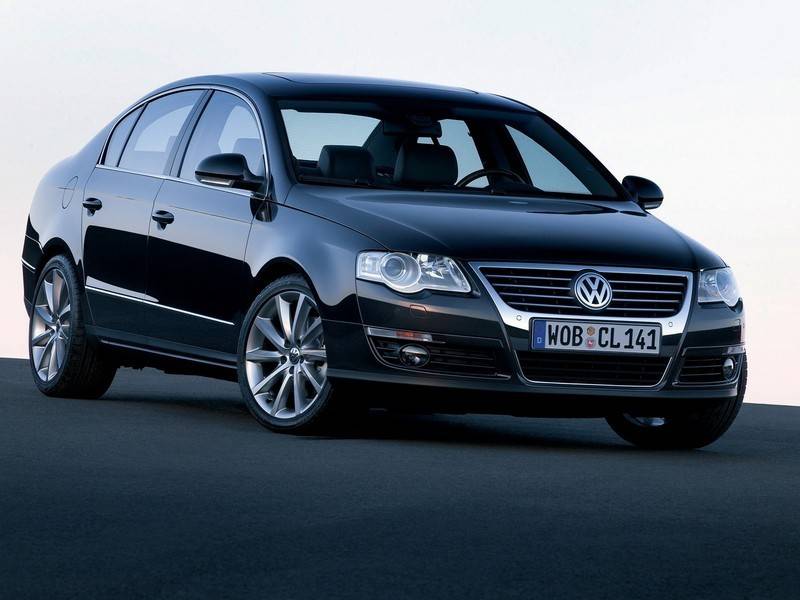
The new generation Passat can now also be ordered with permanent 4MOTION four-wheel drive. It will be available at first with two engines: In the two-litre class, customers can choose between the 2.0l 110 kW/150 hp direct-injection petrol engine or the 2.0l 103 kW/140 hp turbo diesel engine. The diesel version is also available with a diesel particulate filter.
volkswagen-passat
- Make: Array
- Model: volkswagen-passat
2006 Volkswagen Passat


- Make: Array
- Model: 2006 Volkswagen Passat
- Engine/Motor: 3.6 liter V6
- Horsepower: 200@5100
- Torque: 1800
- Transmission: 6 speed automatic
2007 Honda Shadow Sabre
- Make: Array
- Model: 2007 Honda Shadow Sabre
- Engine/Motor: 3.6 liter V6
- Horsepower: 200@5100
- Torque: 1800
- Transmission: 6 speed automatic
- [do not use] Vehicle Model: Array
Generation One of this bestseller made its first appearance in 1973. It is a fact that within the past three decades this Volkswagen has become the very image of automotive progress, representing what “Made in Germany means. This image is characterized by vehicle size, drive technologies, safety features such as airbags, ABS and ESP in addition to quality details including galvanized bodies.

The Passat is now more than just a middle-class saloon. It has matured into a car with a character, into a perfect companion through more than three decades. The rational qualities of the product line have been consistently perfected in the new Passat. At the same time, however, the development team has breathed new passion and pulsating liveliness into this Passat through an uncompromising combination of shape, functionality, design and ergonomics.
Features
The 2006 Volkswagen Passat is redesigned with a longer wheelbase and a wider body featuring a new medallion-shaped grille and clear high-tech headlights. Inside the Passat interior if more functional and ergonomic, with more rear-seat legroom and new rear vents heat and air conditioning. The Passat is powered by a new 200-horsepower 2.0-liter turbocharged intercooled engine delivering 207 lb-ft of torque from 1800 to 5000 rpm. The 280-hp VR6 narrow-angle V6 engine returns and is mated to a refined six-speed automatic transmission with Tiptronic and sport mode. The Passat wagon and 4Motion all-wheel-drive sedan will be available later in the model year.

Interior
Longer and wider than last year's model, the 2006 Passat offers more interior space, particularly for rear-seat passengers. A six-foot passenger can sit comfortably behind a six-foot driver. And while the previous model was among the safest cars in America, the structure of the new Passat is substantially stronger.
Handling
The new Passat offers sportier handling than last year's model. The steering is very precise with steering effort that automatically adjusts to the situation. The new 3.6-liter narrow-angle V6 growls when pressed and delivers robust torque, allowing the Passat to accelerate from 0 to 60 mph in just 6.6 seconds. The six-speed automatic is smooth and responsive and the brakes are excellent.
-----
History
32 years ago, Volkswagen presented the first Passat, which was to become a bestseller. Meanwhile, five generations and more than 13 million of this successful vehicle have been sold world-wide. Let’s turn back the clock to July 1973.

This is when Volkswagen introduced the successor of the “1600” and “411” models on the
market. A modern hatchback saloon with front-wheel drive and a front-mounted, lengthways inline engine. Water-cooled! The horse before the cart. Sensational. Because up to then, with the exception of the K70, the rear-mounted, air-cooled boxer engine had dominated the history of the Volkswagen.
Of course, the Beetle was still there. And how! But the future lay with this Passat, with its superior drive and body concept. One thing is certain: it was a good product. Under the bonnet, petrol engines of up to 63 kW / 85 bhp provided pretty agile propulsion. But you would have needed a crystal ball, if anything, to see that, generations later, there would be up to 132 kW / 180 bhp V6 TDI engines or a W8 with 202 kW / 275 bhp.
Right in the first full year on the market (1974), 133,000 customers decided on a Passat, and as early as December 1976 a million Passats had been sold.
In 1977, while the Bee Gees unleashed the disco craze in Germany with Stayin’ Alive in Saturday Night Fever, Volkswagen presented the stylistically and aerodynamically optimised Passat – still the first generation, but with a classic facelift. Plastic-coated bumpers were an outward characteristic of the series from then on; inside, many components were ergonomically improved.
In March 1978, the 1.5-litre diesel engine (37 kW / 50 bhp) that had proved successful in the Golf followed for the Passat. 7.5 litres average consumption – a lot less with careful driving – heralded a new world of economical cars. In April 1980, the Passat shot through the two-million barrier in terms of units sold. When the successor was introduced in late autumn, the Passat was already assured of its place in motoring history with 2.6 million units.

November 1980 saw the debut of the second generation of this sensationally successful middle-class model. It was a new design: larger, more aristocratic, more grown-up. The Passat had now separated from the Audi 80, and was making its own way. In the second generation of the Passat, Volkswagen remained faithful to the successful hatch-back saloon, but this time presented the new Variant at the same time. Both versions were technologically exciting, with a new, innovative compound-arm rear axle.
A particularly economical unit, the new 1.6-litre diesel with 40 kW / 54 bhp made its first appearance; in August 1982 the power of this self-starter was to climb to 51 kW / 70 bhp with the first turbo diesel in the Passat. Right from market introduction, the Passat was available with its first five-cylinder petrol engine (85 kW / 115 bhp). The same year saw the debut of a classic Passat saloon with four doors and a conventional boot: the Santana. Parallel to this, more and more high-tech components were integrated in the range.
For instance, the all-wheel drive in the Passat Variant GT syncro, first available in 1984. The series underwent a thorough facelift in 1985. It was also in 1985 that Volkswagen began to deliver the first Passat with a computer-controlled catalytic converter (66 kW / 90 bhp), and the three-millionth Passat as such. The top-end Passat with a top speed of 200 kph from a 2.2-litre five-cylinder engine (100 kW / 136 bhp) entered the running. In March 1987, the series passed the fourmillion mark.

In the spring of 1988, Volkswagen put the third generation of the Passat and Passat Variant on the market. The Passat displayed new qualities. It had grown considerably, resplendent in a new line of styling, had a considerably longer wheel base, and now had transverse engines. And again, Volkswagen presented the Variant at the same time. Both body versions were characterised by pronounced aerodynamic perfection. In June 1990 the Passat broke the production barrier of five million units.
The first Passats of the fourth generation were delivered in the autumn of 1993. The most conspicuous visual feature was that the front was no longer almost closed; instead, there was a classic radiator grille. In only three years, this generation of the Passat and Passat Variant, further optimised in many areas, sold almost 700,000 times. The passive and active safety were optimised by series driver and front-passenger airbags, belt tighteners and the anti-blocking system (ABS).
A technical revolution in 1993 was an engine bearing the acronym TDI. The turbo-diesel direct injector developed 66 kW / 90 bhp, allowing speeds of up to 178 kph; average consumption was only 5.3 litres (Variant 5.4 litres). In February 1996, a 1.9-litre four-cylinder with 81 kW / 110 bhp rounded off the TDI range.

The fifth-generation Passat presented in August 1996 heralded a new epoch for the series, with a level of quality, safety and comfort that in many areas completely broke the boundaries to the next higher class of vehicle. The newly designed bodywork is fully galvanised with extremely high static torsion. The newly styled interior corresponds perfectly to this standard. Two of the many technical highlights are the running gear with the four-arm front axle and the standard side airbags.
The basic version of the Passat had a new 1.6-litre aluminium engine (74 kW / 100 bhp). Attractive alternatives to this were the new V5 engine with 2.3 litres capacity and 110 kW / 150 bhp (from September 1997) and the V6, now rated at 142 kW / 193 bhp. The Variant made its debut at the Geneva Motor Show in March 1997. Month by month, the trim and the choice of engines were refined step by step. In 1998, for instance, the first TDI with pumpjet direct injection (85 kW / 115 bhp) and the Passat V6 TDI with 110 kW / 150 bhp followed. From September 1999, ESP was standard for all series Passat models in Germany.

In October 2000, Volkswagen presented the comprehensively reworked fifth generation of the Passat. Forward-looking features were the newly styled front with its high-class chrome radiator grille, and the new rear with the characteristic tail-lights. The quality of the bodywork set new records in the middle class. In addition to the front and side airbags, optional head airbags at the sides were now available. As with many other details, the air-conditioning was included in the standard series package.
An exclusive special role fell to the 202 kW / 275 bhp all-wheeldrive Passat W8 and Passat Variant W8. In the area of high-capacity motorisation, December 2001 then saw the introduction of a new 2.0- litre four-cylinder engine with 96 kW / 130 bhp. March of that year was also to witness the début of a new V6 TDI with 132 kW / 180 bhp. And shortly after, in May, the TDI range for the Passat would have a further V6 added to it. It developed 120 kW / 163 bhp and, like the more powerful V6, conformed to the strict EU-4 exhaust standard.
The sixth generation made it's world debut on the 15th of February 2005 in Hamburg.
-----
Exterior
The new Passat embodies what occurs when designers interpret this clear-cut, logical and comprehensible style more powerfully, athletically and passionately than ever before: design and innovative technology united, working together to catapult the saloon into a sportier, more discriminate, class-transcending dimension in the most ambitious evolutionary step since the series was invented.
Front section
The new medallion-shaped radiator grille combined with headlights, bonnet and bumpers serves to succinctly sum up the traditional Volkswagen vitality and power of design innovation, successfully forming the new face of the brand as outlined here. The stylistic slant selected for this Volkswagen “face of the future“ was anticipated by the much celebrated studies Concept R (Roadster) and Concept C (Cabriolet-Coupé).

Now the first mass-produced vehicle, in the form of the new Passat, bears these characteristics, demonstrating its proportionate power in the process. A ’V’ motif is subtly developed, with lines extending from the bonnet and winding their way to the front of the vehicle, forming a communal framework for the new medallion-shaped radiator grille. The shape and graphic effects of this element are underlined by the chrome construction and self-confident dimensions.
Similarly, the headlights make a significant contribution to the Passat’s identity. Although dipped and full beam headlights are located in a single trapezoidal casing, they are, technically as well as optically, designed as round individual elements. The Passat’s indicators are integrated into the bumper in the form of slender light strips. Their counterparts: stylish side indicators, located in the wing mirror casings.
Silhouette
An exciting mix of vitality and energy is recaptured, in concentrated form, in the graphic design of the side windows. A tightly-drawn lower edge is coupled with a powerfully elegant arch described by the window’s upper edge, beginning in the A-pillar, subsequently fusing with the rear door seam in counter-motion in the environs of the B-pillar. The roof alignment itself arches eloquently down towards the rear. The combination of side window, door seam and roofing gradient produces a prominent C-pillar, optically boosting the dynamic impulse to push forward.

In general, this Passat’s lateral alignment has more muscle than ever before: distinctive lines created in running area and the edge of the car body subsequently slope towards the rear before being “recaptured” in the roof’s design. An impressive lateral touch: the side protection strips extend into the rear bumper.
Rear section
The Passat’s rear is characterised by quick-activating LED tail-lights, completing the stylistic theme initiated by the matching headlights with their round main components. Here, a round element succeeds in interrupting the trapezoidal theme in a downward slant. The new headlights exhibit a distinctive nocturnal graphic effect, as initially demonstrated by the Phaeton.
-----
Design
The new Passat is available in four design lines: Trendline, Comfortline, Sportline and Highline. Each of these lines does not only feature its specific standard engine and interior but also has a character of its own. Trendline stands for the "youngest" version. By its name, Comfortline displays its comfort-focused character just as Sportline shows this version’s dynamics. And, consequently, the Passat Highline comes as the high-end model.
Already in its basic Trendline version, the Passat offers an extensive comfort, function and safety equipment package. This includes dualface front airbags, side and head airbags, active crash headrests in front, ESP, central locking system, electromechanical power steering, electric window lifters in front and the Climatic semiautomatic air-conditioning system.

What happens when designers interpret a clear, logical, intuitively perceivable style with even more power, muscle and passion than ever before can be seen in the new Passat: design united with innovative technologies catapult the saloon into a sportier, more sophisticated, class-transcending dimension in the greatest evolutionary step since the series was first created.
The sixth Passat is therefore characterized by its powerful, avant-garde design. The new VW front section with its chrome medallion-shaped radiator grille and its challenging "staring" headlights, the athletic silhouette and powerful rear section design represent the biggest design leap that has occurred since the product line was created. The outward design of the Passat demonstrates what applies also to its interior: everything is new and everything is different. Let's take the dimensions as an example: the new Passat is 4.77 meters long (+ 62 mm), 1.82 meters wide (+ 74 mm) and 1.47 meters high (+ 10 mm).
Its wheelbase measures 2.71 meters. A clear indication of excellent quality: its static torsion stability is 57 (!) per cent higher than that of its pretty good predecessor and represents the new top performance in this class. The boot volume has also grown considerably: 565 liters maximum (+90 liters).
Interior
A glance into the interior of the new Passat shows a clear, fresh and sophisticated design of a striking simplicity, top-quality materials, and a people-oriented technology not aimed at breaking the theoretical bounds of the technically feasible. The target was to implement perfect ergonomics and ease of operation. Clearly structured functional elements and tylistic simplicity dominate here. The total effect produces a space which enthuses as much as it protects. A space, which although new at first sight, becomes familiar in a moment, with timeless appeal.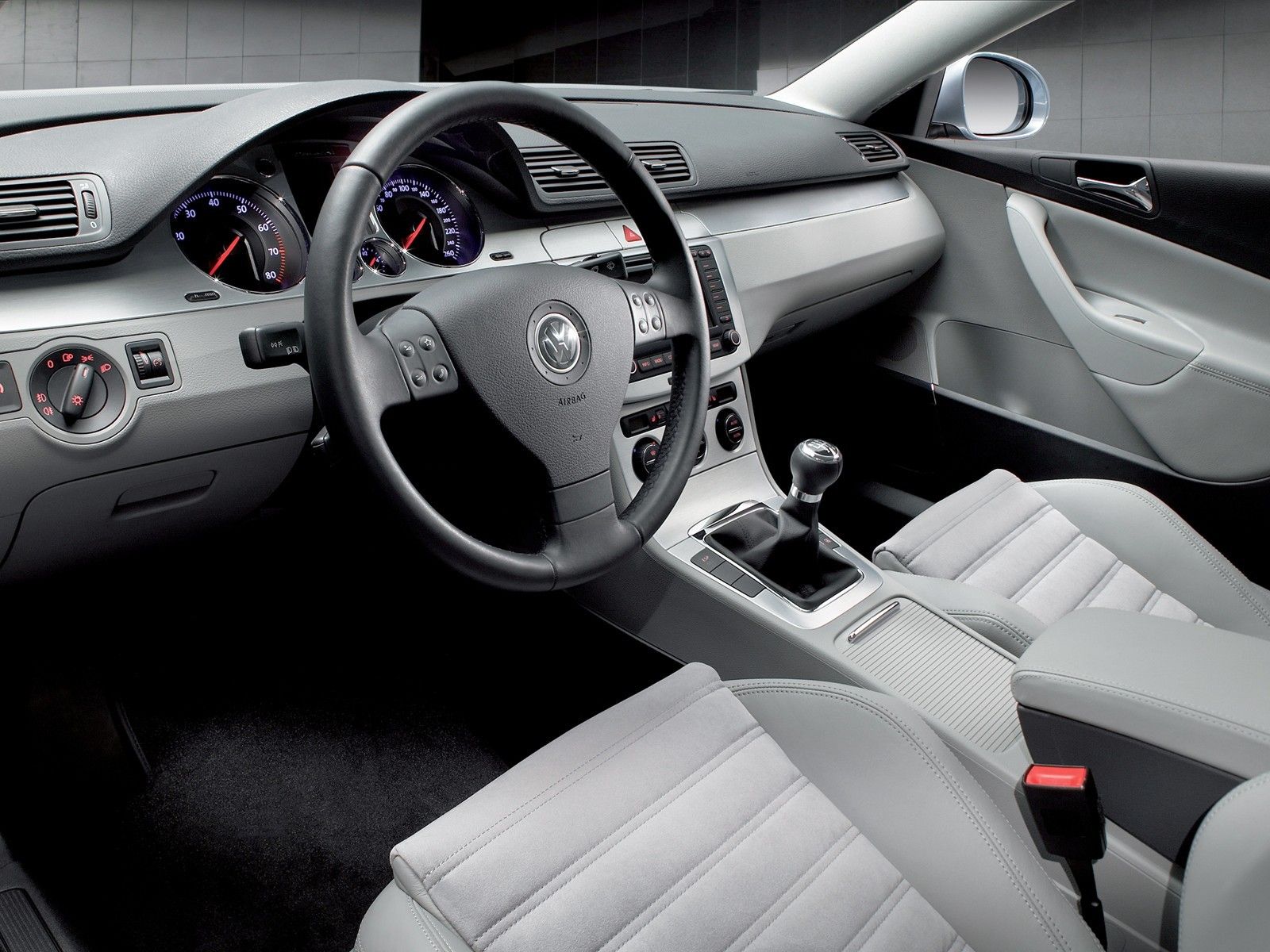 Thanks to the four interior design lines Trendline, Comfortline, Sportline and Highline as well as the four worlds of color (Black, Latte Macchiato, Classic Grey, Pure Beige) the interior can be adapted to suit your own personal taste. Depending on the chosen design line, high-grade wood applications (burr-walnut, poplar, makassar) and aluminum continue the individualization process. The burr-walnut combination on the instrument panel is, for example, perfectly tailored to the fittings’ simplicity, while aluminum trimmings give a classy finish to the entire central console.
-----
Safety
Sensibly complementing highly effective passive safety elements with increasingly intelligent active safety components such as ESP and ACC (adaptive cruise control) results in Volkswagen's presenting the new Passat as one of the world’s safest saloons. The basis of optimum passive safety has been and will be the highest possible bodywork rigidity. And here again, the new Passat sets new standards in its class.
On top of this, it is the car's restraint systems which improve safety at the most perceptible levels. As a standard, the new Passat is equipped with dual-face front airbags, active crash headrests in front as well as side airbags (front) and head airbags (front and rear). As an option, the rear can also be equipped with side airbags and belt tighteners. It goes without saying that the Passat as a well-established vehicle driven on all five continents meets all the applicable crash standards world-wide.

More safety, more comfort and a lot more fun in the Passat saloon due to a wide range of new systems Running gear: the new four-arm rear axle, acoustically isolated from the bodywork by an auxiliary frame, and the McPherson front axle, newly designed around aluminum components (weight reduction of 13.3 kg) ensure agility, comfort and safety at the highest level. The
running gear technology is rounded off by the ESP + trailer stabilization, and all vehicles with trailer hitches are equipped with it as a standard.
Brakes with "wipers": as a standard, all Passat models are equipped with a 16-inch brake system with integrated "disc wiper". The linings are gently applied at certain intervals. This “wipes off” any water film that may have built up due to wet roads and therefore shortens the braking distance.
Electromechanical parking brake: the Passat is the first saloon in its class to have a pushbutton-operated electromechanical parking brake as a standard. Its electronic control system and networking with other control units allowed the integration of a dynamic emergency braking function, a starting assistant (e.g. for going uphill) and an auto-hold function (stopping at traffic lights without constant brake pedal operation).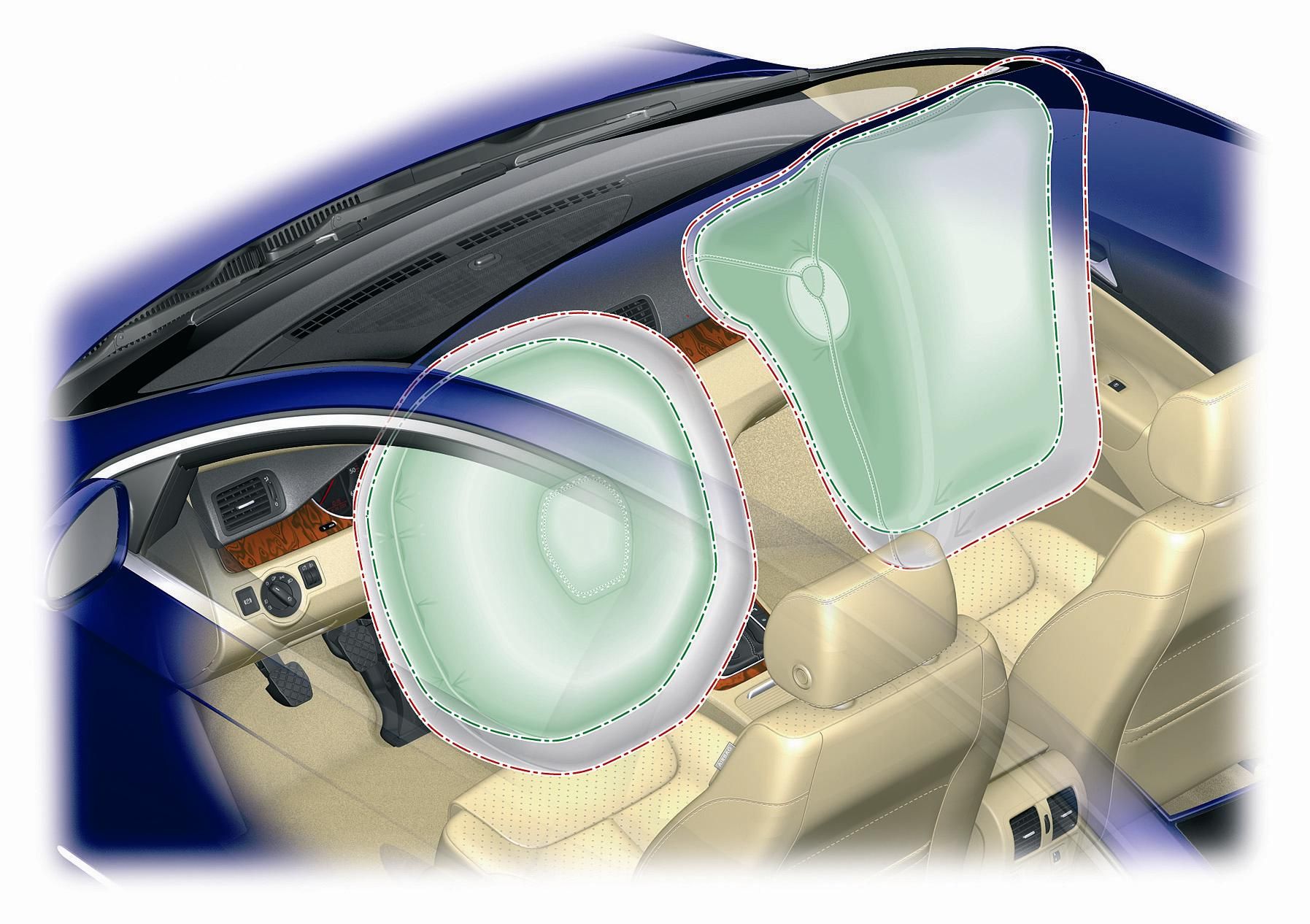 Starting and locking system: the starting and locking system with radio remote control has been completely redeveloped. There is no longer an ignition key in the conventional sense. Most of the transmitter components for unlocking and locking the central locking system have been moved into a retainer to the right of the steering wheel. The engine can now be started by pressing the transmitter. If the Passat is equipped with a keyless entry start and exit system (KESSY), the vehicle is started by pressing a button.
Adaptive cruise control (ACC): another new option available is automatic distance control. The system can be operated intuitively via a separate stalk on the steering column. The Passat brakes automatically at a speed that has been set using the cruise control as soon as the vehicle gets below a defined safety distance from the vehicle in front. When the road is free again, the vehicle accelerates until it reaches the previously set speed. The system;s radar sensor also detects critical proximity situations. It prepares the Passat or subsequent braking operations by moving the linings against the disks and sensitizing the braking assistant in order to increase the effectiveness of emergency braking.
Bluetooth telephone: the Passat now comes with an optional handsfree telephone system with a Bluetooth interface. The wireless integration of the driver’s mobile phone into the vehicle allows the driver to leave the mobile in his or her pocket. A fixed telephone installation in the car takes over the actual mobile phone functions and obtains the necessary data from a SIM card of the mobile phone. The telephone can be controlled via a separate keyboard, the multifunction steering wheel or by voice command. 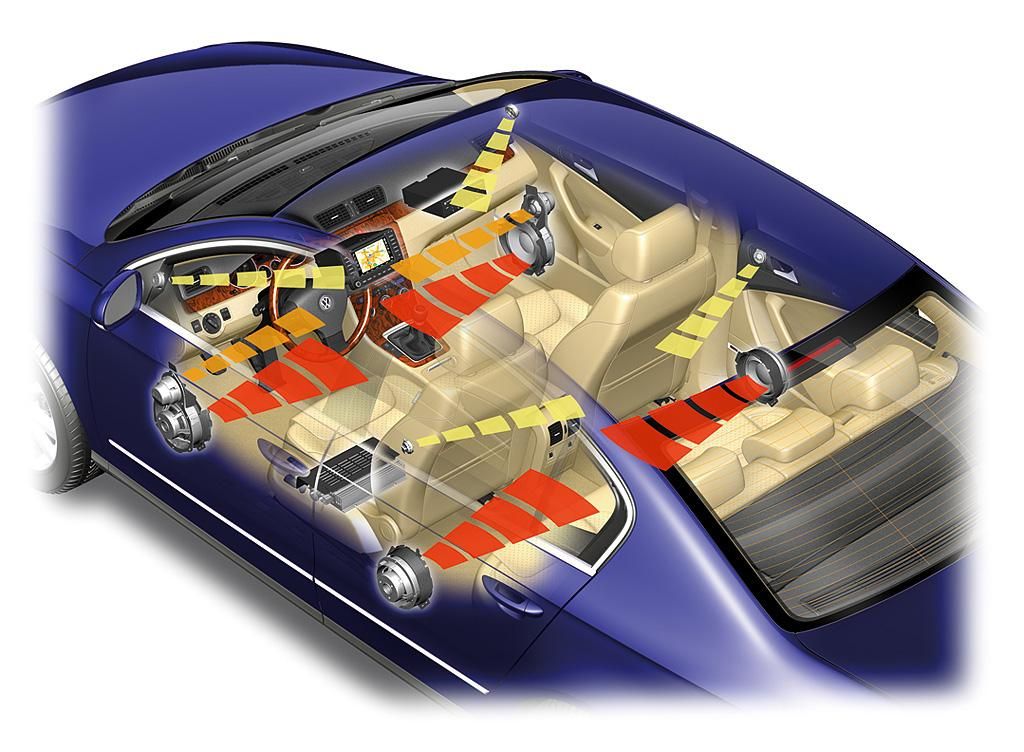 Sound systems from Dynaudio and Volkswagen: experience a really special sound when you switch on the 600 Watt high-end sound system made by Dynaudio, the Danish hi-fi specialist. The 10- channel system with its excellent components sets a new standard. As an alternative, the Passat can be equipped with a 250 Watt Volkswagen sound system. Both systems are offered in combination with the RNS MFD2-DVD navigation systems and the RCD 500 radio system.
Draft-free Climatronic air-conditioning: like it did in the Phaeton, the dual-zone automatic air conditioning system provides draughtfree ventilation at the touch of a button. It is available as part of the special equipment package.
New power supply: business travelers will welcome the facility of charging their laptops using the optional 230 V power supply. Bi-xenon headlights with corner illumination: all headlight systems have been improved significantly compared to the predecessor model, particularly the main beam. The controllable bi-xenon headlights of the new Passat also provide better long-distance visibility. The integrated dynamic corner illumination lamp follows the course of the road with a maximum swiveling angle of 15 degrees and thus ensures optimum visibility at all times. The perfect complement of this system is an additional static turn assist lamp which has major advantages due to its side alignment of about 35 degrees in relation to the vehicle axis, particularly when you turn at crossings and junctions.
Tire inflation pressure monitoring system (RDK): the sensors notify the driver of a possible tire pressure loss by means of a visual indicator. New tires with emergency running characteristics: the selfsupporting tires (SST) on the "Monza" light alloy wheels feature reinforced side walls and allow safe driving even if inflation pressure is low or the tire deflates altogether. The pressure loss is signaled by an indicator lamp.
-----
Engines
The new Passat saloon will be available with eight engines to choose from. For the first time, Volkswagen provides FSI engines with homogeneous direct injection. The output of these engines is 85 kW / 115 PS, 110 kW / 150 PS and in the case of the Turbo FSI 147 kW / 200 PS. The 3.2 liter V6 FSI engine with 184 kW / 250 PS completing the top of the range was shown for the first time at the IAA 2005 in Frankfurt. The entry-level engine is the 1.6 liter fourcylinder engine with 75 kW / 102 PS. The range of diesel engines available consists exclusively of advanced TDI engines.
Overview of petrol engines
1.6 with 75 kW: this 75 kW / 102 PS basic engine of the new Passat series is both proven and economical. Within 12.4 seconds it accelerates the saloon from 0 to 100 km/h, gives it a top speed of 190 km/h and consumes an average of 7.7 liters unleaded premium petrol per 100 kilometers. 1.6 FSI with 85 kW: the "smallest" direct-injection petrol engine in the new Passat has a power of 85 kW / 115 PS. With this engine under the bonnet, the saloon can reach a top speed of 200 km/h and can be accelerated from 0 to 100 km/h in 11.4 seconds.

And still it consumes a mere 7.5 l of unleaded premium petrol per 100 km. 2.0 FSI with 110 kW: the next level of motorization is also provided by a direct- injection petrol engine. Its four cylinders have an output of 110 kW / 150 PS, allow a top speed of 213 km/h and can sprint from 0 to 100 km/h in just 9.4 seconds. The average fuel consumption is 8.2 liters by EU standards. 2.0 TSI with 147 kW: the most powerful four-cylinder engine Volkswagen uses here is the 2.0 FSI with turbocharger and boost inter-cooling already known from the Golf GTI.
The powerful direct injection engine 147 kW / 200 PS at 5,500 rpm, and 1,984 cc speeds the Passat up from 0 to 100 km/h in a mere 7.7 seconds and makes the vehicle reach a top speed of 236 km/h. The average consumption of the 2.0 T-FSI – 8.6 liters – shows how efficiently the combination of FSI and turbocharger works.
At 10.3:1, the 2.0 T-FSI features a high compression ratio and its powerful torque (280 Newton meters between 1,800 and 5,000 rpm) makes it a superior drive unit. To be more precise, the Passat engine uses the advantages of homogeneous direct injection and combines it with the superior power of turbo-charging. The result is an extraordinary torque curve, excellent response, pure joy of driving and not even a hint of a turbo weak spot.
3.2 V6 FSI with 184 kW: a newly developed 3,169 cc V6 engine made its first appearance at the IAA 2005 in the Passat and the Passat Variant. At 6,200 rpm its output is 184 kW / 250 PS and it reaches a maximum torque of 330 Newton meters (from 2,500 and up to 3,000 rpm).
The technical basis is the six-cylinder engine with suction pipe injection known from the Phaeton. The new engine’s features include direct petrol injection (FSI), and its advantages are more power, less petrol consumption and less exhaust gas.

Thanks to its comprehensive redesign, the V6 FSI features optimized stability properties, reduced strain on components and lower weight. The standard equipment of the new Passat 3.2 V6 FSI is its dual clutch automatic transmission (DSG) and its 4MOTION four-wheel drive.
Overview of diesel engines
1.9 TDI with 77 kW: the economical and yet high-torque world of TDI engines in the Passat begins at 77 kW / 105 PS (4,000 rpm) and 250 Newton meters (1,900 rpm). The Passat 1.9 TDI reaches a top speed of 188 km/h, accelerates from 0 to 100 km/ in 12.1 seconds and consumes 5.6 l of diesel per 100 km on average. 2.0 TDI with 103 kW: 209 km/h is the top speed of the 103 kW / 140 PS (at 4,000 rpm) Passat 2.0 TDI. At only 1,800 rpm, the engine reaches its maximum torque of 320 Newton meters and speeds the car up from 0 to 100 km/h in just 9.8 seconds and to a top speed of 209 km/h.

Average diesel consumption: 5.9 liters. This TDI performance level can be combined with a diesel particle filter. 2.0 TDI with 125 kW: the second 2.0 TDI equipped with the highly nnovative piezo pump high-pressure jet injection system and a compensator shaft is a completely new design. The very quiet fourvalve TDI engine has an output of 125 kW / 170 PS (at 4,200 rpm), a torque of 350 Newton meters (1,800 to 2,500 rpm) and accelerates the saloon from 0 to 100 km/h in just 8.7 seconds. The top speed is 233 km/h. This engine also features low fuel consumption averaging at just 6.1 liters per 100 km.
-----
4MOTION in Passat
4MOTION, the four-wheel drive system from Volkswagen, offers enhanced active safety and driving pleasure. In 2006 the new Passat will be available in three different engine versions with the latest 4MOTION system. The top model of the Passat range, the 184 kW / 250 PS Passat 3.2 V6 FSI 4MOTION, has the most effective form of power distribution as standard. The 4MOTION drivetrain is available as an option with the Passat 2.0 FSI (110 kW / 150 PS) and the Passat 2.0 TDI (103 kW / 140 PS). The permanent four-wheel drive system is available for the Passat saloon and estate in combination with all equipment lines (3.2 V6 FSI 4MOTION: starting with the Comfortline).
The Passat comes equipped for the first time with a 4MOTION system featuring Haldex coupling. The coupling, which is fitted directly in the rear axle, is considerably more compact and the system works quickly, sensitively, and quietly. Four-wheel drive also delivers major advantages for towing trailers.

The Passat 3.2 V6 FSI 4MOTION, for example, pulls a hefty maximum trailer weight of 2 200 kg on uphill grades of up to 12 percent. Its gross weight rating for the rear axle is 1 220 kg. For the Passat 2.0 TDI 4MOTION a maximum trailer weight of 2 000 kg is allowed on uphill grades of up to 12 percent and 2 200 kg on up to 8 percent grades - in each case 200 kg more than with the front-wheel drive Passat 2.0 TDI. All Passat’s with a towing attachment also have ESP with special trailer stabilisation as standard.
The proven Haldex coupling is electronically controlled for optimum positive engagement. The 4MOTION system can adjust the engine torque to the road conditions and vary the distribution to all four wheels – this provides a real advantage in terms of safety and driving fun particularly on autumn and winter roads. Both engine versions come with a six-speed manual gearbox.
The average consumption of the 2.0l FSI saloon is 8.9 litres (estate: 9.0 litres). The direct-injection petrol engine accelerates from nought to 100 km/h in 9.9 seconds (estate: 10.2 seconds) and reaches a top speed of 209 km/h (estate: 206 km/h). The Passat 2.0l 110 kW/150 hp FSI fulfils the EU4 emissions standard.

The average consumption of the 2.0l TDI saloon is 6.8 litres (estate: 7.0 litres). The 2.0l TDI saloon accelerates from nought to 100 km/h in 9.9 seconds (estate: 10.5 seconds) and reaches a top speed of 204 km/h (201 km/h).
From November, the flagship engine version from the Comfortline will be the Passat 3.2l V6 FSI presented at the Frankfurt International Motor Show, which features permanent four-wheel drive and the dual-clutch gearbox (DSG) as standard. It delivers 184 kW /250 hp and develops a maximum torque of 330 Nm.
-----
Options
The Passat range has been expanded to include a new engine-gearbox combination: The 2.0 l 103 kW TDI is now available with an automatic direct shift gearbox. Other additions to the model range include safety features like cornering lights and a tyre pressure monitoring system. Auxiliary heating is now also available.
The combination of a direct shift gearbox and a TDI engine is ideal as the low consumption of the diesel engine is maintained despite the automatic transmission. The 2-litre TDI accelerates from 0 to 100 km/h in 9.8 seconds and reaches a top speed of 206 km/h. The average consumption is 6.0 litres. The Passat 2.0 l 103 kW TDI with direct shift gearbox fulfils the EU 4 emissions standard.

Safety can be increased further with several new options: The special equipment available for the Passat now also includes Bi-Xenon headlights featuring the dynamic cornering light function. A maximum swivelling angle of 15 degrees ensures optimum illumination of the road. The system is rounded off with an additional static turn-off light. Aligned to around 35 degrees to the side of the vehicle axle, these lights also illuminate the roadside when you turn into side roads.
The tyre pressure monitoring system makes another contribution to the increased safety. The wheels are equipped with sensors that send a data telegram to the convenience system control unit. The data received is compared with the preset tyre pressure. A warning indicator informs the driver when tyre pressure is lost.

A heavy-duty suspension system, which has been raised by 20 millimetres, is also new to the range. It features a stiffer damper configuration and an engine protection plate.
Comfort was one of the main focuses during development of the Passat. An auxiliary heating system is another new option. It can be switched on either with a timer switch or, if you prefer, with a remote control. The system is not only useful in the winter, the auxiliary ventilation function can also be used to reduce the temperature inside the car in the summer.
The new equipment is available for both the saloon and the estate.