
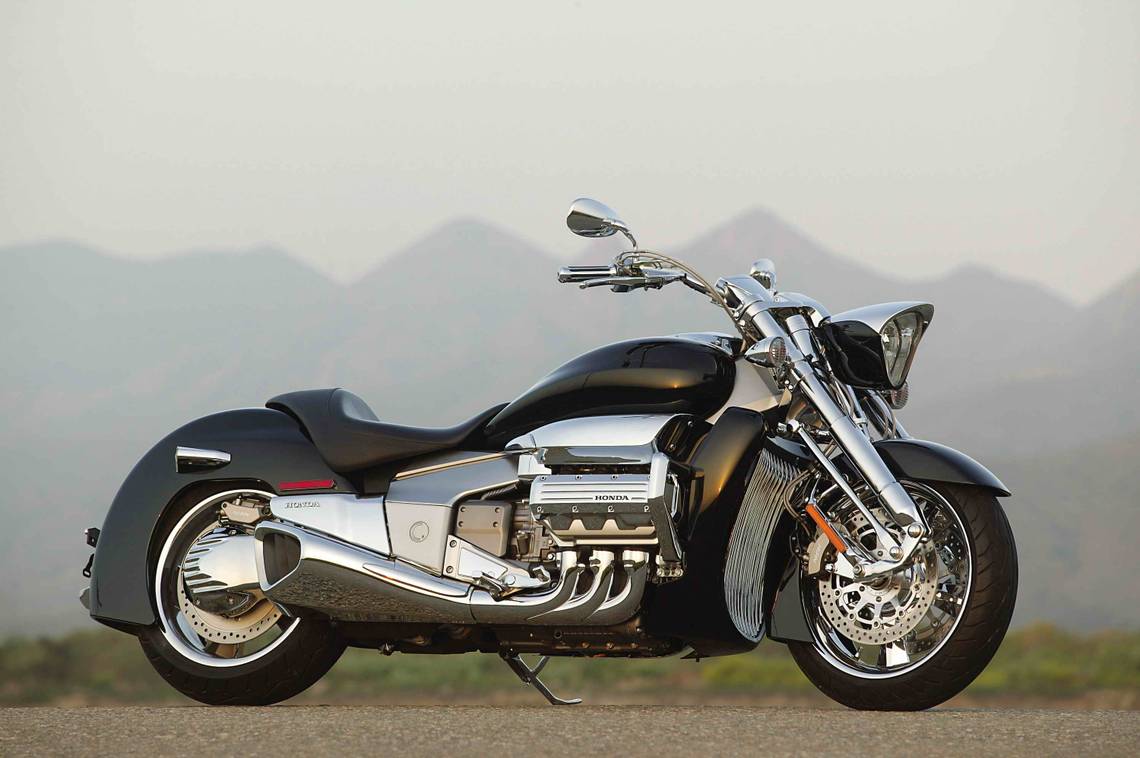
The Rune. High concept meets high performance in the ultimate expression of form and function. Cruiser styling is taken to all-new heights and blended seamlessly with Honda's most advanced technology. A masterpiece? To be sure. And it can be all yours-in your choice of three head-turning colors
2004 Honda ValKyrie Rune


- Make: Array
- Model: 2004 Honda ValKyrie Rune
- Engine/Motor: liquid-cooled horizontally opposed six-cylinder
- Horsepower: 106 HP
- Transmission: 5-speed
- [do not use] Vehicle Model: Array
Honda’s Valkyrie Rune astonishes us in a number of ways and on many levels.
After you look at the Valkyrie Rune up close and see the degree of detail and the quality of finish, it’s kind of shocking that this utterly unique 1800 flat six will sell for only $27,000 (with chromed wheels). It’s amazing that a huge company like Honda ever took the Rune past the concept-vehicle stage, that it took the time (6 years) and effort to build a limited-production piece of rolling art. The fact that it’s being built on an assembly line in Ohio also takes us aback. It’s remarkable that Honda let its designers stray this far out of their usual boxes, and that the designers could spread their wings and fly so perfectly when they were released from those boxes. We were surprised to learn that those designers — who dreamt of the Rune, who drew it, shaped it and championed every curve and angle through the processes leading to production — were mostly Americans.
And finally we are dazzled by the engineers who took this vision of the Genuine Honda Custom and managed to turn it into production reality, to make it function to Honda’s considerable standards without compromising away the designers’ sensational vision.
The example most often cited by both sides of the issue is the Rune’s radiator. The designers found a radiator that looked right and fit the space they wanted to fill. The engineers found that radiator moved about 20% of the BTUs they needed it to handle. The engineers would have rearranged the surrounding parts, reshaped the front fender and stuffed a great big radiator in there. But the designers weren’t going for that. Shapes and part placement were critical to this motorcycle. In the end, the engineers had to come up with a very efficient radiator with compound curves that pleased the designers and met Honda’s tough standards for cooling. That scenario was repeated for almost every part of the motorcycle. In virtually every case, the designers got their way and the engineers came up with technology to satisfy the vision and Honda’s technical and functional requirements.
Though we are impressed that Honda’s various motorcycle-creation divisions could meld such disparate requirements, we weren’t surprised to confirm that they had done so when we rode the bike. Though its size and radical styling scream that it should be a handful, we knew that Honda wasn’t going to manufacture a bike that was intimidating to ride. You will need a thick wallet to pilot a Valkyrie Rune, but an average riding portfolio will be sufficient.
-----

Timeline
While it's true the Rune sprung from the fertile minds of Honda's futurist designers, shades of this revolutionary machine were seen in real steel nearly 10 years ago. The Rune traces its lineage back through a line of concept vehicles all the way to 1995, when Honda revealed the radical Zodia at the Toyko Motor Show.
Zodia
The Zodia was an innovative concept cruiser, a high-tech custom showcasing engineering concepts never seen in production, and styling that blended elements of classic retro lines with new-age futuristic technology. Some of the Zodia's more shocking design elements, such as the trailing-link front suspension and single-side swingarm, are now seen in the Rune.
The Zodia's senuous body lines wrapped around many other unique features. Powered by a 1500cc maintenance-free overhead camshaft V-twin, the Zodia transferred engine power to the rear wheel via Honda's innovative hydro-mechanical automatic transmission, the HFT (Human Fitting Transmission). Braking was supplied by unique rim-mounted brakes assisted by Honda's latest generation of Linked Braking/Antilock Braking System.
The T-Series Concepts
Three years after the Zodia first appeared, Honda revealed another concept machine, this one based on the Gold Wing's horizontally opposed six cylinder engine. T1, as it was known, would be followed by three more concept bikes in the T-series, each seemingly more radical than the next. While all four began as Honda Research America (HRA) ideas and sketches, outside sources-including a master fabricator not connected with motorcycling in any way-were also tapped in order to push the boundaries of design beyond the usual limits. All the T-series concept bikes were shown to the public, and Honda carefully gauged public reaction. Of the four, T2 clearly triggered the most response. In fact, so strong was public opinion that Honda should build a motorcycle exactly like T2 that this perspective became the core objective of the Rune. Not surprisingly, the Rune and its T2 concept forebear appear nearly identical.
Concept Type 1

- First to be introduced to the public in late 1998/early 1999, T1 aims to evoke a hot-rod or muscle car image.
- Purposely abbreviated body parts shift the focus of T1 away from exterior parts and onto the engine.
- Based on a steel-tube twin-spar frame, the brightly painted frame members sweep back to lend a sporty image, one that is enhanced by the chromed, cast-aluminum swingarm pivot and stylized grab rail.
- The grab rail is faired into the rear fender (a similar treatment was given to the VTX), which is chopped for a shorty look and also sports an integrated LED taillight that produces a clean, uncluttered appearance in the rear end.
- The smoothly integrated tank/seat junction has also been echoed in the VTX, as is the handlebar-clamp mount for the speedometer-two more styling elements that make for sleek, clean lines.
- The design of the T1's exhaust pipes has been loosely derived from sportbikes and muscle cars, thereby adding to the sporty, performance image.
- The rear suspension is a distinct departure from the Pro Arm single-shock design. A cast aluminum swingarm and a chrome-plated strut lead to a single shock that purposely peeks out from under the seat and fuel tank.
Concept Type 2

- T2 blends together a neo/retro persona; retro with respect to the deep fenders and low-slung tank that are evocative of lowered and chopped roadsters from the 1940s and '50s. Yet the T2 is cutting-edge with its use of a six-cylinder engine and aluminum twin-spar frame plus Pro Arm rear suspension.
- The radiator shroud transcends function to become a full- on styling element with sweeping curves that also hark back to classic roadster grills.
- On the T2, the single-sided Pro Arm swingarm stands out in its full glory; note the massive construction!
- Taking advantage of the right-side Pro Arm, the left rear quarter has been purposely left unencumbered to highlight the gorgeous rear wheel that is perfectly framed by the strong lines of the sweeping, flared rear fender. Notice the clean and functional look provided by the knock-off wheel hub.
- The beautifully integrated, faired-in muffler was kept short to keep the rear wheel area open, but it makes its own powerful statement along the way.
- The bold, massive look to the radical two-shock trailing- link front end lends a strong mechanical presence, further feeding the neo/retro presence.
- The unique dual-bulb headlight treatment includes a projector beam in the bottom portion, which gives the headlight a very different face. Note the painted headlight shell with the chromed cap.
- With the instruments packaged into the wing-shaped handlebar cover in futuristic style, plus the flush-mounted LED taillight/turn signals, the T2 offers a distinctly neo look from head to toe.
Concept Type 3

- The drag strip served as the inspiration for the T3, with styling aimed toward a more performance-based machine rather than a pure cruiser. Note the tubular steel frame, flawless hand-formed aluminum body pieces, and air scoops on each side, in keeping with the drag bike look.
- With a raked front end, bold pipes and short fenders, the T3 takes on a very businesslike appearance.
- The sweeping fan-shaped arrays of triple exhausts on each side tickle the eyes and tease the ears; with six-into-six pipes, what would this bike sound like at full chat?!
- Drag-style handlebar and an upright speedometer lend a functional air to the T3's treatment, one that is capped off by the gigantic 230/60-16 rear tire. The conversion to chain final drive is most appropriate.
- The front wheel presents a beguiling look; the brake discs bolt up directly to the wheel's five spokes rather than through central disc carriers, creating an unusually open and airy appearance.
- The T3's rear fender offers a nicely integrated, organic style treatment as it flows curvaceously forward and downward into the seat and "side panel" area.
Concept Type 4

- Unlike the first three designer-driven T-bikes, the T4 concept is unique in its intent as a technical material study-an internal showpiece that is a rolling exercise in construction techniques. T4 was formed by the hand of master fabricator Mike McCluskey, a man who usually spends his time restoring Ford Cobras and vintage aircraft. Striking as the styling may be, it's the flawless execution and expert craftsmanship that really stand out.
- The twin-spar frame consists of three sections of solid billet aluminum per side plus the steering head; all have been milled to shape, then welded together in virtually seamless perfection. Billet aluminum triple clamps top off the exquisite front end
- The three pieces of the swingarm were likewise milled from billet, and the exposed-shaft driveshaft moved outboard for rear-wheel clearance. The driveshaft's front and rear gearcases are also milled billet items.
- Even small, unobtrusive pieces such as the front engine hanger have been milled from billet; it's a real piece of artistry in metal, squirreled away from sight.
- With flush-mounted allen head bolts and clearcoat finish over brushed aluminum, the T4 finish exudes a very mechanical presence.
- More than a styling exercise, the hand-formed aluminum chin piece also houses the radiator element within its vented confines. Note the tidy little coolant reservoir that resides on the right side of the engine.
- Nothing too subtle about the rear drag slick-it's the real deal, a 26.0 x 9.0-15. Outrageous? You bet!
- Custom-made pieces include the exhaust system, coolant tank, battery box and taillight.
-----

Technology
Honda's race team engineers first dreamed up the all-new Unit Pro-Link rear suspension system to enhance mass centralization-a key element in racing-as well as to open up possibilities in frame design. Because the top eye of the shock in the Unit Pro-Link is captured on the top of the swingarm, suspension forces aren't transmitted to the frame. And the frame itself can be opened up or lowered because a sturdy crossmember is no longer needed as a frame attachment point for the rear shock.
Of course, all that is well and fine for racing-oriented machinery, but how does this new-think engineering make a street rod better? The main benefit to the Rune is simply this: Because no rear crossmember is needed on the frame for shock attachment, the Rune's seat can be perched a mere 27.2 inches off the ground. That's about as low as it gets, which means the Rune is as cool as it gets-in this area and just about every other aspect as well.
Like the Unit Pro-Link systems used on the championship- winning 2002 RC211V MotoGP bike and the 2003 Daytona Supersport- dominating CBR600RR, the Rune's shock runs from the top of the swingarm down through the swingarm itself, to attach to a bellcrank linkage system located below. There, a pair of arms attaches the bottom shock eye to the bottom of the frame via a pair of tension links.
As the rear wheel rises in passing over a bump, the pull of the tension links rotates the arms, thereby compressing the shock from the bottom. Even though the shock itself moves upward as the swingarm moves up, a rising-rate ratio in the bellcrank system continues to compress the shock from below. Depending on the geometry of the linkage, the bottom of the shock can move more, and more rapidly, than the top of the shock; hence, the shock compresses.
Also like its sporting cousins, the Rune shock features a remote reservoir to supplement oil capacity in the damper-a bit of high- tech trickery that remains cloaked within the stylish bodywork. But don't fret about not being able to show off this tasty little tidbit; onlookers will still have plenty of eye-candy to enjoy while checking out the Rune.
Trailing Bottom-Link Front Suspension
For a while now, Honda's R&D division has piqued expectations among legions of concept bike fans as they have snared glimpses of an innovative trailing bottom-link front suspension. Now, the faithful have been rewarded as this attention-grabbing front end makes its debut on a production machine, the Rune.
The heritage of the trailing bottom-link runs through a pair of concept motorcycles that were eagerly embraced by forward- thinking fans of the sport. The distinctly futuristic Zodia made its debut in 1995 at the Tokyo Motor Show and the image of this sleek- looking concept power cruiser stayed indelibly marked in the memory of many watchful fans. Two of its more impressive elements: a trailing bottom-link front suspension and a single-sided swingarm- sound familiar? Next up was the T2 model revealed to the public in December of 2000 at a motorcycle show, where this precursor of the Rune was clearly the runaway favorite among three new concept models.
Like these two non-runners before it, the Rune uses twin pushrods to transfer suspension loads through a linkage system. These arms and links actuate what appear to be twin shocks flanking the steering head and headlight. In actuality, the right side contains only the main spring for the front suspension system, while the left shock handles damping duties and also contains a lighter weight sub- spring.
Although the brilliant finish and ground-breaking configuration appear to imply a new kind of suspension sensation, the new trailing bottom-link system has been designed to return a feel and fork action that is entirely familiar to seasoned motorcyclists. There's no need to make special accommodations for this new front end; just ride and enjoy.
Rune Engine
The most impressive looking hot rod ever conceived by Honda had to boast impressive performance credentials as well. So it should come as no surprise that the Rune is the most powerful Honda custom to ever turn a wheel on public roads.
To accomplish this goal, Honda's engineers tackled the task in classic hot-rod style. Beginning with the already massive 1832cc liquid-cooled overhead-cam horizontally opposed six-cylinder engine built in America for the new GL1800 Gold Wing, the engineering design team leaned on this touring-oriented powerplant to boost its power to impressive new heights. Six 32mm throttle bodies with 12-hole injectors replace the twin-body system used on the GL for upgraded fuel flow and a freer flowing system. New camshafts, revised 3-D fuel injection and ignition timing mapping, along with a new close- ratio gearbox all help make the Rune a true road warrior, with more torque than any other two-wheeler around. In addition, a 6.9-liter airbox supplies large volumes of clean, cool air to the engine, and a free-flowing six-into-two exhaust system delivers added power along with a lumpy-sounding and surprisingly authoritative growl that grows to an inspired howl at full throttle.
All of which gives the Rune a full measure of impressive performance to match its impressive countenance.
-----

Overview
No manufacturer, including Honda, has ever constructed a motorcycle like the Valkyrie Rune. The conceptual forces driving the shape and face of the Rune were pure flights of imagination, a designer's dream come true. Unfettered by budget or engineering restraints, Honda's R&D group was free to push past conventional boundaries, taking the Rune squarely into uncharted territory.
The result is pure mechanical magic. A stylish and strong diamond-shape aluminum frame stretches over a massive 68.9- inch wheelbase, the longest in Honda history. The largest disc brakes fitted to a production Honda motorcycle can be found at both ends-dual 330mm discs up front with a 336mm unit in back-and they are integrated by Honda's Combined Brake System. Then there's the Rune's innovative suspension system, a trailing bottom-link fork in front, and single-shock Unit Pro-Link rear system that first saw action in the MotoGP wars.
This innovative chassis wraps around a muscular 1832cc six-cylinder engine that's been hot-rodded for serious road work, and rigid mounted to help impart a direct mechanical feel, and compliment the Rune's solid handling manners. Throw in an exquisite seamless 6.2-gallon fuel tank, ultra-low seat, a choice between two handlebar options, flush-mounted LED taillights, plus a unique remote steering lock that unlocks automatically when you turn the key on, and you know without a doubt you've got your hands on something special indeed.
Deep roots run true
For all its innovation, however, the roots of the Rune can be traced back to earlier designs and models in the Honda arsenal. In conceptual terms, much of the Rune's spirit was inspired by the Zodia, a stunningly gorgeous concept cruiser first unveiled at the Tokyo Motor Show in 1995.
Beyond its sensuous lines, the Zodia also brought a host of forward-thinking engineering concepts into the spotlight, and more than a few of the most prominent elements have now become reality in the Rune. Trailing-link front suspension. Single-side swingarm. Custom styled wheels on prominent display. The Zodia serves as harbinger of all this and more.
The advent of the power cruiser
In 1996, Honda unfurled another stunning flight of fancy, but in this case it was a genuine hands-on production model with a commanding presence: the six-cylinder Valkyrie, the first genuine OEM power cruiser. Boasting a hot-rodded 1520cc engine derived from the legendary GL1500 Gold Wing, the first Valkyrie demolished existing performance standards by churning out more than 100 horsepower and 100 pounds-feet of torque-right off the showroom floor! The Valkyrie's modern-era hot-rod custom styling, confidence- inspiring handling and startling acceleration placed this breakthrough motorcycle into a class of its own.
Art becomes life
The strong response and loyal following inspired by the Valkyrie prodded exploration into new spheres of design, all revolving around the horizontally opposed six-cylinder engine. What kinds of new designs could the most creative minds in the world dream up, given enough latitude? That question was answered in December of 2000, when Honda made its first showing of three new concept bikes, which accompanied an earlier design model.
Dubbed T1, T2, T3, and T4, these ground-breaking pieces of rolling art were put on display during a motorcycle show in Long Beach, California, and the public response was overwhelming. Hordes of motorcycle enthusiasts fell head-over-heels in love with these exquisite forms, but only one emerged as the clear favorite: T2. From this concept, the Rune was born.
The power of dreams
At its inception, Honda established a firm foundation as an engineering-driven company, and that reputation has only continued to grow evermore dominant over the decades. However, Honda is also a company that dreams-as the Honda Dream, one of its earliest models, can ably attest. So it should really be no surprise that excellence of engineering and the wildest extremes of the imagination can actually take form together at Honda, melded into the shape of the new Rune.
The Rune is not only the most powerful cruiser Honda has ever produced, it is also arguably the most extravagant demonstration of styling, engineering and production prowess ever to set two wheels on paved roads. The Rune carries the aura of a one-off custom special, but its stylish form has also been infused with an elegance of engineering that could be created only within the most modern multi-million-dollar production facility on the planet.
Only at Honda can the wildest dreams become reality. And the new Valkyrie Rune will soon herald that message, all across the land.
-----

A View From The Top
As Vice President of the Motorcycle Division at American Honda, Ray Blank carries a full load of responsibilities that must surely seem endless at times. However, there are those special occasions when he can revert to being a motorcycle enthusiast, plain and simple. And the decision to move forward with the Rune was such an occasion, one that required as much heart for motorcycles as business foresight. Here, Ray Blank fills us in on some of those decisions and details that made the Rune a reality.
How did the idea of producing the Rune originate?
We were looking to take the original Valkyrie to the next level. When it was first introduced, this bike, which had been derived from the 1520cc Gold Wing, had a significant impact on the motorcycle market. The Valkyrie was the first genuine power cruiser, a custom-styled motorcycle that had plenty of muscle, great handling and long-distance touring abilities to go along with its good looks. It really expanded the notion of what a cruiser's functional capabilities could encompass, and in doing so the Valkyrie built an unusually strong following.
So we wanted to extend this concept once again and take another cutting-edge motorcycle into uncharted territory, establishing new directions that no other manufacturer had ever attempted. We wanted to set the bar higher than ever, erecting standards that no one else had yet imagined, while also exploding old limitations on what an original equipment manufacturer could mass produce.
Were there any precursors that contributed to the Rune's design?
Yes, of course. When our R&D department develops concept models, everyone within the company looks these things over very carefully, and the enthusiast within every person naturally tends to pick favorite elements and models. It's the same kind of reaction all motorcyclists experience when viewing a cool concept bike, but we can add the caveat-sometimes-of, "What if."
In this case, we looked back at the Zodia concept bike Honda introduced in 1995. It had a look many of us remembered fondly, largely because of the trailing-link front suspension system. With this idea still fresh in our memories, we asked the designers at Honda Research Americas (HRA) to include this look in a series of concept bikes based on the big-inch GL six-cylinder engine.
What was the result of that work?
The design that HRA called T2 proved to be a truly exceptional accomplishment. There was a strong positive reaction from within Honda circles. We then revealed T2 to the public, and their reaction was the same. The most amazing thing about this reaction was the overwhelming consensus from all parties that the entire T2 design should be retained as a whole; it wasn't just a few parts that struck people's emotions, it was the entire bike. So we decided to preserve the design through production as an intact entity.
How does that differ from typical product planning?
You have to remember that Honda's greatest strength is its engineering ability. Function, horsepower, performance, durability-a lot of very measurable qualities. But now here we were, championing the production of what was essentially a one-off custom special, a show bike with a whole set of gut-level aesthetic qualities that are impossible to measure.
The Rune concept is extremely extravagant, because it places the highest priorities on style rather than measurable science and engineering, and that created challenges during product planning. It is a very emotional product. But when a gut feeling is so strong, avid motorcyclists can communicate with one another on a different level. We accomplished a lot on this new concept after hours, at restaurants, just motorcycle guys talking to each other, scribbling on napkins, waving our hands around.
What was it that finally clinched the idea of producing the Rune?
A lot of people looked at the T2 and said, "Great bike, but it could never be produced." That's the kind of challenge that fueled this project. Honda has a long history of building improbable machines, and making them successful. The CB750, the Gold Wing, the RC211V-there is nothing conventional about these machines, and building them expanded Honda's capabilities. The Rune expands our capability in yet another direction, blurring the line between concept and reality, and pushing our production capabilities to new levels. In the end, that's what makes the Rune unique beyond its elegant design and styling.
-----

Bringing The Dream To Reality
As Large Project Leader (LPL) on the Valkyrie Rune, Masanori Aoki was challenged to make a personal and professional odyssey of sorts. Originally a specialist in Honda sport bikes, Aoki brought to bear those high-performance tricks of the trade while designing the new-generation Gold Wing, the GL1800, which has more sporting appeal and ability than most people ever imagined possible.
Armed with such an intimate knowledge of F6 design and production, he was called upon to work his engineering sleight-of-hand once more with the Rune, producing a machine the likes of which has never been attempted. How did Aoki accomplish that task? That's exactly what we asked.
Usually new models begin with an engineering design, but the Valkyrie Rune design was created from an HRA prototype model. Has Honda ever done this before, starting with a styling model?
There were some production machines that started with styling models but the Rune is the first model that reproduced the original design fully and faithfully.
What other vehicles did the Rune/T2 mock-up remind you of?
Because the Rune/T2 mock-up is a new design with a full measure of originality, no other motorcycles come to my mind. When I think about automobiles, however, it brings the images of American cars from the 1940s and 1950s.
What did you think as an engineer when you were first assigned to create a running replica of a styling design? Did this process seem backward?
To be honest with you, I thought it would be impossible to mass-produce the product without changing the styling design. It was just too radical of a design. And yes, as an engineer I thought the process was completely backward; we've never seen anything like this before.
With the sport bikes you've worked on and even the GL1800, you probably began the projects with a certain engineering mindset. How did you approach the Rune assignment, which was styling oriented above all?
Since there were no distinct function or performance goals that had to be met, we were free to focus on capturing the styling and design from the mock-up. That included all elements such as the location of the front and rear tires, and the location, position and dimension of the engine.
To that end, we had to spend a significant amount of time creating a clay model to maintain the original design. Also, we had to incorporate 11 new technological and production methods to achieve our goals-that's a significant amount of new production technology.
Was it easy for you to relate to the Rune/T2 from the start, or did you have a time when you finally embraced the concept in full?
Honestly speaking, when I first saw the T2, I said to myself, "Are we really going to produce a motorcycle like this?" It was pretty wild looking. But when I attended the Cycle World motorcycle show held in Long Beach and saw the reaction from the customers on a first-hand basis, I completely grasped the concept.
We were hoping that the T1 mock-up would be most popular because new-model development had already begun based on the T1. Frankly speaking, people at the show who saw the T2 mock-up expressed a most unusual degree of excitement. In fact, the customer response was so strong it was difficult for many Japanese to understand such enthusiasm. The T2 was nearly four times more popular than any of the other designs-far and away the overwhelming favorite. I remember how one person even said, "I will bring $30,000 in cash, so please sell it to me right away."
How did your experience with the GL1800 help you with the Rune project?
During the development time I spent in preparation for the GL1800, I learned how Americans enjoy riding motorcycles. The Rune has similar aspects such as "enjoying the appearance" and "enjoying the exhaust sound" besides the more measurable aspects of a motorcycle such as accelerating, stopping and going around curves.
Our understanding is that the Rune exhaust system was one of the more difficult challenges to overcome. Why was this so, and how did you solve the challenge?
The styling design had already been decided, and the short length posed a potential problem with exhaust pipe volume. Also, we wanted the Rune to have a distinctive exhaust sound that was a reflection of the bike's visual image. So we had to design a unique silencer, and we changed things in the exhaust collector. Also, to achieve the complex shape of the muffler end cap, we employed the lost-wax casting technique, a manufacturing method typically not used in the motorcycle industry. But when I look at the production version of the Rune, I can smile and know that all the work was worth it in the end.
-----

Features
Bringing concept to reality like never before, the 2004 Rune is a limited-edition hot-rod designed to turn heads even faster than it turns the 1/4-mile.
Unique Features
- Revolutionary Unit Pro-Link rear suspension.
- Trailing-link front suspension.
- Fuel-injection system with six 32mm throttle bodies.
- Seamless 6.1-gallon fuel tank.
- Chrome-plated clutch master cylinder, front brake master cylinder and lever.
- Honda Ignition Security System (H.I.S.S.).
- LED taillight flush-mounted in the rear fender.
- Remote steering lock automatically unlocks when the key is turned to the On position.
- A 68.9-inch wheelbase, the longest in Honda's lineup.
- Largest front and rear brake discs ever fitted on a production Honda motorcycle.
Engine/Drivetrain
- Liquid-cooled horizontally opposed fuel-injected 1832cc six-cylinder engine provides the ultimate in hot-rod style and performance.
- Six 32mm synchronized throttle bodies deliver air to six specially designed Denso 12-hole programmed fuel injectors, producing an atomized fuel mixture that is highly combustible for optimum efficiency and power.
- Parallel two-valve cylinder head design utilizes direct shim-under-bucket valve actuation and requires no 600-mile service. First valve clearance inspection is at 32,000 miles.
- 6.9-liter airbox supplies a large volume of cool, clean air to the engine for maximum performance.
- Rigid-mount engine designed to accent the impressive looks and feel of the unrivaled, largest-displacement F6 engine.
- Chrome cylinder head covers give a unique muscle- car image.
- Two front-mounted radiators with chrome cover provide optimum cooling efficiency for increased engine performance and the ultimate in hot-rod style.
- Rotary Air Control Valve (RACV) provides auto- choke function and maintains precise idle control under widely varying engine loads and operating temperatures.
- Six-into-two exhaust system for the ultimate in hot- rod appearance and sound.
- Maintenance-free hydraulic clutch, electronic ignition and chain-driven camshafts reduce servicing time and cost.
- Powerful, 1100-watt alternator offers plenty of power for electrical accessories.
- Quiet and virtually maintenance-free shaft drive.
- Smooth shifting five-speed transmission.
- California version meets CARB 2004 emission standards.
Chassis/Suspension
- Unique aluminum diamond-shape frame has a style all its own. Chassis features the longest wheelbase in Honda's lineup at 68.9 inches.
- Trailing bottom-link front suspension transfers axle load through pushrods and linkage to two upper shocks--one housing the main spring and one a sub-spring and damping system. This unique suspension system offers 3.9 inches of compliant travel and excellent stability.
- New Unit Pro-Link rear suspension is patterned after RC211V GP racer's. The upper shock mount is contained within the swingarm rather than the frame. With no top frame-mount for the shock, this unique system eliminates negative suspension energy from being transmitted into the frame, allowing optimum frame rigidity and better handling in corners. The Unit Pro-Link design also permits a low seat height of 27.2 inches, and 3.9 inches of wheel travel.
- Dual 330mm front and single rear 336mm disc brakes are the largest used on a production Honda.
- The Rune's braking system features two three-piston front calipers and a single two-piston rear caliper. Rider application of the front brake lever activates the two outer pistons of the front calipers. Application of the rear brake pedal activates the two pistons of the rear caliper and the center pistons of the front calipers. When only the rear brake pedal is used, an inline delay valve smooths application of the front calipers' center pistons.
- Large, comfortable gunfighter-style seat.
- Two wheel options will be offered: chrome and Spec47 silver painted wheels.
- Large-section radial tires--a 180/55R-17 rear and 150/60R-18 front--provide superb grip and an excellent ride.
Additional Features
- Honda Ignition Security System (H.I.S.S.) features a fail-safe electronic interlock that prevents the engine from being started in any way other than with the two original keys. Totally disabling the engine at the very heart of its ignition system, it cannot be bypassed by either hot-wiring the ignition or exchanging the ignition switch module, greatly reducing the possibility of theft.
- Remote steering lock system is activated by pulling a lever on left side of motorcycle. With key in Off position and the handlebar in full-lock-left position, a piston is inserted into the steering stem. System is automatically unlocked when key is turned to On position.
- Chrome-plated clutch master cylinder, front brake master cylinder and lever.
- Stainless steel mesh throttle cable adds to custom look.
- Stainless steel mesh brake hose.
- Seamless 6.1-gallon fuel tank for genuine custom look.
- Distinctive chrome headlight features two 55-watt H7 bulbs. In low-beam operation, the upper bulb is on. Select high beam and both bulbs are on for maximum illumination.
- Tank-mounted instruments are recessed, and feature a non-glare digital readout for speedometer, fuel gauge, tripmeter and odometer.
- Two handlebar options to choose from: Rear-Set and Forward-Set. Rear-Set handlebar is 50mm closer to the rider and 20mm lower than Forward-Set. Forward-Set handlebar is 50mm farther from the rider and 20mm higher than Rear-Set.
- Handlebar-mounted indicator lights for oil pressure, fuel injection, high beam, turn signal, neutral, coolant temperature and locking system.
- LED taillights are mounted flush in the rear fender for a one-off custom look.
- Low, 27.2-inch seat height adds to long and low custom look.
- Convenient push-to-cancel turn-signal switch.
- Handlebar switches and controls use internationally approved ISO graphic symbols.
- Large-diameter custom handgrips feature a new design with comfortable rubber strips integrated in a stainless steel finish.
- Machined stainless steel oil-level dip-stick.
- Chrome-plated radiator cover gives hot-rod look.
- Assembled in Marysville, Ohio.
- Transferable three-year unlimited-mileage limited warranty; extended coverage available with a Honda Protection Plan.
- Ownership includes one-year complimentary Membership in the Honda Rider's Club of America. Benefits include discounts, travel benefits, roadside assistance and much more. For HRCA details, call 1-800-847-HRCA.
* Honda First--Represents the first use of a significant technology on a mass-production motorcycle.
-----

SPECS
Model: NRX1800
Engine Type: 1832cc liquid-cooled horizontally opposed six-cylinder
Bore and Stroke: 74mm x 71mm
Compression Ratio: 9.8:1
Valve Train: SOHC; two valves per cylinder
Carburetion: PGM-FI with automatic choke
Ignition: Computer-controlled digital with three-dimensional mapping
Transmission: Five-speed
Final Drive: Shaft
Suspension:
- Front: Trailing bottom-link; 3.9 inches of travel
- Rear: Unit Pro-Link with single shock; 3.9 inches of travel
Brakes:
- Front: Dual full-floating 330mm discs with three-piston calipers
- Rear: Single 336mm disc with two-piston caliper
Tires:
- Front: 150/60R-18 radial
- Rear: 180/55R-17 radial
Wheelbase: 68.9 inches
Seat Height: 27.2 inches
Dry Weight: 794 pounds
Fuel Capacity: 6.1 gallons
Colors:
- Illusion Blue
- Double Clear Coat Black
- Candy Black Cherry
California version differs slightly due to emissions equipment.
Specifications and feature details subject to change without notice.