
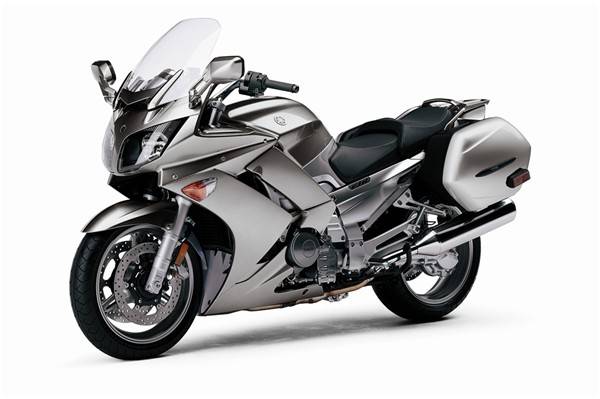
All the performance, comfort and refinement you expect with effortless electric shifting using barmounted paddle or the foot-operated gearshift. Super Sport touring has never been so smooth.
2007 Yamaha FJR1300AE


- Make: Array
- Model: 2007 Yamaha FJR1300AE
- Engine/Motor: liquid-cooled, 16-valve, DOHC, inline four-cylinder
- Horsepower: 145 HP@ 8000 RPM
- Torque: 99 lbs/ft@ 7000 RPM
- Transmission: 5-speed
- [do not use] Vehicle Model: Array
Features
Key Features:
Yamaha exclusive electric-shift five-speed transmission eliminates the clutch lever entirely—now you can click off super smooth shifts using either the left bar-mounted paddles or the foot-operated gearshift lever.
145 horsepower, a light and rigid aluminum frame, sportbike running gear and standard hard sidebags go beautifully together.
Pushbutton adjustable windscreen and a thick comfy seat for two are perfect for comfortable, long-distance riding.
The world’s first supersport touring bike boasts standard ABS and adjustable ergonomics—that widen the gap between it and common sport tourers to a gaping chasm.
Advanced air management system and adjustable bodywork, keep the FJR rider looking and feeling cool.
Engine:
Compact, lightweight 1298cc, DOHC, 16-valve, liquid-cooled inline four-cylinder engine delivers power and torque (145 hp @ 8000 rpm and 99 ft.-lbs. of torque @ 7000 rpm) for an unequaled spread of muscle over a wide rpm range.
Another Yamaha first: a computer operated clutch and electronic shift actuators eliminate the need to operate the clutch. Yamaha Chip Control Shifting snaps off clean upshifts and downshifts every time using either the left bar-mounted paddles or the low-effort foot shifter.
Engine is a fully stressed chassis member, allowing for a lightweight frame design.
Curved radiator with custom ducting and twin-ring cooling fans keep engine and cockpit cool.
Slant-block engine design uses stacked, tri-axis gearbox shafts that help minimize powerplant size while optimizing chassis geometry for balanced weight distribution and great handling.
Lightweight forged pistons with carburized connecting rods provide superb strength and reduced reciprocating mass for outstanding high-rpm durability.
Patented electroplated ceramic composite cylinder bores ensure greater heat dissipation and thus reduced frictional power loss.
Advanced fuel injection system is ideal for long-distance supersport-touring, delivering crisp, seamless throttle response in a variety of altitude/weather conditions.
Gear shift shaft features a needle-roller bearing to reduce friction for silky-smooth shifting.
Shaft final drive system is super-durable and virtually maintenance-free.
Low-vibration crankshaft with two gear-driven secondary counterbalancers help deliver a glass-smooth ride with reduced rider/passenger fatigue.
Constant-mesh 5-speed transmission utilizes wide ratios to deliver relaxed long-distance touring performance combined with seamless power and acceleration.
Four-into-one-into-two stainless steel exhaust optimizes engine performance across the powerband.
Wet-sump oil system uses an easy-access cartridge-type oil filter mounted on the engine’s left side.
Chassis/Suspension:
Sharp-looking bodywork and air-management system keep the bike and rider cooler; a central vent beneath the instrument panel cools the rider and reduces negative pressure, and fairing side panels with 1.2-inch adjustability let the rider direct airflow.
Adjustable ergonomics: the seat can be adjusted up or down by nearly an inch, and handlebar pullback angle is three-position adjustable over a half-inch range.
Long swingarm provides even better ride and handling characteristics, and rear spring preload adjustment is a snap.
Standard equipment Unified Braking System w/ABS: The front brake lever activates six of the eight front braking pistons and two rear pistons; the rear brake pedal activates two rear pistons and the other two front pistons—for balanced anti-lock braking in all conditions.
Ergonomically shaped, large-capacity, 6.6-gallon fuel tank offers excellent comfort and range and is constructed of steel allowing for the use of magnetic tankbags.
Tall overall secondary gearing reduces engine rpm for more comfortable long-distance cruising.
Rear frame with integrated grab handle makes lifting the bike onto the centerstand a snap.
An additional catalyst and a heated O2 sensor are located in the exhaust for increased control range and low emissions.
Additional Features:
Slim profile even with bags in place for excellent in-town maneuverability.
Subframe-fitted quick-release luggage mounts provide easy use of the standard accessory hard sidecases, which are conveniently matched to the ignition key.
Long dual seat features two-part construction using different foam densities for the front and rear sections, ensuring plush comfort for both rider and passenger.
Big windscreen adjusts over a wide range, for improved wind protection with little negative pressure.
Instrument panel contains an electronic analog speedometer and tachometer; LCD digital odometer, dual tripmeters, gear position indicator, fuel, coolant and air temperature gauges, and clock; lights for neutral, high beam, turn signals, low oil and engine warnings—as well as real-time mileage, average mileage and air temperature.
Sleek, cat-eye dual 12V 60/55-watt multi-reflector headlights throws an extremely broad beam for superb visibility and feature easy-access adjustment knobs; mirrors are easy to adjust and retract horizontally.
Powerful dual-bulb taillight features integrated turn signals for a slick, one-piece look that’s aerodynamic and conspicuous.
Integrated front turn signals with clear lenses add to the FJR1300’s cutting-edge aerodynamic bodywork.
Glove box contains a 12V outlet for phones, GPS units, electric vests, etc.
Standard toolkit located in convenient storage compartment under passenger seat.

-----
SPECS

Engine
Type: 1,298cc, liquid-cooled, 16-valve, DOHC, inline four-cylinder
Bore x Stroke: 79 x 66.2mm
Compression Ratio: 10.8:1
Carburetion: Fuel injection (FI)
Ignition: Digital TCI
Transmission: 5-speed w/Yamaha Chip-Controled Shift
Final Drive: Shaft
Chassis
Suspension/Front: 48mm Soqi telescopic fork w/adjustable preload, compression and rebound damping; 5.4" travel
Suspension/Rear: Single shock, link-type, w/adjustable preload and rebound damping; 4.8" travel
Brakes/Front: Dual 320mm discs w/4-piston calipers
Brakes/Rear: 282mm disc, CBS ABS standard
Tires/Front: 120/70-ZR17 radial
Tires/Rear: 180/55-ZR17 radial
Dimensions
Length: 88.2"
Width: 29.3"
Height: 52.4"
Seat Height: 31.5”- 32.3"
Wheelbase: 60.6"
Ground Clearance: 5.3"
Rake: 26°
Trail: 4.3”
Fuel Capacity: 6.6 gal.
Dry Weight: 593 lbs.
Other
Warranty: 1 Year (Limited Factory Warranty)
MSRP: $15,599 (Cerulean Silver)

-----

Change is good
When Yamaha introduced the FJR1300 in the summer of 2002 as an early-release 2003 model, it hoped to attract younger- than-average riders to the sport touring segment by touting the bike's sport abilities more than its touring qualities. Yamaha even went as far as to dub the bike a "Supersport Tourer." Whatever the name, the Sport Touring market has grown 35% since 2002, according to Motorcycle Industry Council figures, and Yamaha's FJR1300, as of 2005, owns 28% of that market.
Yamaha's intent with the new versions of the FJR is to grab more market share, with the 1300 A retaining its athletic capability while offering better comfort to more touring oriented riders and with the 1300AE, and its clutchless shifter, offering better convenience to commuters and newer riders.
Change is good, but Yamaha Engineers knew better than to mess with the FJR’s heart and soul, its engine. The Yamaha's hollow, cast aluminum main frame also remains unchanged, but the rest of the chassis has received several evolutionary enhancements. The bolt-on sub-frame has been redesigned to be narrower, which allows the same 8.0-gallon-capacity hard saddlebags to be moved inward, reducing the FJRs width at the bags by two inches and adding to maneuverability. The new sub-frame also incorporates a sturdy and effective handle with which to lift the bike onto its standard centerstand and an alternate position for the seat, providing a high and low option, a difference of 20mm.
The latest model's handlebars are also adjustable front-to-back by 11 mm, thanks to three different mounting points on the top triple clamp, while the passenger footpegs have been repositioned further down, forward and outward for better long-range passenger comfort. The windscreen, adjustable on-the-fly via a toggle switch on the left handlebar, now extends nearly 50mm higher and 25mm closer to the rider to reduce buffeting in the cockpit area.
Many subtle changes have been made to control wind flow and improve rider comfort, including additional air ducts in the bodywork and dashboard to control air reaching the rider as well as adjustable side fairings to direct cold air away from the rider. Changes made to send more cooling air to the engine include passages cast into the steering head, more space above the radiator and between the front of the fuel tank and the frame rails, more space between the bottom of the fuel tank and the top of the engine, and a larger, more efficient, curved radiator with twin fans.
Both of the FJR1300 models come with a new Unified Braking System (UBS), which Yamaha claims is carefully designed to avoid the most common criticism of other linked front and rear brake systems - taking individual front and rear brake operation away from experienced and sport-oriented riders.
The most significant change to the FJR1300, however, is the availability of the amazing YCC-S system on the AE version.
First things first, this is not an automatic transmission. Under no circumstances will the YCC-S ever shift without being commanded to, up or down. If you come to a stop in fourth gear, the bike will stay in fourth gear until you shift it back to first. If you run first gear out until its hits the rev limiter it will not shift into second gear until the rider tells it to.
Secondly, the YCC-S system is not meant for enhanced performance; in other words, it was not designed for faster lap times or quicker elapsed times at the drag strip.
Instead, the system was meant as a convenience, to offer unobtrusive, clutchless shifting to enhance comfort and reduce fatigue while commuting and on long trips—and maybe to suck in a new rider or two.
In essence, the YCC-S system is a computer-controlled clutch and shift actuation system bolted onto a standard FJR1300 five-speed transmission and fully integrated with a Engine Control Module (ECM) unique to the AE model. The rider tells the system he or she wants to shift up a gear with a lift of the left foot pedal or a pull of the index finger on a mountain-bike-style trigger shifter on the left handlebar. To go down a gear, the rider uses his or her left foot to depress the foot pedal or left thumb to press the shifter under the left handlebar. A downshift can also be accomplished by flicking the trigger shifter outward with the left index finger, a method that proved easiest due to the hard- to-reach location, under the horn button, of the thumb portion of the hand shifter assembly.
Upshift or downshift, the rider doesn't have to do anything else, not even lift off the throttle, although feathering the throttle, as done during normal clutchless power-shifting at the racetrack, results in a much quicker shift time. To help the rider keep track of gears, a gear position indicator has been added to the new and very effective gauge cluster.
After starting and warming up the FJR-AE, the hand shifter must be activated by pressing a button on the left handlebar. Then with the lightest of brushes from the index finger against the trigger shifter, first gear is selected and confirmed with an audible thunk from the transmission and a "1" in the gear indicator on the dashboard.
Pulling away from a dead stop the first time can be tricky, but after two or three times, the transition from stop to go was learned and never forgotten.
Once underway, shifting becomes an easy flick of the finger. After years of shifting gears with my left foot I quickly abandoned the practice without hesitation and regret. And I soon discovered I could shift up and down with only my index finger rather than risk an embarrassing toot of the horn if I missed the thumb shifter, something that happened all day long during the bike’s press introduction.
Riding a 180-mile loop north and east from San Diego on freeways through two-lane sub- urban roads, east over two-lane country highways, around serpentine sportbike curves and back southwest again, we were able to try the YCC-S in many different situations.
First, YCC-S wasn't intended for drag-race starts, but opening the throttle from a stop does result in a very rapid acceleration. Downshifts can also be made while the throttle is held open, but the system will not allow a downshift that will make the engine over-rev.
One thing the YCC-S can do better than most humans, however, is pull away from a dead stop in third gear. The system knows what gear it is in, but without demanding a down- shift, it will take any throttle opening given and try to get the bike going as smoothly and quickly as it can by, again, slipping the clutch just right. 0f course, downshifting at high rpm, upshifting with a wide open throttle, and pulling away from a stop in third gear all will have a negative effect on clutch life expectancy.
Aside from the YCC-S sp tem, the FJR1300 really lives up to its "Supersport Touring" billing. For a 600-pound, 60-inch-long motorcycle, it goes, stops and turns better than anybody would expect it to. The engine produces enough torque at low rpm to propel the bike, rider and passenger out a corner with authority and enough horsepower to significantly shorten the distance between points A and B.
In terms of rider comfort, the FJR1300 had to be one of the most-if not the most comfortable-motorcycles I've ever ridden. In addition to the suspension, the seating position (with the seat at its lower of two settings and the handlebars at the middle setting) was nearly perfect for long distance riding with a few corners thrown in, and the thick foam of the seat was soft and supportive at the same time. When raised into its full upright position, the windscreen provided a sizeable pocket of still air, but this position resulted in I excessive turbulence and wind noise for this 74-inch-tall rider. I preferred the wind- screen all the way down in order to get the cleanest possible blast of wind at my helmet. And finally the adjustable and speed-sensitive heated grips, which are available on the FJR-AE only, proved effective on a 55-degree morning freeway ride when set at the lowest setting.
-----

YCC-S Electric Shift System
What is it?
The YCC-S system is essentially a manual transmission with a computer controlled clutch. Internally, the FJR1300’s 5-speed transmission and clutch remain intact; however, we’ve added a clutch controller and electronic shift actuator all connected to a sophisticated computer to provide perfect, clutchless manual shifting in any situation.
What it is NOT!
It is not an automatic, CVT, or like any “pushbutton” or “tiptronic” transmission found in most passenger cars, ATVs, scooters or snowmobiles. All of these systems use some form of torque converter or centrifugal clutch. The all-new FJR1300AE is a true manual transmission that borrows its technology right from Formula 1 cars and exotic sports cars where only the absolute best will do. The YCC-S system will not shift by itself and the rider still must complete every shift when accelerating or coming to a stop just like any other manual transmission.
Who is it for?
The YCC-S system is not for the lazy or uninspired, rather the system was designed to eliminate the fatigue of operating the clutch, and put more emphasis on the enjoyment of the ride, particularly on long trips or in traffic. The system responds quickly to the riders commands and is designed to be unobtrusive. Although it is not for everyone, the YCC-S system is state of the art and groundbreaking and provides a riding experience like no other motorcycle on the market.
HOW DOES IT WORK?
Shifting: You have 2 options to shift, either the standard foot shifter or the left hand push/pull shifter. The gear shift pattern is 5 up – neutral is at the very bottom of the shift pattern.


Activating the push/pull shifter: Once the main switch is turned on, push the button on the left handle switch. A green light will illuminate just to the side of the button to indicate the system is activated. This can be done at anytime as long as the main switch is on. If you do not activate the system, you will only be able to shift using the foot shifter and either one can be used with the system activated.

Starting from a complete stop: Once the engine is started and in neutral, shift up into 1st gear. The system will not allow you to shift out of neutral if the throttle is opened. When in gear, the system automatically disengages the clutch and the bike will not move. To start moving, open the throttle at whatever rate you wish. The YCC-S computer and clutch actuator smoothly modulates the clutch as you build ground speed and the bike will accelerate just as if you were operating the clutch yourself.
Upshifting: To upshift, click up on the foot shifter, or if you choose to activate the hand shifter, pull the handlebar mounted upshift switch with your index finger. You can shift at any RPM you choose provided it will not cause the engine to lug severely. The computer calculates the optimum clutch engagement time and the electronic shift actuator changes gears in a fraction of a second. The amount of clutch slippage will be determined by how aggressive you are on the throttle. The harder your acceleration, the more the clutch slips.

Downshifting: As you are decelerating to come to a stop you should down shift by using either the thumb actuated handlebar switch (if the system is activated) or the foot shifter. If you do not down shift when coming to a stop, the gear shift indicator will begin to flash. This is recommending that you down shift into 1st gear. The system will not downshift for you. If you still choose not to down shift and you come to a complete stop, the motorcycle will accelerate from a stop but at a lower rate and with severe clutch slipping which will cause premature clutch wear.

Braking to a complete stop: When braking, whether from a smooth controlled stop or aggressively, the clutch is disengaged automatically at the proper time to keep the engine running. There is no need to shift into neutral when stopped, the clutch will be disengaged automatically.
Parking the motorcycle: The motorcycle can either be parked in neutral or in any gear. If the main switch is turned off when the motorcycle is in gear the clutch will engage itself 3 seconds after the main switch is turned off and the motorcycle cannot be pushed in gear. To move the motorcycle after this occurs, you must turn on the main switch, have the start/stop switch in the run position and then apply the front brake. At that time the clutch will disengage itself and you can push the motorcycle.